
Feimo Zhu
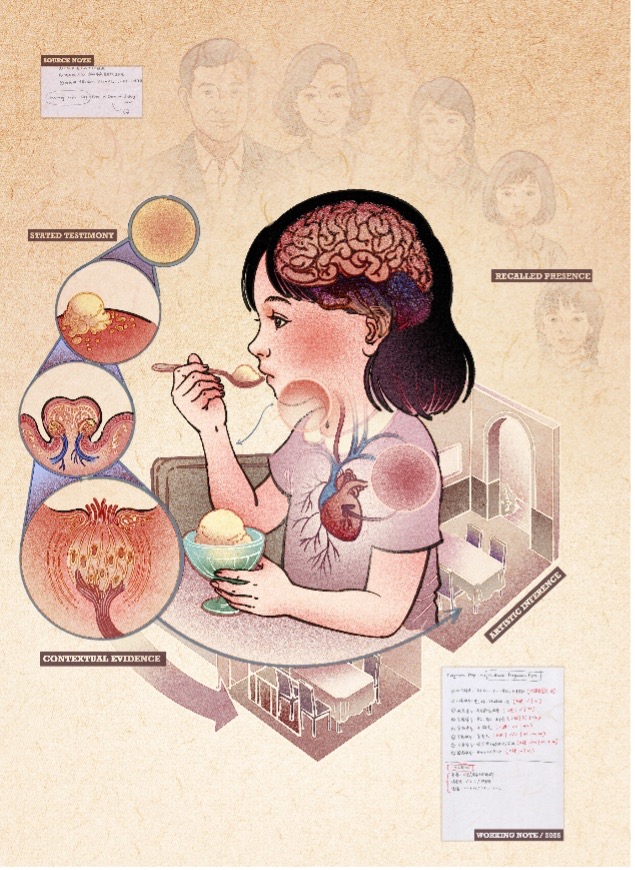
Image by Feimo Zhu. Jiefang Hotel Fragment Page. Artwork © 2026 Feimo Zhu.
What happens when incomplete historical evidence becomes a finished image? How might public historians show these gaps and explain their visual choices in exhibitions and other public displays? Michael Frisch examines how editorial decisions, including omissions, shape the public presentation of oral history. Susan A. Crane discusses how museums can present history in ways that conflict with visitors’ personal memories and expectations.1 In exhibitions, archival displays, and digital reconstructions, public historians may need to turn incomplete historical materials into visual presentations. These presentations may draw on different sources, but viewers may not always see where evidence is missing or where interpretation is involved. One challenge is to communicate uncertainty without making the presentation difficult to understand. As an artist, my current approach is to examine historical testimonies and archival records through drawing. I use notes, labels, and separate images to distinguish what is supported by the sources, what involves my own interpretation, and what remains uncertain.
My MFA project on the experiences of Japanese war orphans left in Northeast China after the Second World War became a starting point for answering some of these questions. For my final art portfolio, I drew on fragmented archival records and personal accounts of Japanese war orphans to create a fictional character. I then wrote a life story for this character and developed it into a series of illustrations. Some details about time, location, and family relationships remained unclear in the testimonies and archival records I used. To turn this fictional story into a coherent series of illustrations, I had to arrange events, construct scenes, and imagine details that the historical sources did not provide. Although the story was fictional, the illustrations did not clearly show which elements came from historical accounts and which I had imagined. This made me think more carefully about how to show the relationship between historical sources and my own artistic choices.
From this experience, I have begun developing an approach to drawing that I call “Drawing-as-Evidence,” working with Aoki Misako’s recorded testimony rather than a fictional narrative. Aoki was born in Japan and moved with her family to Manchuria, where she became a Japanese war orphan after the Second World War. She returned to Japan in 1996, and her recorded testimony was later made publicly available by Japan’s Ministry of Health, Labour and Welfare. For example, in my first data comic, I added dialogue to a scene about her learning Roman letters, although her testimony did not record the exact conversation. However, I soon realized that readers might mistake these invented words for what was actually said. In the second version, I replaced the speech bubbles with short labels. Even without the invented dialogue, I still had to make choices about how to draw the scene.
Rather than filling every gap to complete a scene, I used annotations, separate fragments, and empty space to help communicate uncertainty and my own interpretive choices. I also used fragment pages to examine individual details from Aoki’s testimony. MSullivan argues that making visual art can be a form of creative and critical inquiry through which artists develop new insights.2 Barrett and Bolt’s edited collection examines how knowledge can emerge through artistic practice.3 For example, Aoki recalled using a smaller bucket because a larger one was too heavy, but did not describe its exact appearance. In my fragment page, I used separate drawings, notes, and labels instead of turning the bucket memory into a complete scene. This let me examine the detail on its own, although the drawings still involved my interpretation.
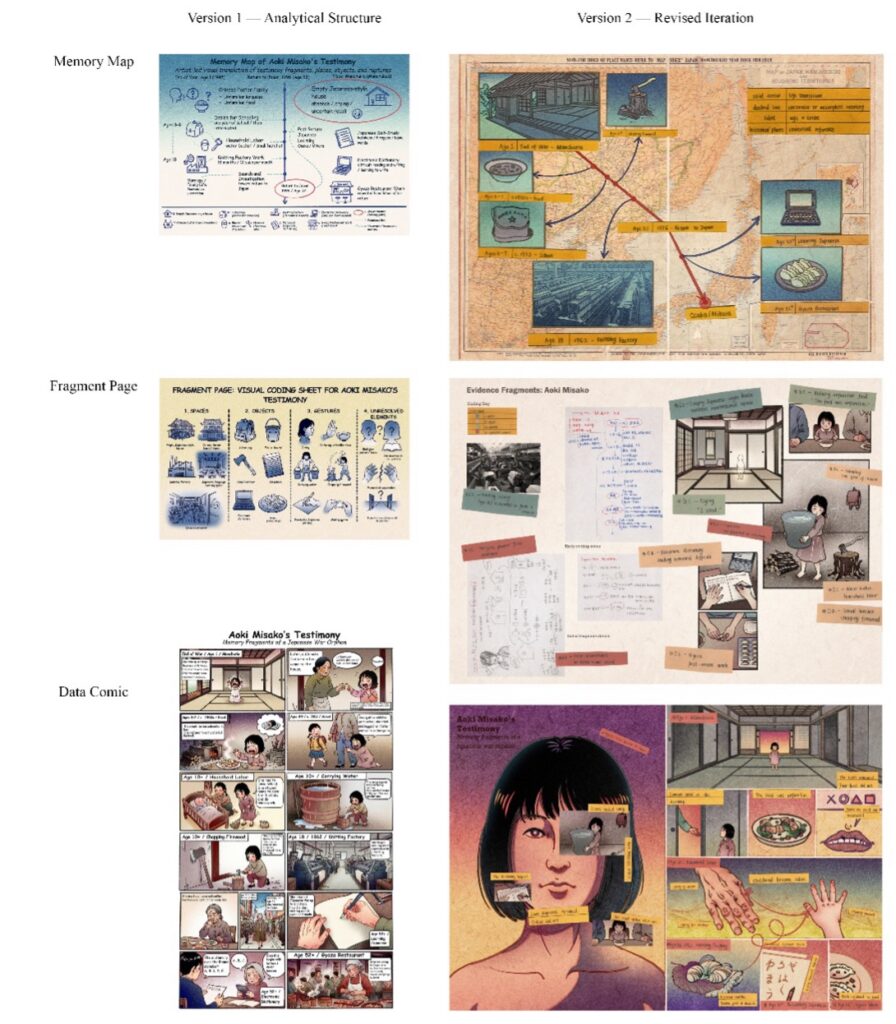
Figure 1: Two versions of visual experiments based on Aoki Misako’s publicly available testimony, 2026. Version 1 (left) uses structured diagrams and comic panels, while Version 2 (right) includes collage, handwritten notes, and more varied layouts. Images by Feimo Zhu. Artwork © 2026 Feimo Zhu.
These two memories are not historically connected. I used the two experiments to test how Drawing-as-Evidence might work under different conditions. With Aoki’s recorded testimony, I could not ask follow-up questions or invite her to review my drawings. In the second experiment, I could work directly with the narrator and receive feedback on my visual choices. In this case, I interviewed my mother about the first time she ate ice cream as a child at Jiefang Hotel in Xi’an, China. During the interview, she described the shape of the ice cream glass and drew a sketch to show what she remembered. When she later reviewed my drawing, she pointed out that the shape of the glass did not match what she remembered. I then looked for reference photographs of ice cream glasses and revised my drawing. I treated her sketch as a record of what she remembered, rather than independent confirmation of the glass’s original appearance. Her feedback made me reconsider my visual choices, even though some details remained uncertain.
Figure 2: Image by Feimo Zhu. Jiefang Hotel Fragment Page. Artwork © 2026 Feimo Zhu.
Figure 2 shows how I tried to make differences in memory and interpretation visible. I placed the memory of eating ice cream at the centre, surrounded by drawings and research notes. At first, I drew the hotel interior and family figures as clearly as the ice cream scene. However, my mother recalled the ice cream in greater detail than the hotel layout or the appearance of the family members. I therefore made the hotel interior and family figures fainter, allowing them to recede into the background. The figures are labelled “Recalled Presence,” while the hotel interior is marked “Artistic Inference.” I also used anatomical drawings as metaphors for sensory memory, rather than as evidence of a specific bodily response.
In developing exhibitions, archival displays, and digital reconstructions, public historians may need to make their interpretive choices visible to viewers. When presenting history to the public, we might consider which details are directly supported, which are inferred, and which remain unresolved. In my MFA work, I focused on building a coherent fictional narrative. Now, I try to show how I use historical sources, where I make my own choices, and what remains uncertain. For me, a finished image does not need to fill every gap with details the evidence cannot support. Public historians might consider using labels or source notes to reveal and incorporate their interpretive choices into the exhibit itself.
Feimo Zhu is an independent illustrator and visual researcher working with fragmented memory, oral testimony, and archival gaps. Her current work explores how drawing can make uncertainty and interpretation visible in historical research. This article draws on a publicly available testimony and a family-memory interview. Zhu did not interview Aoki Misako directly, and recognized that her testimony contains gaps and uncertainties. In the Jiefang Hotel experiment, Zhu used the participant-generated sketch as memory material rather than verified documentary fact. The participant gave permission for her interview material, sketch, and related visual work to be used in this article. Throughout the project, Zhu distinguished verbal testimony, participant-generated material, artist-led inference, and unresolved information.
- Crane, Susan A. “Memory, Distortion, and History in the Museum,”History and Theory 36 (1997): 44-63. ↩︎
- Sullivan, Graeme. Art Practice as Research?: Inquiry in Visual Arts / Graeme Sullivan. Sage Publications, 2010. ↩︎
- Barrett, Estelle and Barbara Bolt, eds. Practice as Research: Approaches to Creative Arts Enquiry. I.B.Tauris & Co Ltd, 2010. https://doi.org/10.5040/9780755604104. ↩︎
This work is licensed under a Creative Commons Attribution-NoDerivatives 4.0 International License. Blog posts published before October 28, 2018 are licensed with a Creative Commons Attribution-NonCommercial-ShareAlike 2.5 Canada License.