
By Caliesha Harris
This post is part of the Tomorrow’s Historians series.
The world always seems to be ending. This past summer, as wildfire smoke hung over much of Ontario, I tried my best to shelve my climate anxiety only to end up reading four-hundred-year-old sources describing similar experiences. No matter where I looked, the world seemed on the brink of disaster.
My dissertation explores environmental crisis and apocalyptic thought in late-Tudor England. I read cheap print—sermons, pamphlets, and almanacs—to understand how strange weather was experienced as an apocalyptic phenomenon. In the last decades of the 1500s, we read of ‘signs and tokens’ — comets, eclipses, severe thunderstorms, double rainbows, freakish snowstorms, and floods. In 2026, we saw one of Canada’s worst wildfire seasons ever. On top of this, extreme heat, flooding, and drought persisted across the country. Readers will be interested in Elbows Up for Climate, an interactive site that maps Canada’s many environmental disasters this year. It is hard not to feel fear and anxiety looking at this map. These reactions, however, are useful to make dynamic what is often presented as static. Because of the catharsis, fear, and wonder that sprang from observing signs in nature, sixteenth-century people read moral warnings and affirmations into them. Understanding their reality helps make sense of ours.
As a historian of the sixteenth century living through ‘unprecedented times,’ complete with climate disasters and large segments of the population living in apocalyptic expectation, I am uniquely positioned to show how precedented our experiences are. In this short essay, I spotlight an earthquake that shook London in 1580, one example from a generation that witnessed environmental disasters alongside political crises, religious reform, and technological advances. Using this case study, I bring the apocalyptic rhetoric I study into conversation with our own contemporary language. This exchange encourages empathy for historical actors we might otherwise view as superstitious or simple. Empathy for the past means recognizing where we can see ourselves by working to understand what is unfamiliar.
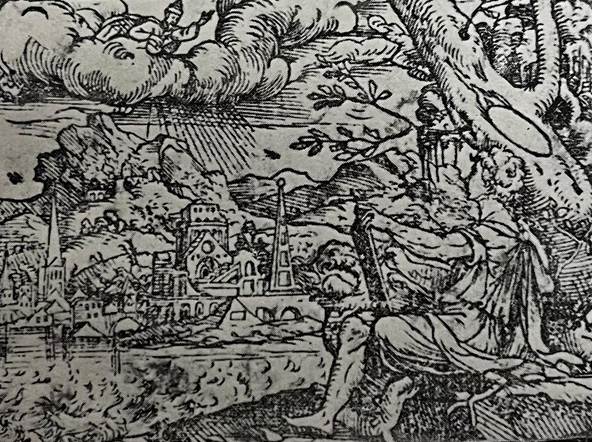
On April 6, 1580, an earthquake struck London, England. As buildings shook and stones fell from church roofs, people trembled, fearing what had happened, what it meant, and what would follow. For a populace well attuned to things gone wrong, disorder in nature offered another opportunity to cast dissident religious and political actors as both the cause and the consequence of the topsy-turviness that seemed to characterize their lives. Half a dozen pamphlets published in the days and weeks following the quake convey the many shades of contemporary reaction.[1] Titles like “A warning for the wise,” “A Discourse of the End of this World,” and “A Shorte and Pithie Discourse…Conferred with that Most Strange and Terrible Worke of the Lord in Shaking the Earth” reinforce how historical actors equated signs in nature with human morality and action.
In a pamphlet published days after the earthquake, Thomas Churchyard wrote:
“An Earthquake came, with whirling noise as House and Towre should fall:
A lo[v]ing rode of threatning wrath, sent sure to warne vs all.
For such a terror did it bring, to e[v]ery honest minde,
As day of [J]udgement had bene come, with storme and whirling winde.”[2]
Churchyard’s words remind us that Judgement Day could be terrifying and spectacular all at once. From fear to awe, readers today may be struck by how the 1580 earthquake confirmed for many that the end times were imminent. What struck me, however, was the range of emotions present in these sources, emphasizing the value of a sensory approach. This approach entails paying attention not just to what is said, but to the tone and affect, with the goal of recentering not merely on how contemporaries described catastrophe, but on how they felt.
Approaching the apocalypse as something sensory-driven also helps us grasp how easily moments of disaster were made political. After London’s 1580 earthquake, two children, Mabell Everet and Thomas Gray, died from falling stones. Their deaths were immediately politicized, with one commentator reflecting, “I pray you let no man flatter or falsely persuade himself with a natural cause, or with the mischance of two poor children’s death, for that shall not serve when the time cometh.”[3] Framing Mabell and Thomas’s deaths as predetermined and supernatural, and then positioning any disagreement with that framing as a barrier to salvation when the apocalypse arrives, shows how commentators can find religious and political advantage where crisis and apocalypticism intersect. Interpreters drew on high emotions to weaponize events and advance their understanding of the world, often ostracizing those who disagreed.
Apocalyptic rhetoric continues to be effective in the modern age because signs can be directed to encourage, neutralize, or dismantle individual and communal anxieties. Following the earthquake, one commentator wrote, “We have had manifold motions, sundry signs, yea, and exceeding examples of His wrath, and displeasure, by comets and blazing stars as lately hath been seen over this City of London.”[4] Four hundred years later, in the aftermath of Hurricane Katrina, the mayor of New Orleans commented, “Surely God is mad at America. He sent us hurricane after hurricane after hurricane, and it destroyed and put stress on this country.” As ‘signs’ of God’s displeasure, the earthquake and hurricane signal disorder in nature, opening the door for solutions that are often religious or political. If God communicates his anger through nature, man might respond by changing his behaviour, morality, and attitude. This presents both great opportunity and danger.
Like our Tudor counterparts, we read nature with emotional and moral glosses. Strange weather and natural disasters continue to be encoded with religious and political rhetoric, giving authors and readers a chance to participate in a narrative that demands and rewards emotional investment. When politicians and religious leaders warn of disaster as a call to repentance, we must understand the calls to action bound up in, and embodied by, this rhetoric. I say this not to diminish the palpable weight sin carries for many, but to acknowledge the psychological and communal implications of demanding shifts in morality, action, and practice, often in apocalyptic terms.
Natural disasters and eco-crises today make the objects of my study tangible. Over the past summer, I researched and wrote under extreme weather warnings. In the three years since I began my dissertation research, wildfires have raged across Canada every summer. As a historical researcher, my anxiety and fear about climate change activate my empathy for those I study. I, too, feel dread looking at the hazy skies; I, too, feel fear and uncertainty radiating off those around me. We constantly wait for disaster, and these events can feel both horrible and cathartic. Experiencing disaster after anticipating it can feel surreal, and the many layers of conflicting emotion offer nuanced insight into how our ancestors thought about and moved through similar catastrophes.
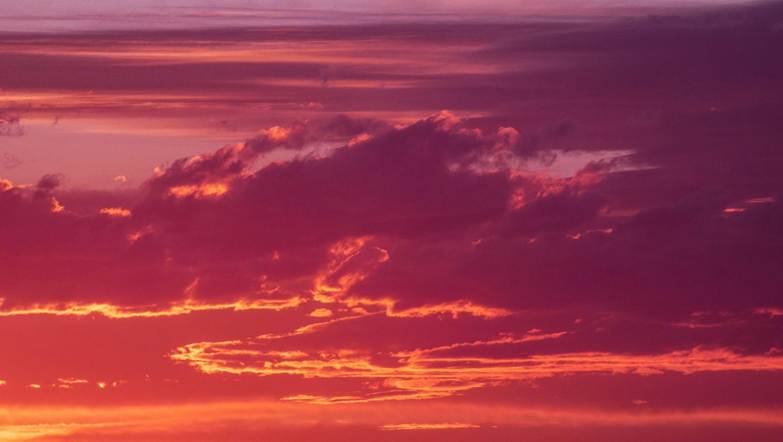
As Gen Zers take to social media to post stories and edits dramatizing ‘apocalyptic skies’ or doomsday scenarios, we are reminded that disaster wears many faces. Despair is often monetized and popularized to signal meanings beyond the environmental disaster itself. I am grateful to live and work in areas relatively unaffected (in a material sense) by wildfires and other climate disasters. I acknowledge the privilege of reflecting on environmental disaster as a tool for historical research rather than a life-altering reality.
Attending to the emotional weight of natural disaster helps us reflect and analyze the past, while also giving us a fuller sense of the many ways our present moment might be understood. Conflicting meanings and experiences remind us of a truth shared with our Tudor counterparts: when things go awry, no single truth holds. Indeed, we must recognize that the framing of what is natural and unnatural itself upholds hierarchies of white supremacy and patriarchy. When we say ‘our world is ending’ or ‘we are living in the end times,’ other dimensions of meaning often lurk beneath.
Where does this leave us? By activating historical empathy and drawing comparisons to those who came before us, we join a conversation across centuries that continues to yield meaning, insight, and warning. My dissertation makes an argument that is still true today: climate disasters are sensory phenomena. The anxiety, fear, and wonder that people carry affect how they negotiate with religious and political meaning. Living through strange weather and hearing neighbours, friends, and media whisper about the end of the world reminds me that we still read nature like a manuscript that warns us about our futures and scares us about our world. Seeing yellow, smoky skies evokes a moral and spiritual discomfort. Even if this feeling does not consciously manifest in theological terms, many of us feel an unquantifiable unease. We are struck by a wrongness that is, at best, cinematic and, at worst, dystopian. Looking at the past reminds us that while climate change may bring new disasters, our anxieties have historical precedent.
Caliesha Harris is a Ph.D. Candidate in History at McMaster University. Her SSHRC-funded dissertation explores the intersection of apocalypticism and environmental disaster in late-Tudor London. Her published work examines the Venetian context, featuring a rare prophecy as evidence of the apocalypse’s political ramifications. When she’s not studying, Caliesha can be found hiking or canoeing and collecting vinyl. She can be reached at harric49@mcmaster.ca
This series was produced within the project Historicizing Our Times: Histories of Migration and Climate in the Digital Space, which is supported in part by funding from the Social Sciences and Humanities Research Council.
Accessible resources: Elbows Up for Climate, Early English Books Online, English Short Title Catalogue
[1] See Thomas Churchyard, “A warning for the wise, a feare to the fond, a bridle to the lewd…” London: By John Allde, and Nicholas Lyng, 1580; Arthur Golding, “A discourse vpon the earthquake that happened through this realme of Englande…” London: Imprinted by Henry Binneman, 1580; Abraham Fleming, “A bright burning beacon forewarning all wise virgins…” London: Imprinted by Henrie Denham, 1580; Gabriel Harvey, “Three Proper, and Wittie, Familiar Letters.” London: Henry Bynneman, 1580; “The order of prayer vpon Wednesdayes and Frydayes…” London: by Christopher Barker printer to the Queenes Maiestie [and Henry Bynneman], 1580.
[2] Thomas Churchyard, “A warning for the wise, a feare to the fond, a bridle to the lewd…” (London: By John Allde, and Nicholas Lyng, 1580): Fol. BIIv.
[3] Thomas de Twyne, A Short and Pithie Discourse, concerning the engendring, tokens, and effects of all earthquakes in generall. London: Printed by John Charlewood for Richard Iohnes, 1580. Reprinted in a modern edition by R.E. Ockenden (1936). Acquired from the Bodleian Libraries, University of Oxford, 18822 e.20 (6) (Box B000000207720).
[4] Anthony Munday, A vievv of sundry examples Reporting many straunge murthers, sundry persons periured, signes and tokens of Gods anger towards vs. (London: Printed by John Charlewood for William Wright, 1580): fol. CIIIr.
This work is licensed under a Creative Commons Attribution-NoDerivatives 4.0 International License. Blog posts published before October 28, 2018 are licensed with a Creative Commons Attribution-NonCommercial-ShareAlike 2.5 Canada License.