
Kendra Coulter and Brianne Machan
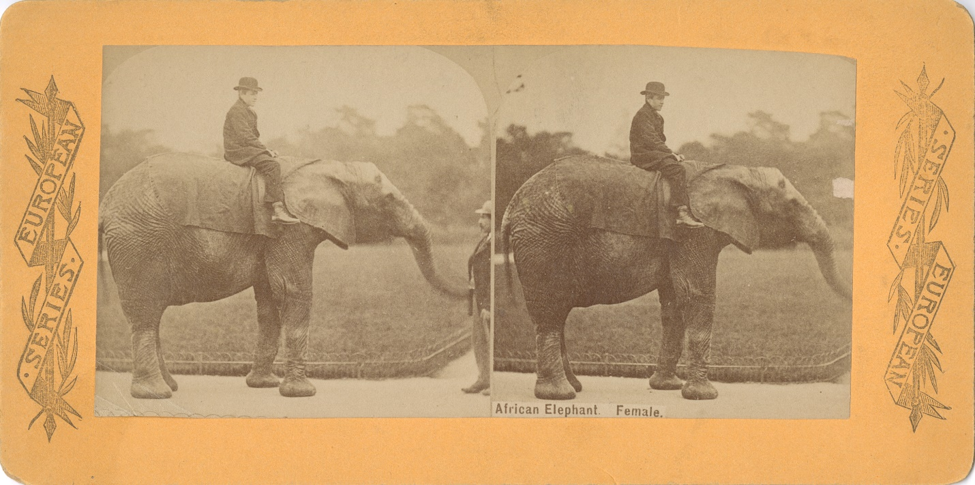
This elephant is believed to be Alice. Courtesy of the Elgin County Archives. Steve Peters Jumbo Collection (M2 S2 Sh7 B2 F22 1)
On September 15, 1885, the world-famous elephant Jumbo was struck and killed by a train in St. Thomas, Ontario. Today, his likeness appears in a monument, business logos, and public art across the city. The tragic ending to Jumbo’s life is only part of the picture, however, by moving our historical lens outwards, a larger, multispecies tableau comes into focus, one with important depth and texture, and animals whose lives offer powerful, enduring insights.
Here we highlight Jumbo’s supposed companion, Alice, a female elephant named after the curious little girl free to follow her imagination in Lewis Caroll’s Wonderland books, a particularly ironic choice for an elephant who was permitted to make very few choices. The fact that Alice’s life has largely gone unrecognized deepens the injustice, and we seek to play a small role in honouring her memory by amplifying her story as a sentient being in her own right, and as a representative of the many animals obfuscated within history.
To do so, we enlist Coulter’s concept of work-lives, which emphasizes the importance of considering not only animals’ conditions at work, but also their experiences before and after their jobs, both on a daily basis, and over the course of their full lives.[1] It recognizes that animals are whole beings with minds, bodies, relationships, and interests that matter, whether historical or contemporary. When applied to animal “performers” like Jumbo and Alice, vital truths about their lives beyond the spectacle come into focus.
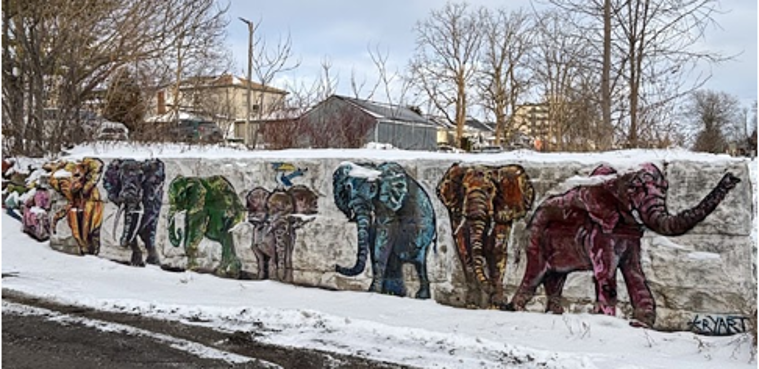
Public art in St. Thomas Ontario. Courtesy of Kendra Coulter.
Elephants who filled the big tops of the Victorian era were normally taken from their family herds by contracted hunters. Both a mother and young elephant would be forcibly separated and chased on horseback. As the mother became exhausted, her legs would be slashed, causing her to bleed out and die, thereby allowing for the youngster to be taken.[2] Jumbo and Alice both would have witnessed the violent killing of their mothers and, as young mammals, still been suckling.[3] This is how their work-lives began.
Along with giraffes, antelopes, monkeys, and many other animals, the young elephant would be transported to a port and shipped to animal traders. The animals who survived the harrowing journey would be sold to zoos and other private collectors. Jumbo was first put on display at the Jardin de Plantes in Paris before being sent to the London Zoo in 1865. Cherished as a gentle giant by zoo visitors, he gave rides to thousands of people (including the royal family and a young Winston Churchill). However, Jumbo’s life off the job was far more volatile and he would thrash around at night, causing him to break his tusks.[4]
Alice’s primary job at the London Zoo was also to carry people on her back. Her daily (and nightly) experiences when not working were punctuated by a deeply disturbing incident. Alice was initially under the care of Jumbo’s handler, Matthew Scott, but then assigned to two new managers who tied her down. Her resistance to the ropes was so fierce, she ripped nearly twelve inches off her trunk. Manager of the elephant house Abraham Bartlett wrote, “I found the end of her trunk in the middle of the den… It was warm and the nerves and muscles were still quivering and in motion. The poor beast appeared in great distress…”[5] Away from the spotlight, the quotidian risks to captive elephants could be severe.
In 1881, P.T. Barnum purchased Jumbo to add to his circus collection. There was significant public outcry in England over the loss of Jumbo, and this was when Alice was first publicly identified as his “widow.”
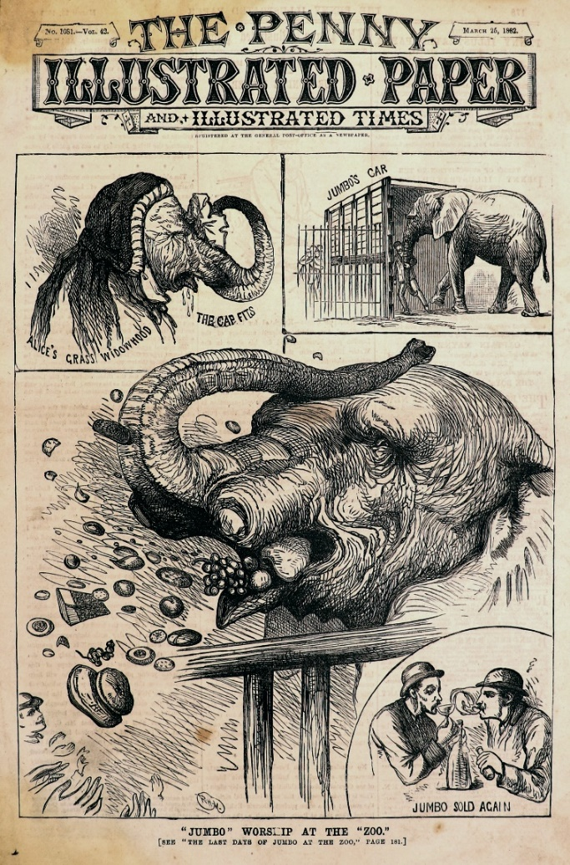
“‘Jumbo’ Worship at the ‘Zoo.’” The Penny Illustrated Paper and Illustrated Times, 16 March 1882. Courtesy of the Elgin County Archives. Steve Peters Jumbo Collection (M6 S1 Sh7 B2 F2 1)
In communities across the eastern United States and Canada, Barnum exhibited Jumbo in the “Greatest Show on Earth” until the devastating train collision in St. Thomas. Seeing an opportunity to continue to profit from Jumbo posthumously, Barnum prepared to showcase the skeleton and mounted remains as an attraction. But Barnum wanted even more of a spectacle and set his sights on Alice. He purchased her from the London Zoo, had her shipped across the Atlantic, and toured her around alongside the hide and skeleton of Jumbo, once again as “Jumbo’s widow.”
The archival evidence diverges on whether Alice and Jumbo had played together or interacted much at all while at the zoo or were mostly indifferent to each other.[6] Wild elephants have been observed grieving the deaths of other elephants, but they certainly do not marry or even pair bond. In the wild, adult males (bulls) spend most of their time alone or with other bulls, away from the large, female-centric, matrilineal and matriarchal herds. But Barnum wasn’t known for letting facts constrain his business ventures. He asserted that the presence of “Jumbo’s widow” fascinated circus goers and made for a lucrative season, despite the death of his star attraction.
The next chapter in Alice’s story was deeply troubling. On November 20th, 1887, a fire broke out at the circus’ winter quarters. Jumbo’s remains were saved, but not Alice’s life. She and a number of other animals perished, prioritized after inanimate objects.[7]
Jumbo’s skeleton was subsequently sent to the American Museum of Natural History in New York City and his mounted hide to Tufts University, before it, too, burned in a fire nearly a century later. The Tufts University varsity athletics teams remain ‘the Jumbos’ and people may enjoy jumbo pretzels or veggie dogs at sporting events as they watch closeups of the athletes on ‘jumbotrons.’ Jumbo’s name lives on and his tragic death is memorialized. Barnum’s fame endures, too. But Alice’s life has largely been forgotten.
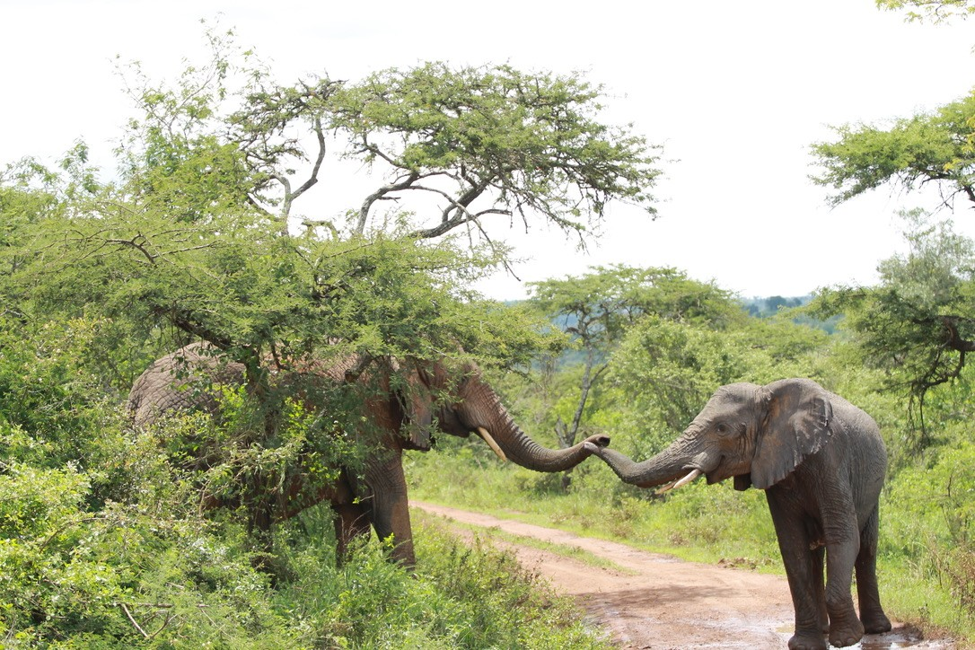
African elephants in the wild. Photo courtesy of Brianne Machan.
Behind the scenes, at every stage, these animals’ lives were marked by harm and violence, from the killing of mothers and forced extraction of youngsters, the painful training methods regularly used, and the physical, psychological, and social deprivation of captive life. Neither Jumbo nor Alice enjoyed anything resembling a peaceful retirement, a notion that would likely have been foreign to Victorian ideas about animal keeping. Even so, a growing number of animal welfare advocates were challenging social norms about normalized harm to animals and business leaders directly, including Barnum.[8]
This story is both vital and ongoing. Today, the lives of captive wild animals forced to perform and put on display for human entertainment are a source of contention and concern. Moreover, there are significant practical challenges when zoos, roadside and mobile attractions, and other venues close, whether due to governmental action or in response to declining revenue, as people increasingly reject the keeping of captive wild animals.
It is important to sit with these uneasy and upsetting stories of animal abuse as they lead to important questions that we, as a society, must continue to ask. Most significantly, how can our species work to make amends for historical and ongoing injustices? For the animals who survive, what comes next?
Kendra Coulter is Professor and head of the animal ethics and sustainability leadership program at Huron University College and a fellow of the Oxford Centre for Animal Ethics. Her first novel, The Tortoise’s Tale (Simon & Schuster), traces more than a century of history through the perspective of a giant tortoise.
Brianne Machan earned an honours BA in history at Huron University College and is now an MA student in public history at Western University. Brianne has worked for the Sarnia and District Humane Society since 2020 and is passionate about animal history. She created Tails from the Grave: History of Happy Woodland Pet Cemetery.
Accessible and Additional Resources
Railway City Museum Jumbomania Exhibit elements online
Attenborough & the Giant Elephant
Andrea Ringer, Circus World: Roustabouts, Animals, and the Work of Putting on the Big Show (Champaign: University of Illinois Press, 2024).
Kim Stallwood, The Topsy Project
St. Thomas’s Jumbo the elephant. The CBC News story from 1985 about the creation of the monument in St. Thomas
[1] Kendra Coulter, Animals, Work, and the Promise of Interspecies Solidarity (New York: Palgrave Macmillan, 2016); Kendra Coulter “Toward Humane Jobs and Work-Lives for Animals,” in Charlotte Blattner, Kendra Coulter, and Will Kymlicka eds. Animal Labour: A New Frontier of Interspecies Justice? (Oxford: Oxford University Press, 2020).
[2] Paul Chambers, Jumbo: The Greatest Elephant in the World (London: Andre Deutsch, 2007); Susan Nance, Animal Modernity: Jumbo the Elephant and the Human Dilemma (New York: Springer, 2015). See also Susan Nance, Entertaining Elephants: Animal Agency and the Business of the American Circus (Baltimore: The Johns Hopkins University Press, 2013).
[3] A growing body of recent research is building understanding of the depth of elephants’ emotions and minds, including their experiences of grief and trauma. For notable and accessible examples, see The Nature of Things and the work of G.A. Bradshaw and Barbara J. King.
[4] Modern research and technology have determined that Jumbo’s teeth were a source of agony and a probable cause of his distress. Elephants are supposed to go through six sets of molars that are ground down by their natural diet that includes twigs, bark, and other rough materials. Because he was fed a diet of soft foods and even sticky buns, Jumbo’s teeth did not wear out, and the subsequent sets of molars could not erupt. For a synthesis, see The Nature of Things.
[5] Chambers, page 102.
[6] The details about Alice’s arrival and time at the London Zoo vary, with Jumbo’s keeper Matthew Scott writing in his memoir that he had requested a female companion for Jumbo be taken from Africa once Jumbo was ‘grown,’ and other sources, including Chambers and Nance, suggesting Alice arrived around the same time as Jumbo. Similarly, whether the two interacted much is unclear, with Scott claiming they played together. Unfortunately, anthropocentric institutions like archives are not designed to preserve animal perspectives, so we are left to read against the grain and interweave various sources in search of animals’ experiences. The 2022 essay collection, Traces of the Animal Past: Methodological Challenges in Animal History, advances the possibilities for animal history, and, simultaneously, establishes how many things — and beings — remain unknown.
[7] Many, many animals owned and exhibited by Barnum were killed in fires. See, for example, The Lost Museum.
[8] Darcy Ingram, The Second Greatest Show on Earth: Henry Bergh, the Protection of Animals, and the Evolution of the Modern Social Movement (Montreal and Kingston: McGill-Queen’s Press-MQUP, 2025); Kendra Coulter, Defending Animals: Finding Hope on the Front Lines of Animal Protection (Cambridge: The MIT Press, 2023).
This work is licensed under a Creative Commons Attribution-NoDerivatives 4.0 International License. Blog posts published before October 28, 2018 are licensed with a Creative Commons Attribution-NonCommercial-ShareAlike 2.5 Canada License.