
by Lucas Tsovras
“I vote for Mr. Godin. I don’t care for what party he belongs.” – George Zoubris1
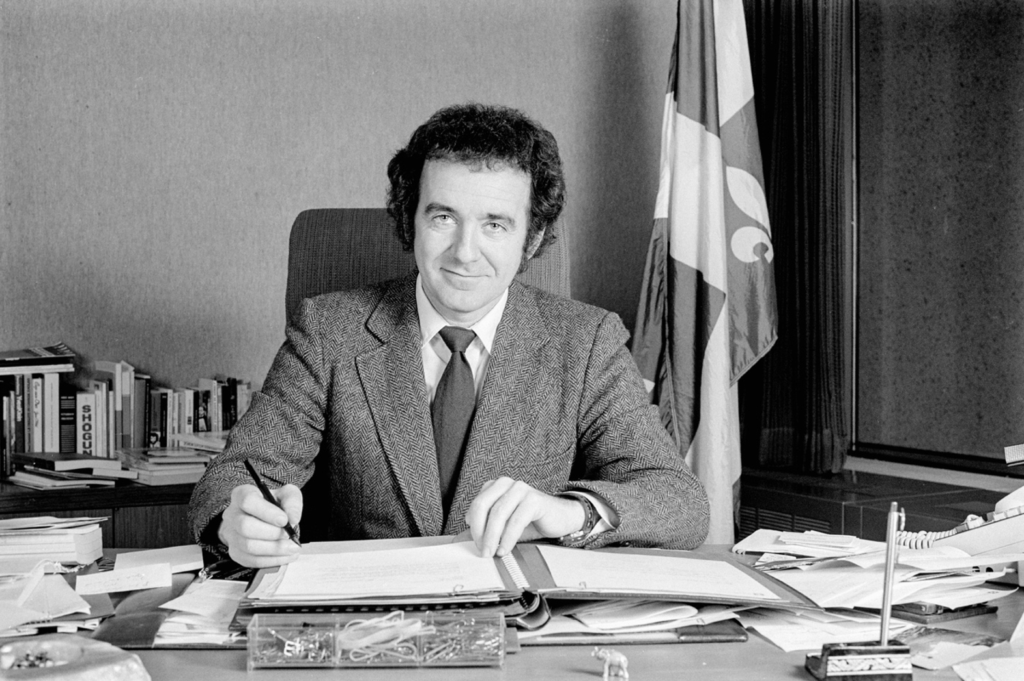
Bernard Vallée, « Portraits de Gérald Godin, Ministre de l’immigration, » 19 November 1980, BAnQ numérique.
1976 is best remembered in Quebec as the year the levee broke. The rising tides of québécois nationalism and the sovereigntist movement evolved into a majority victory in that year’s general election for the Parti québécois [PQ], the national progressivist party seeking a sovereignty-association agreement with the Canadian federal government. Under its founder and first Premier, René Lévesque (1922-1987), successive PQ cabinets passed legislation and reforms from 1976 through 1985 that radically altered the course of Quebec’s history. Amidst those years, narratives emerged about peoples on the margins of the province’s society challenging what it meant to be québécois and who could benefit from the Quiet Revolution. Montreal’s Mercier district played host to one such narrative.
~
Mercier was a provincial electoral district in central Montreal. Going into the 1976 general election, its deputy was Robert Bourassa (1933-1996), Parti libéral du Québec [PLQ] leader and Quebec’s Premier. Bourassa had held this largely francophone working class district in every general election since 1966. Mercier was considered a PLQ stronghold, a belief reinforced by a growing immigrant demographic commonly assumed to lean in the governing party’s favor.2 A strong contingent of the electorate, however, had tired of their “absent” deputy and his party’s unpopular policies. Still, few believed that would help Bourassa’s underdog rival in Mercier, PQ candidate Gérald Godin. This burgeoning politician was a marginal figure in the popular imagination and his party, but Godin nonetheless conducted an intensive door-to-door campaign that turned him into a fixture of the community. His charisma and personability throughout countless hours of speaking with voters set a precedent which could not be matched by a Premier.3 And it paid off.
November 15th, election day: 13,450 votes to Godin; 9,714 to Bourassa.4
The Premier of Quebec had lost to a political rookie.
~
Gérald Godin (1938-1994) was first and foremost a man of letters, as the Trois-Rivières native made his name through poetry. His poems championed the working-class French dialects of Quebec, contributing to the introduction of Joual in the province’s literary canon. His roles as editor of Éditions Parti pris (1965-1977)5 and co-organizer of the famous Nuit de la poésie (1970)6 assured his position at the top of Quebec’s francophone literary scene. Along with his wife, Quebec’s great chanteuse Pauline Julien (1928-1998), Godin was arrested in the federal agency raids of 1970’s October Crisis, certifying his credentials as a genuine souverainiste.7 He furthermore entered parallel careers in journalism and as a lecturer at UQAM. When the latter path was interrupted by striking, Godin received an offer from an acquaintance to present himself as the PQ’s candidate in Mercier.8 The poet took the gig, and he stole the show.
~
With the PQ in power, and Godin at the National Assembly, few wondered what to make of those immigrants in Mercier.
In 1977, the PQ passed its “Charter of the French Language,” popularly known as Bill 101. With French officialised as the sole official language of Quebec, immigrants were now mandated to enroll their children in the francophone school-system.9 Despite a grandfather clause that protected most Greek-Canadian children from that eventuality, Bill 101 received broad opposition from the ethnic community. When considering that law and what was then a looming referendum, the PQ and its politicians had lost most of the allure they held with Greek-Canadians prior to the 1976 election. The actuality of the 1980 sovereignty-association referendum only deepened the divide.
But Gérald Godin had some old friends on the Greek-Canadian Left. His alliances with the anti-dictatorship networks that had developed in Montreal gave him contacts unlike any other politician from outside the community.10 This time, independence was not the cause. Rather, secularization, a longtime cause of the Quiet Revolution, was to bring Godin and Greek-Canadians together.
In 1975, the Hellenic Community of Montreal [HCM]11 requested an amendment to a 1926 private law regarding its governance to the Commission permanente des consommateurs, coopératives, et institutions financières. The pre-existing version of the law placed the HCM under the auspices of the Greek-Orthodox Archdiocese of North America. This reality was unpopular with a large contingent of the organization’s paying membership. Initially, the HCM’s elected leadership contacted Saint-Louis MNA Harry Blank to support their secularization project. Association with Blank proved unproductive, as the amendment proposal remained unresolved for four years. Blank passed the baton to Godin in 1979, and progress abounded. The politician quickly arranged a meeting with the Commission.12 Godin’s commitment and positive outlook upon the project is captured in the meeting minutes: “C’est depuis 1975 que ce projet de loi, à peu de choses près, figure au feuilleton de la Chambre et ce n’est que maintenant qu’il va peut-être aboutir. Donc, je pense que nous nous sommes hâtés très lentement, comme gouvernement, ainsi que nos prédécesseurs, et c’est ce qui explique un peu l’impatience de la communauté grecque de Montréal qui attend ce projet de loi.”13
Godin surely related to the HCM’s desire for secularization, having lived through and contributed to Quebec’s departure from ultramontanism. His passionate defence of the project against entrenched opposition (which included Archbishop Sotirios of Toronto) was particularly inspiring when considering the facts that he held no ministerial position, that Greek-Canadians were a small minority in his district, and that the HCM’s offices were not even located in Mercier! Projet de loi privé 231 successfully passed, secularizing the HCM’s directorate.14 Godin was promptly named an honorary member of the Greek-Canadian community.15
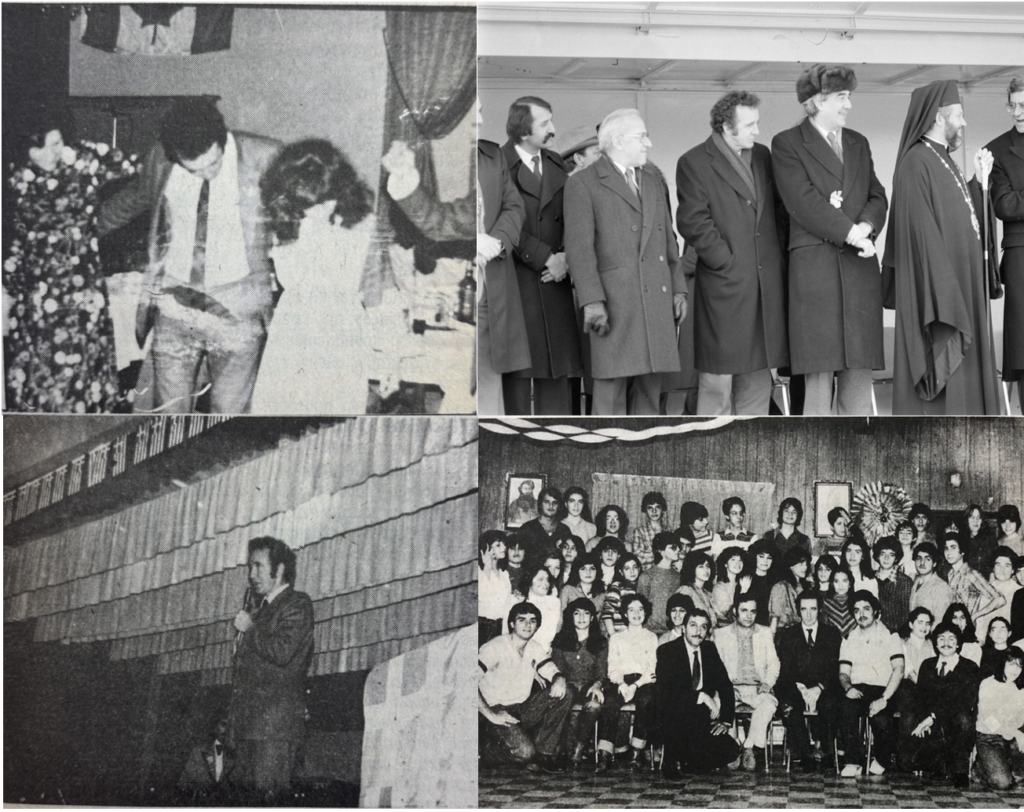
Clockwise from top left: Greek dancing (The Greek-Canadian Tribune, 10 April 1981, 1); Third-left, Godin participates in Greek Independence Day Parade (Robert Mailloux, “25 mars 1984,” Fonds La Presse, BAnQ numérique); One of Godin’s (seated, center) many visits to the Cretan’s Association (The Greek-Canadian Tribune, 13 February 1981); Addressing a Greek-Canadian crowd, in Greek (The Greek-Canadian Tribune, 5 October 1981).
Mercier was restructured in 1980. Stretching further westward into the Mile End, 6090 new voters16 were incorporated into its electorate. Crucially for many Greek-Canadians, Jeanne-Mance St, Park Avenue, and Hutchison St now all belonged to Mercier.17 Since the 1950s, the Greek-Canadian community had gravitated toward Park Avenue and entrenched itself upon its surrounding blocks. Travelling north of Mont-Royal Avenue, one was greeted by souvlaki restaurants, various Greek regional association headquarters, a branch of the National Bank of Greece, and even two cinemas which regularly screened imported Greek films. That is not to mention the many other businesses owned and staffed by the Mile End’s Greek-Canadians. Park Extension may have been the Greek-Canadian neighborhood, but Park Avenue was undoubtedly their hub.18 Overnight, Godin inherited some 4000 Greek-Canadian constituents with the 1980 referendum and the lived realities of Bill 101 fresh in their memories.19 Godin’s assessment was daunting: “Je suis entre leurs mains.”20
Godin was named Ministre des communautés culturelles et de l’immigration in 1980 and promptly hired Joseph Xenopoulos as his liaison to the Greek-Canadian community. Working in tandem, they developed a clever strategy to earn this ethnic group’s confidence. Godin, the poet, had a natural affinity for languages. Before addressing Greek-Canadian audiences at community events or PQ rallies, Xenopoulos would prepare him Greek-language speeches written out phonetically in Latin script. Godin delivered these flawlessly, and enhanced them with his uncanny ability to slide in dozens of words that Xenopoulos had never taught him.21 These speeches were latched on to by Quebec’s press, whether English, French, or Greek, who all acclaimed Godin as having achieved fluency in the Greek language.22 This was far from the truth. But the skills Godin possessed and exemplified in those rallies demonstrated his willingness to directly communicate the policies of his party to immigrants in their language.
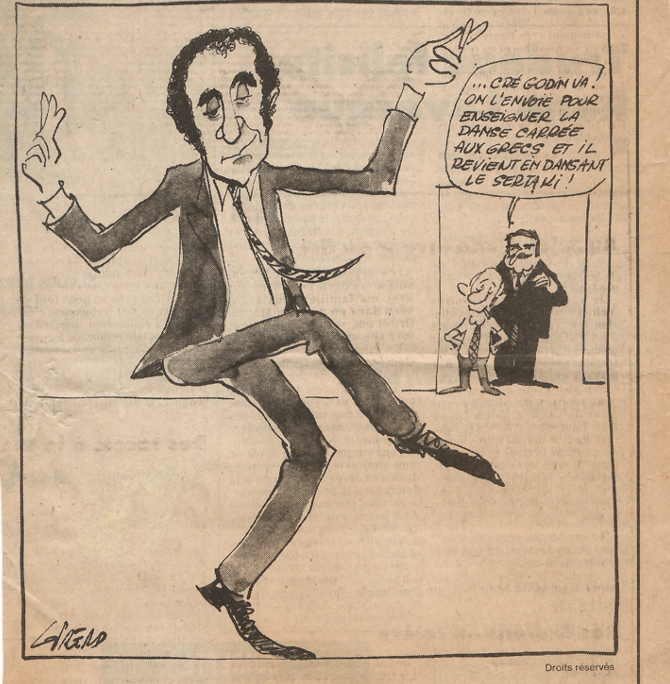
“Look at Godin go! We send him to teach the Greeks the square dance, and he comes back dancing the sirtaki!” Cartoon by Girerd originally published in La Presse, republished in The Greek-Canadian Tribune, 24 April 1981, 12, Hellenic Library of Montreal.
The PQ published Greek-language pamphlets and purchaseed advertisement space in Greek-Canadian media, and Godin’s appeal with Greek-Canadians was beginning to show.23 A La presse report on his campaign captures his growing popularity: « Un restaurateur [grec], pour ne plus fâcher ses compatriots, a bien consenti à retirer de sa vitrine la photo de René Lévesque. Il a toutefois tenu à garder celle de Gérald Godin dans sa porte. Le ministre de l’Immigration a aidé sa famille et il ne l’oublie pas. »24 But still, by the morning of April 13th, 1981, few believed Godin had much of a chance in Mercier. It was an assumed fact that the unpopular PQ would lose all ethnic votes to the PLQ. In an interview shortly before the election, Godin flipped the script: “N’est-ce pas plûtot le PQ qui est rejeté par les ethnies?”25
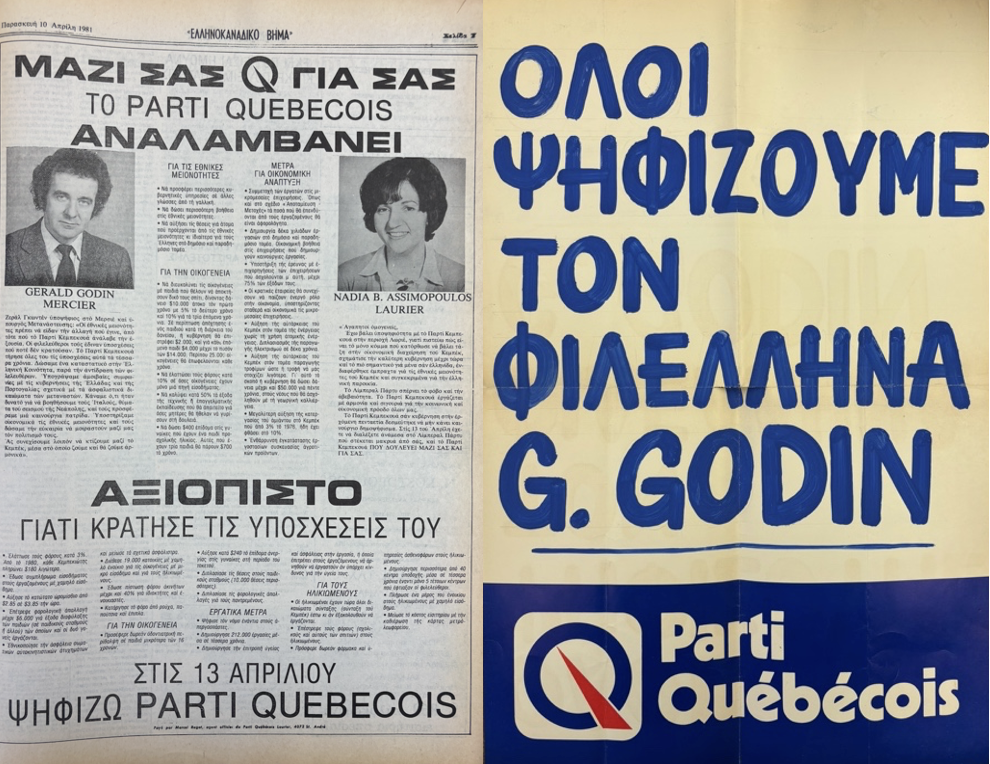
(Left-to-right) Parti québécois campaign advertisement for the Greek-Canadian press (The Greek-Canadian Tribune, 10 April 1981, 3, Hellenic Library of Montreal); “We all vote for the philhellene G. Godin,” 1981 election campaign poster (Hellenic Library of Montreal).
Last-ditch efforts were made by the PQ to make further inroads with Greek-Canadians. The day before the election, 200 undocumented Greeks were made Canadian citizens thanks to an amnesty plan spearheaded by Godin.26 And interestingly enough, René Lévesque’s final stop on the campaign trail was a visit to the Cretan’s Association on Park Avenue, accompanied by Laurier candidate Nadia Brédimas-Assimopoulos and Godin. The PQ’s Greek chapter only numbered some-200 members, but the necessity of winning the community’s votes clearly stood out the PQ leader, who addressed the crowd in English.27 Perhaps it was not Lévesque’s fate in their hands, but Godin was well-aware that their community’s strength in number could easily reverse 1976’s result.
~
Once the votes were counted, Godin not only rewon his seat, but he defeated his PLQ opponent by an even greater margin than in 1976.28 The press readily attributed this success to his aggressive campaigning for Greek-Canadian votes. Le soleil reported ¼ of Mercier’s Greek-Canadians as having voted for Godin. However, the verity of such claims is impossible to determine.29 Ultimately, the significance of Godin’s 1981 campaign is not entirely proved, as conclusive as it was, by its positive result. It is rather what his campaign symbolized that deserves to be remembered and celebrated. That a québécois de vielle souche and separatist engaged with an ethnic minority’s political interests with genuine vigour presents a legitimate anomaly, as Godin stands alone in his party’s history. His romantic vision of Quebec’s future is well worth remembering, and remains best expressed in his own words:
« En ’76, on a décapité le Parti libéral dans Mercier. Il s’en est jamais remis. En ’81, on a ouvert le Parti québécois aux néo-québécois. En conter de ce soir, je le dis à tous les membres du PQ : c’est possible! C’est possible! La communauté grecque a voté PQ cette année pour la première fois de son existence! C’est très important pour l’avenir du Parti québécois, oui, mais surtout, pour l’avenir du Québec! Il faut déjà envisager dès ce soir, un Québec ou tout le monde seront des frères et des sœurs. Sans aucune différence, sans aucune distinction. »
– Gérald Godin (Aréna Paul Sauvé, 13 April 1981)30
Lucas Tsovras is currently enrolled in the MA history program at McGill University. His research is supported by the Social Sciences and Humanities Research Council of Canada through a Canada Graduate Scholarship and the Immigrec research project, and focuses on the integration of Quebec’s Greek-Canadian community during the Long Quiet Revolution (1960-1983).
- Godin, directed by Simon Beaulieu (Les Films du 3 Mars, 2011), 0:35:59. ↩︎
- Jacques Benoit, « Mercier: Bourassa peut dormir en paix! » La presse, 4 November 1976, A 11, BAnQ numérique. ↩︎
- Gérald Godin, « Journal d’une campagne électorale, » Possibles 1, no. 2 (Hiver 1977) : 19-28, BAnQ numérique. ↩︎
- Résultats des élections générales du 15 Novembre 1976 : Mercier, » Élections Québec, accessed 26 March 2025, https://www.electionsquebec.qc.ca/resultats-et-statistiques/resultats-generales/1976-11-15/142/. ↩︎
- Éditions Parti pris (1964-1984) was a Leftist publishing house based in Montreal. Prominent authors published by the house include Pierre Vallières, Pierre Vadeboncoeur, and Réjean Ducharme ↩︎
- La nuit de la poésie 27 mars 1970 was a poetry reading starring over 50 of Quebec’s most prominent poets. It featured in Jean-Claude Labrecque’s NFB documentary of the same name (1971). ↩︎
- For a general biography of Godin, see: Jonathan Livernois, Godin (Lux Éditeur, 2023). ↩︎
- Livernois, Godin, 273-294. ↩︎
- Assemblée nationale du Québec, Projet de loi 1, Charte de la langue française au Québec, 31st legislature, 2nd session, 1977, Bibliothèque de l’Assemblée nationale du Québec. ↩︎
- Dimitrios Machlouta, “Academic Refugees or Undesirable Newcomers? Greek Anti-Junta Networks, Francophone Intellectuals, and Canada’s Quandary during Quebec’s Quiet Revolution, 1960-1976,” Canadian Studies 98 (2025): 81. ↩︎
- The HCM was a non-profit organization controlling the operations of several Greek-Orthodox churches and Greek-Canadian community events in Montreal and was often identified by politicians as the primary body of a Greek-Canadian interest bloc. It has since been renamed the Hellenic Community of Greater Montreal. ↩︎
- Nick Auf der Maur, “Political battle stirs Greek community,” The Gazette, 25 June 1980, 3, ProQuest; « L’Église orthodoxe s’est opposée en vain, » Le droit, 18 June 1980, 55, BAnQ numérique. ↩︎
- Assemblée nationale Québec : Commission permanente des consommateurs, coopératives et institutions financières (Quatrième session – 31e Législature), “Projet de loi no 231,” Journal des Débats 21, vol. 318(17 Jue 1980) : (B-15194), Archives de l’Assemblée nationale du Québec. ↩︎
- Assemblée nationale Québec, “Projet de loi no 231,” B-15182-15207. ↩︎
- For an overall treatment of the HLM’ secularization project, see: Kostas Petrogiannis, Εμείς και μείς [Us and Us] (1982), 164-166. ↩︎
- « Mercier : historique de la circonscription, » Élections Québec, accessed 26 March 2025, https://www.electionsquebec.qc.ca/cartes-electorales/circonscriptions-provinciales/fiche-circonscription-provinciale/mercier/#anchor9. ↩︎
- Claude Gravel, « Godin doit trimer dur dans Mercier, » La presse, 4 April 1981, A 13, BAnQ numérique. ↩︎
- Yves Desjardins, Histoire du Mile End (Septentrion, 2017), 267-270. ↩︎
- For the Greek-Canadian community at large’s response to Bill 101, see: « Mémoire présenté par : l’ensemble de la communauté grecque de Montréal au : comité parlementaire sur le projet de loi no. 1, » (Mai 1977), Hellenic Library of Montreal; for a pro-independance Greek-Canadian assessment of the referendum: Dimitrios Koulouridis, « Ναι η όχι» [“Yes and No”], The Hellenic Postman, 15 May 1980. ↩︎
- Lise Lachance, « Mercier : Grecs, Portugais et Italiens détiennent la balance du pouvoir, » Le soleil, 31 March 1981, B-3, BAnQ numérique. ↩︎
- Livernois, Godin, 332-337. ↩︎
- Anthony-Wilson Smith, “Even PQ losers are giddy as caucus maps new term,” The Gazette, 16 April The Gazette, 4, ProQuest; « Une leçon de grec… » Le soleil, 11 juin 1981, B-2, BAnQ numérique; «Ο κ. Ζεράρ Γκωντέν: κοντά στην παροίκια μας,» [“Mr. Gérald Godin: close to our community”], The Greek-Canadian Tribune, 13 February 1981, 1. ↩︎
- See figures 7 and 8. ↩︎
- Gravel, « Godin doit trimer dur dans Mercier. ». ↩︎
- Lisa Binsse, « Un prêtre grec invite ses fidèles à voter PQ, » La presse, 9 April 1981, A 12, BAnQ numérique.. ↩︎
- Peter Hadekel, “Party time for city’s Greeks as 200 become Canadians,” The Gazette, 13 April 1981, 3, ProQuest. ↩︎
- Réjean Lacombe, « Au moins un député grec au Parlement, » Le soleil, 23 March 1981, B-3, BAnQ numérique; Norman Delisle, « Lévesque met fin à sa tournée en rencontrant les Grecs, » Le quotidien, 13 April 1981, 14, BAnQ numérique. ↩︎
- « Résultats des élections générales du 13 avril 1981 : Mercier, » Élections Québec, accessed 26 March 2025, https://www.electionsquebec.qc.ca/resultats-et-statistiques/resultats-generales/1981-04-13/670/. ↩︎
- Lise Lachance, « Un Grec sur quatre a voté pour Godin, » Le soleil, 16 April 1981, B-1, BAnQ numérique. ↩︎
- Godin, 0:41:50. ↩︎
This work is licensed under a Creative Commons Attribution-NoDerivatives 4.0 International License. Blog posts published before October 28, 2018 are licensed with a Creative Commons Attribution-NonCommercial-ShareAlike 2.5 Canada License.