Daniel R. Meister
Recent stories in the CBC revisit the controversy surrounding the appointment of Mary Simon, the first Indigenous person to be appointed Governor General of Canada. Simon, an Inuit woman, was bilingual, fluent in English and Inuktitut, and committed to becoming more proficient French while in office. Despite her efforts, and the fact that the Governor General is not subject to the Official Languages Act, some 1,300 complaints were filed related to her nomination. No doubt as a result of this controversy, Prime Minister Mark Carney assured Radio-Canada that the next Governor General would “absolutely” be bilingual in English and French. These comments, in turn, were criticized by some, including retired Nunavut politician Jack Anawak, who countered that it was “colonial thinking” to define bilingualism as meaning only English and French.[1]
How is it that the even the definition of the term “bilingual” remains contested in Canada today? And why is the issue so important that the controversy lasted for the entirety of Mary Simon’s tenure as Governor General? A closer look at the historical context out of which the Official Languages Act emerged reveals that this simmering controversy is not only unsurprising, but that further contestations and debates are likely.
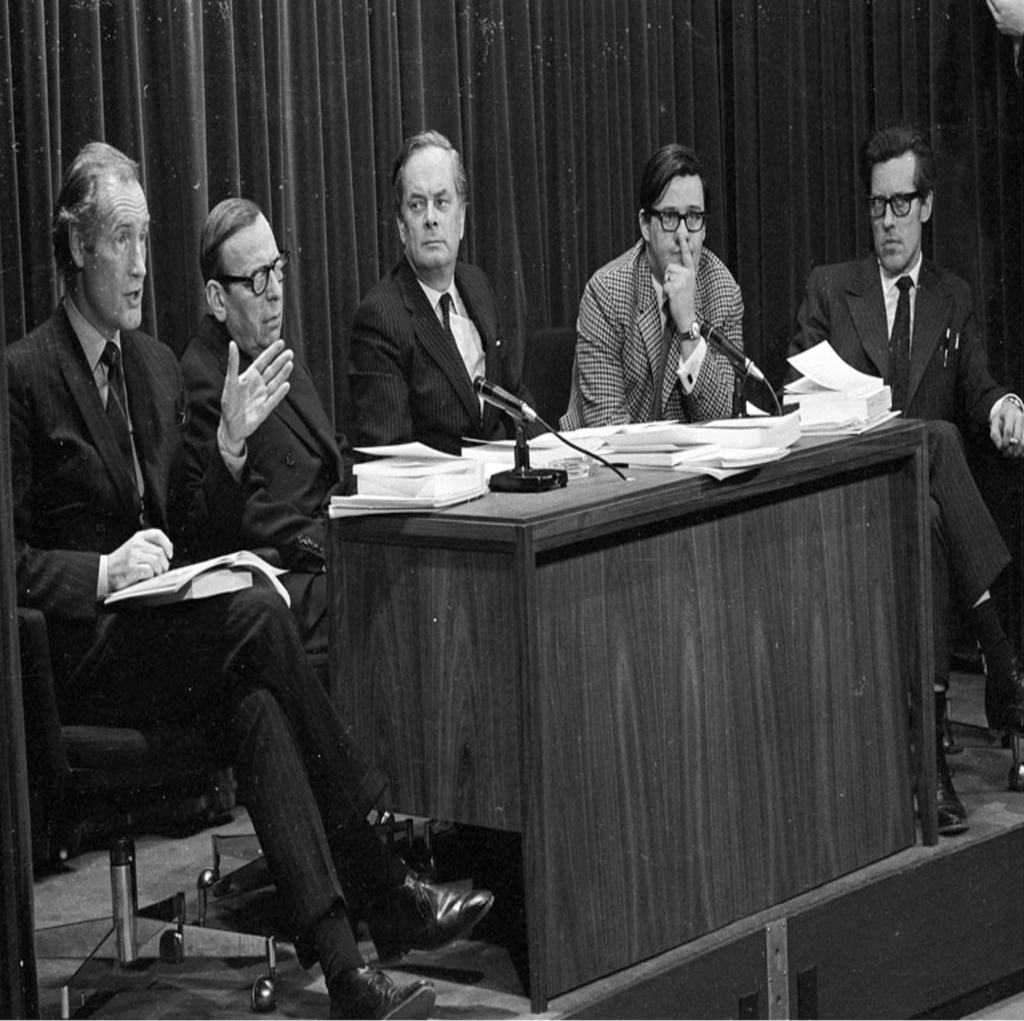
The immediate context out of which official bilingualism emerged was the Quiet Revolution. Beginning around 1960, the Quiet Revolution was marked by the crumbling of Quebec’s conservative political order and an unleashing of modernization, secularization, and nationalism – which in some quarters turned to separatism. The Quiet Revolution’s causes, chronology, and outcomes are heavily debated.[2] One thing is certain, however: while many factors played into the discontent that many Quebecers felt about their province’s place in the Canadian federation – economic, cultural, linguistic, religious – the federal government’s response was in large part focused on the linguistic elements. Responding to André Laurendeau’s 1962 call for a royal commission on bilingualism, the federal government eventually launched the Royal Commission on Bilingualism and Biculturalism, which was active from 1963–1969.[3]
The Commission’s terms of reference tied the definitions of bilingualism and biculturalism to Canada’s two “founding races”: the British and the French. Yet these definitions were contested throughout the Commission’s hearings, by members of the public and even one of the commissioners themselves. Commissioner J.B. Rudnyckyj, a Ukrainian Canadian linguist, first floated the notion of “multiple bilingualism” and “multiple biculturalism” before going on to issue a dissenting opinion that argued for the creation of regional language rights.[4]
The “other ethnic groups” (the non-English, non-French, predominantly European-descended) were the most vocal in arguing for an expansion of language rights, in part by challenging the Commission’s narrow definition of bilingualism and arguing for the more literal definition of two languages. This was the “western definition,” referring to the multiplicity of bilingualisms in western Canada, or “inofficial bilingualism,” as Rudnyckyj called it.[5] However, Indigenous peoples also contested this narrow definition. Ethel Brant Monture argued that, even considering all Indigenous languages as one group, Canada was “a tri-lingual country.”[6]Stella Kinoshameg made a similar point by beginning her presentation to the Commission entirely in Anishinaabemowin, causing the simultaneous English-French translation system to fall silent.[7]
In the end, despite Rudnyckj’s efforts, and the efforts of Ukrainian Canadian organizations to build a “third force” of ethnic and Indigenous groups to push for linguistic and cultural rights, the Commission stuck with their terms of reference. The federal government hewed closely to the Commission’s recommendations when it came to language. Two years after the first volume of their report, on The Official Languages, was published, the government passed the Official Languages Act (1969) that made Canada’s official languages English and French. And even though the government went beyond—even against—the Commission’s recommendations in abandoning the notion of biculturalism and instead opting for multiculturalism, this too was carefully placed within a “bilingual framework.”
Only in 2019 did the federal government pass legislation supporting and promoting Indigenous languages in Canada. But as critics pointed out, the Indigenous Languages Act (2019) was “not really a language rights law at all.” It did not confer rights; it did not place an obligation upon the state to implement those rights; and – most notably – it did not grant Indigenous languages the status of official languages.[8] In short, Indigenous languages remain outside the official languages paradigm established in 1969. The result? “Even my language, Inuktitut, is slowly weakening because official languages are supported to grow and be prosperous languages whereas Indigenous languages are not,” Simon told the CBC. “If we’re going to save Indigenous languages as a country, we have to do more.”[9]
In a speech given in 2008, Will Kymlicka suggested that “something like ‘multiculturalism within a bilingual framework’ is the only possible basis for Canada to survive as a country. The only way to keep Quebec in the country is to re-affirm duality in the form of official bilingualism. But the only form of duality that can be politically sustained is one that does not come at the expense of ethnic groups, excluding them from public space and state resources. I see no other viable formula for keeping the country together.”[10]
But even this analysis failed to consider that multiculturalism was really “colonial multiculturalism,” because it “insufficiently recognize[s] the sui generis or inherent rights of Aboriginal peoples which existed before colonization and continue still,” as political scientist David B. MacDonald would later put it.[11] Indeed, Indigenous peoples are the ones who have born the expense of the political compromise of “multiculturalism within a bilingual framework,” the ones who have been consistently excluded by it.
The undying present controversy over a literally bilingual Governor General being insufficiently “officially bilingual” demonstrates the creaky and contradictory foundations of Canada’s framework of official languages and cultures, the weaknesses of which have been insufficiently addressed by subsequent legislation. As long as a gap persists between these two definitions of bilingualism, there will always be room for critique. So, instead of taking the existing framework as unchangeable, perhaps it is time to delve a little more deeply into the possibilities offered by the “something like” to which Kymlicka refers.
Daniel R. Meister is an Adjunct Research Professor in the Department of History at St. Thomas University and an Adjunct Professor in the Department of Political Science at the University of New Brunswick. He researches the history of Canada’s policy of multiculturalism and is a Regular Contributor to Active History.
[1] Bianca McKeown, “‘Colonial Thinking’: Inuit Criticize Backlash to Gov. Gen. Mary Simon’s Brand of Bilingualism,” CBC News (9 May 2026). See also Benjamin Lopez Steven, “Outgoing Gov. Gen. Says Criticisms Levelled Against Her French Abilities Were Unfair,” CBC News (24 May 2026).
[2] See for instance Michael D. Behiels, Prelude to Quebec’s Quiet Revolution: Liberalism versus Neo-Nationalism, 1945–1960(McGill-Queen’s University Press, 1985); Émile-Martin Meunier and Jean-Philippe Warren, Sortir de la “Grande noirceur”: L’horizon “personnaliste ” de la Révolution tranquille (Septentrion, 2002); Michael Gauvreau, The Catholic Origins of Quebec’s Quiet Revolution, 1931–1970 (McGill-Queen’s University Press, 2005); and Xavier Gélinas, La droite intellectuelle québécoise et la Révolution tranquille (Presses universitaires de Louvain, 2007).
[3] On its history, see Eve Haque, Multiculturalism Within a Bilingual Framework: Language, Race, and Belonging in Canada(University of Toronto Press, 2012); and Valérie Lapointe-Gagnon, Panser le Canada: Une histoire intellectuelle de la commission Laurendeau-Dunton (Éditions du Boréal, 2018). Gérard Pelletier, Secretary of State from 1968–1972, confessed in his memoirs that he always regretted that title that the Pearson government had given the commission, remarking in part : « Je déplore l’usage du premier [terme, bilinguisme,] parce qu’il est trop général et devait donner naissance à … confusion… » Pelletier, L’aventure du pouvoir, 1968–1975 (Stanké, 1992), 63.
[4] Haque, Multiculturalism Within a Bilingual Framework, 57, 177–8.
[5] Haque, Multiculturalism Within a Bilingual Framework, 65 and 102.
[6] Haque, Multiculturalism Within a Bilingual Framework, 70.
[7] “Teacher Wants Indian Language Preserved,” North Bay Nugget, 26 March 1964, 5; and Susan Dexter, “Count Us Out on Biculturalism View of Indians,” Toronto Star, 26 March 1964, 8; both in D.R. Meister, “One of the Cultural Minorities”? Indigenous Peoples and the Creation of Official Multiculturalism,” Canadian Historical Review 106, no. 1 (2025): 57–82.
[8] Kariwakeron Tim Thompson, “Strengthening the Indigenous Languages Act – Bill C-91,” Yellowhead Institute (27 February 2019); and Lorean Sekwan Fontaine, David Leitch, and Andrea Bear Nicholas, “How Canada’s proposed Indigenous Languages Act fails to deliver,” Yellowhead Institute (19 May 2019) (“at all”).
[9] Steven, “Outgoing Gov. Gen.”
[10] Will Kymlicka, “The Three Lives of Multiculturalism,” in Revisiting Multiculturalism in Canada: Theories, Policies, and Debates, ed. Shibao Guo and Lloyd Wong (Sense, 2015), 17–35. The piece began as a lecture of the same name delivered to the UBC-Laurier Institution Multiculturalism Lecture Series, University of British Columbia, 15 April 2008, available online at https://thelaurier.ca/lecture-podcasts/.
[11] David Bruce MacDonald, “Aboriginal Peoples and Multicultural Reform in Canada: Prospects for A New Binational Society,” Canadian Journal of Sociology/Cahiers canadiens de sociologie 39, no. 1 (2014): 65–86.
This work is licensed under a Creative Commons Attribution-NoDerivatives 4.0 International License. Blog posts published before October 28, 2018 are licensed with a Creative Commons Attribution-NonCommercial-ShareAlike 2.5 Canada License.