
Thomas Stroyan
In February 1968, the Quebec government agreed to loan Chile two Canadair CL-215s (also known as the CANSO). The CL-215 was an amphibious flying boat built for the purpose of performing firefighting tasks such as waterbombing. The loan came at a moment of need for Chile, in 1967 it had experienced a record drought the likes the country had not seen since the 1920s. This resulted in a climate emergency which threatened Chile with both crop failure and forest fires. The provincial government of Quebec had no issue with loaning the planes to Chile. Due to the Southern and Northern hemispheres having inversed summers, Quebec had no need of the planes while Chile was at the highest risk for forest fires and vice versa. Quebec simply made the loan conditional on the aircraft being returned by April of the same year.[i] Quebec’s provincial government also had a secondary motive: the loan helped the Quebec-based Canadair, who had been pursuing sales in Chile for some time, showcase their aircraft to Chile.[ii] The two planes arrived in Chile without incident and were used to simultaneously train Chilean pilots and demonstrate the capabilities of the planes.[iii] The loan appeared to be a success, the Quebec Ministry of Transportation and Communications reported a great deal of Chilean media interest in the two CANSO aircraft and indicated that a major purchase was on the horizon.[iv] In the end, the loan did not lead to a direct purchase but this isn’t to say that the Chileans weren’t grateful, they were. The federal government in Santiago instructed the Chilean embassy in Ottawa to send a formal thank you to the Quebec government. This simple act of gratitude, however, turned out to be far more diplomatically complex than one would imagine. To understand why, one must examine the phenomena of the Quebec Sovereignty movement and how it affected Canada’s diplomacy with another developing country on the other side of the Atlantic Ocean, Gabon.
Since 1960, Quebec under the Liberal Party led by Jean Lesage pursued a policy of ‘Maîtres chez Nous’ – Masters of Our Own House. Maîtres chez Nous was the quintessential policy of the Quiet Revolution, a period in which Quebec underwent a rapid cultural, political, and technical transition. It shed the cultural and institutional supremacy of the Catholic church in the province, increased the strength of the Quebec government in internal affairs and increasingly pushed against what it thought of as colonial domination from Anglo Canada. Maîtres chez Nous was framed as a decolonialization process in which Quebec fought for increasing autonomy over its own affairs. In 1966, the Lesage Liberals lost to Daniel Johnson’s Union Nationale. The party left, but the policy of Maîtres chez Nous endured. Quebec sovereignty had become a bipartisan policy pursuit and by the late 1960s, Quebec’s quest for sovereignty was looking increasingly more like separation. As such, its quest for autonomy in its internal affairs, with some help from Charles de Gaulle, was spilling into external affairs, which was federal jurisdiction.
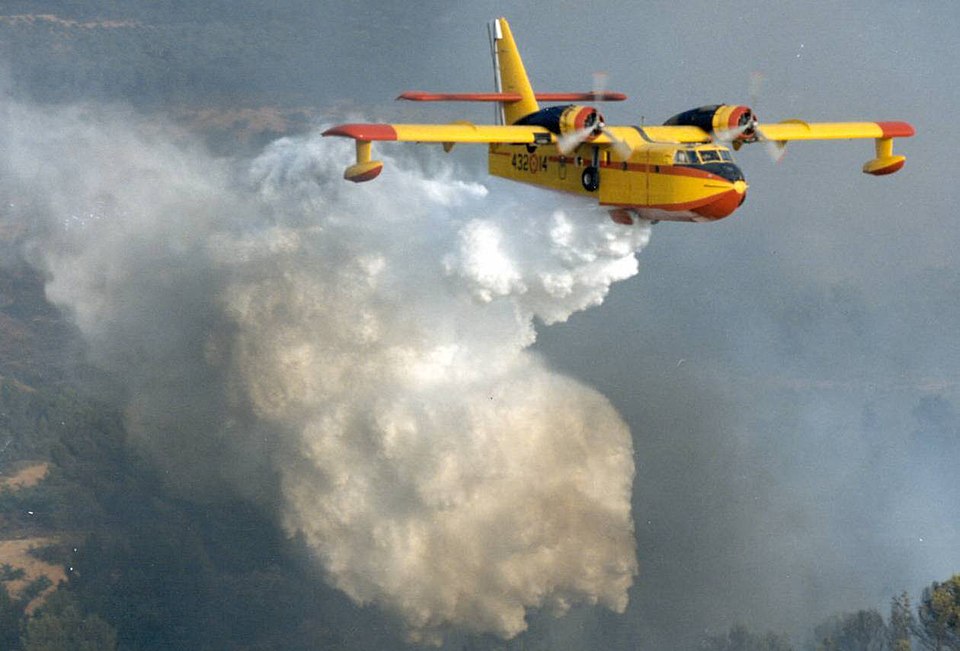
Un Canadair CL215 Del 43 Grupo En Plena Descarga. n.d. Own work. Accessed May 20, 2026. https://commons.wikimedia.org/wiki/File:CL215_43_Grupo.jpg. – The caption translates roughly to: “A Canadair CL-215 from the 43rd Group in mid-drop.”
In 1967, the Quebec government, with the assistance from France, arranged for Quebec to participate directly, without first consulting Ottawa, in a meeting of Education Ministers of France and its former colonies to be held in Libreville, the capital of Gabon. A meeting of this nature was contested ground between Quebec and Ottawa as education constitutionally was under provincial jurisdiction; however, international relations, and thus participation in international conferences, was under federal purview. Quebec, if it succeeded at representing itself at this conference, could begin the process of establishing an international name for itself and further separatist ambitions. Furthermore, these technical conferences were part of a larger vision that would be realized in 1970, the creation of an organization of French-speaking states that would be called La Francophonie, an organization similar in dimensions to the Commonwealth. Under pressure from France, the Gabonese government agreed to invite Quebec to the conference without consulting Ottawa and even neglected to extend an invitation to the Canadian ambassador to Gabon. Quebec attended the conference between February 5th and 10th of 1967. The end result of this conference was rather dramatic and best summarized by former minister of the Canadian embassy in Paris, Eldon Black. He stated:
“The Conference took place with Quebec flags flying and congratulations from the French delegation to the Gabonese for having treated Quebec as a full participant. Cardinal, the head of the Quebec delegation, received the ‘Order of the Green Elephant,’ and Ottawa suspended relations with Gabon.”[v]
The Pearson government, in response, punished Gabon on March 4th of 1967 by suspending diplomatic relations with the African country and with it, all potential aid projects with Canada.[vi] The whole saga has been referred to in Canadian scholarship as the Gabon Affair.[vii]
In the context of the Gabon Affair, the complicated nature of Chile’s dealings with Quebec makes more sense. Quebec separatism was manifesting itself in the international arena and Gabon was caught in the crossfire of this struggle between Ottawa, Quebec, and Paris. If the Canadian federal government was willing to cut relations entirely with Gabon in its struggle with Quebec separatism, similar frictions could develop between Chile and Canada if Santiago did not tread lightly. As this unfolded, the Chileans were looking at Canada with great interest, particularly in terms of receiving technical assistance and foreign aid from Ottawa. The Chileans took careful note of the Gabon Affair. In March 1968, the Gabon Affair was reported on in detail to Santiago by the Chilean embassy in Ottawa.[viii] In this way, the Gabon Affair greatly shaped how the Chilean government approached contacting Quebec City.
The Chilean embassy in Ottawa was instructed to thank the Quebec government for loaning Chile the CANSO aircraft. The Chilean embassy, however, reported back to Santiago that thanking Quebec was a complicated affair. The embassy made direct reference to the Gabon Affair and explained that if the Chilean embassy contacted the Quebec government directly, it could be construed as Santiago supporting Quebec separatism and invoke the fury of Ottawa. In the context of 1968, for a developing nation such as Chile, this could be as severe as having diplomatic relations suspended altogether. The Chilean ambassador explained that his initial plan was to visit Quebec City and request an audience with Quebec Premier, Daniel Johnson, directly.[ix] Under normal circumstances, this would have been the perfect opportunity to thank the Premier. After all, it was diplomatic protocol for ambassadors to have an audience with Premiers when visiting their respective provinces. The ambassador, however, went on to explain that this would prove impossible without offending Ottawa as Premier Johnson had complicated matters. He decreed that any audiences with him by foreign dignitaries should be requested via his own protocol, directly, and not through the intermediary of Ottawa. Under the difficult circumstances, the Chilean ambassador reported that he decided to extend Santiago’s gratitude to the Quebec government through Chile’s consulate in Montreal as, being situated in Quebec, it would not be irregular for the consulate to contact the Quebec government directly.[x]
The sheer difficulty in navigating something as simple as a ‘gracias’ to the Quebec government for loaning essential firefighting equipment to Chile demonstrates just how much of a strain Quebec Separatism had put on diplomatic affairs with Canada. It also explains, in part, why the Chilean government was enthusiastic about the incoming Pierre Trudeau government who, after taking office in April 1968, promised to remove Quebec separatism form the international sphere and box it into internal affairs. The Chileans were supportive of Ottawa’s struggle with, “divisionist factions” who were supporting Quebec’s encroachment on federal jurisdiction in international affairs.[xi] And while they viewed Pierre Trudeau’s intentions positively they also concluded that Ottawa risked inducing, “the countries that are interested in the special treatment of Quebec to accentuate this policy, with consequences that are easy to imagine.”[xii]
Chile was right to be cautious. As a developing country at the periphery of Ottawa’s traditional foreign policy focus and one looking toward an expanded aid program under the new Trudeau government, Chile could not afford to take risks. Quebec’s aircraft extinguished the physical flames threatening Chile’s forests, but preventing political fires in Ottawa required an entirely different kind of firefighting. To avoid Gabon’s fate, Chile’s diplomacy with Canada had to remain strictly federal, no matter who owned the water bombers.
Thomas Stroyan is a PhD candidate at Western University. He specializes in Canadian – Latin American relations and has taught both pre- and post-confederation Canadian history as well as modern Latin American history. He is currently finishing his dissertation, a comparative analysis of Canadian relations with Chile and Argentina from 1968-1979, and is working on other projects exploring artificial intelligence in education and the historical profession.
[i] Chilean Embassy in Ottawa and Chilean Ministry of External Affairs, “Sobre Viaje Aviones Canadienses a Chile,” February 20, 1968, Fondo Paises, CAN 28, Archivo de la Cancillería de Chile.
[ii] Canadair had at one point had even arranged a sale of six CL-215s to the Chilean government for $9 million but this sale fell through due to a loss of interest on the part of Chile. Canadian Ministry of External Affairs, “Chile – Provision of Canadian Water Bombers,” February 13, 1968, RG25-A-3-c – Department of External Affairs fonds, Volume number: 13962, File – 37-22-1- Chile (part 1) – Foreign Trade – Strategic Trade Controls – Export of Arms and Military Equipment by Canada – Chile, Library and Archives Canada.
[iii] Quebec Ministry of Transport and Chilean Embassy in Ottawa, “Deux Avions Du Quebéc Combattent Les Feux de Forets Au Chili,” February 28, 1968, Fondo Paises, CAN 28, Archivo de la Cancillería de Chile.
[iv] Chilean Embassy in Ottawa and Chilean Ministry of External Affairs, “Información Sobre Los Aviones ‘CANSO,’” March 21, 1968, Fondo Paises, CAN 28, Archivo de la Cancillería de Chile.
[v] Eldon Black, “La Francophonie and the Outbreak of Hostilities: The Gabon Affair,” in Direct Intervention: Canada-France Relations 1967-1974, 1st ed., Carleton Library Series 187 (Carleton University Press, 1997), 32-33, https://doi.org/10.1515/9780773580923.
[vi] In April 1968, for example, Ottawa sent former Minister of Justice, Lionel Chevrier, to head a mission to French Africa to investigate how Canada could increase its foreign aid programmes in the region. The Chevrier Mission as it came to be called did not visit Gabon. Chilean Embassy in Ottawa and Chilean Ministry of External Affairs, “Misión Chevrier a Países Africanos de Habla Francesa,” April 8, 1968, Fondo Paises, CAN 28, Archivo de la Cancillería de Chile.
[vii]Readers wishing to learn more about the Gabon Affair are encouraged to consult Eldon Black’s book chapter, “La Francophonie and the Outbreak of Hostilities: The Gabon Affair,” and David Meren’s book chapter, “Chapter 8: Crisis: From Montreal to Libreville,” in With Friends like These: Entangled Nationalisms and the Canada-Quebec-France Triangle, 1944-1970 (UBC Press, 2012), https://doi.org/10.59962/9780774822268.
[viii] Chilean Embassy in Ottawa and Chilean Ministry of External Affairs, “Incidente Con Gabón y Relaciones Con Francia,” March 14, 1968, Fondo Paises, CAN 27, Archivo de la Cancillería de Chile.
[ix] Chilean Embassy in Ottawa and Chilean Ministry of External Affairs, “Agradecimientos al Gobierno de Quebec Por Aviones CANSO,” April 19, 1968, Fondo Paises, CAN 27, Archivo de la Cancillería de Chile.
[x] Chilean Embassy in Ottawa and Chilean Ministry of External Affairs, “Agradecimientos al Gobierno de Quebec Por Aviones CANSO.”
[xi] The Chileans were almost certainly referring to France when they mentioned ‘divisionist factions.’ Chilean Ministry of External Affairs and Chilean Embassy in Ottawa, “Pierre Elliott Trudeau, Nuevo Primer Ministro de Canadá,” May 6, 1968, Fondo Paises, CAN 27, Archivo de la Cancillería de Chile.
[xii] Chilean Ministry of External Affairs and Chilean Embassy in Ottawa, “Pierre Trudeau y El Problema de Quebec,” June 23, 1968, Fondo Paises, CAN 27, Archivo de la Cancillería de Chile.
This work is licensed under a Creative Commons Attribution-NoDerivatives 4.0 International License. Blog posts published before October 28, 2018 are licensed with a Creative Commons Attribution-NonCommercial-ShareAlike 2.5 Canada License.