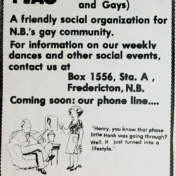
Rosemarie Forsberg In 1979, lesbians in Fredericton, New Brunswick, found community not in a dedicated gay bar or a visible neighbourhood, but on the dance floor of the Cosmopolitan Club. On Thursday nights, women quietly gathered with friends, effectively “queering” a predominantly heterosexual venue. In a city without lesbian bars, bookstores, or formal organizations, even a dance floor could become… Read more »
Michael Dawson Today’s visitors to Venice are hard-pressed to ignore the locals’ frustration with their presence. In 2025, CNN lamented the impact of overtourism on this popular destination “hollowed out by vacation rentals.”[1] In 2024, the BBC noted that the city had introduced a daily entry fee, a ban on loudspeakers, and a limit on tour group size – all… Read more »
Peter L. Twohig On 16 April 2026, five thousand long-term care (LTC) workers in 56 facilities throughout Nova Scotia began a strike. A tentative agreement ended the labour action after eight weeks, another example of a lengthy labour dispute in a nursing home. Indeed, some of the longest strikes in recent Canadian history have been in LTC.[i] Striking long-term care… Read more »
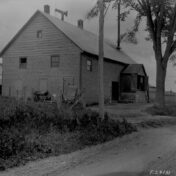
Stéphane Castonguay and Colin Coates This is the ninth post in a series about the Great Acceleration as a framework and reconnaissance for Canadian environmental history. The posts in this series are cross-posed with NiCHE The relationship between agriculture and the Anthropocene unfolds across a temporal and conceptual spectrum punctuated by the various proposals for a “Golden Spike.”1 At one end… Read more »
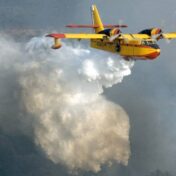
Thomas Stroyan In February 1968, the Quebec government agreed to loan Chile two Canadair CL-215s (also known as the CANSO). The CL-215 was an amphibious flying boat built for the purpose of performing firefighting tasks such as waterbombing. The loan came at a moment of need for Chile, in 1967 it had experienced a record drought the likes the country… Read more »
Walter T. Cassidy The Windsor Star reported an incident on May 28th, 1954—as did papers all over North America—about a Port Colborne, Ontario woman being arrested in Buffalo, New York, for trying to enter the United States “illegally” after being in an accident in the neighbouring American town. It was her second time trying to cross the border, the first… Read more »
Daniyal Elahi and Harris Elahi In December 2025, ActiveHistory.ca published our first piece on Private Hasan Amat, a soldier of the 1st Battalion, Canadian Expeditionary Force, killed at the Battle of Hill 70 on August 20, 1917. To our knowledge, he is the first identified Muslim soldier killed in action serving with the CEF. He is also one of twenty-two… Read more »
Alicia Carefoote This is the fifth post in a series about the Great Acceleration as a framework and reconnaissance for Canadian environmental history. The posts in this series are cross-posted with NiCHE. When environmental historians describe the “Great Acceleration,” they usually point to dramatic post-Second World War transformations in human activity.1 Carbon emissions surged. Industrial production expanded. Highways, suburbs, pipelines, and hydroelectric megaprojects reshaped… Read more »
Josh Sandlos This is the fourth post in a series about the Great Acceleration as a framework and reconnaissance for Canadian environmental history. The posts in this series are cross-posted with NiCHE. Each year in my “Canadian History Since Confederation” survey class, I take my students on a deep dive into something that has high potential to be boring: Statistics Canada tables on historical… Read more »
John W. Bessai This is the third post in a series about the Great Acceleration as a framework and reconnaissance for Canadian environmental history. The posts in this series are cross-posted with NiCHE. Lake Diefenbaker concentrates the Great Acceleration within one prairie watershed. It shows how postwar Canada joined environmental transformation, settler state authority, hydraulic control, agricultural expansion, and the reordering of Indigenous… Read more »