
Shannon Stettner
As a child, on Friday nights just before 9:00 pm, I’d tuck myself under a living room end table. If I was quiet and hidden, I could usually get away with watching at least part of Dallas. I was equal parts enthralled and scandalized. The epic “Who shot JR?” storyline was my first memorable introduction to crime and, like millions watching, I was captivated. A few years later, I made the leap to true crime as a somewhat under-supervised, voracious reader with ready access to a bookshelf full of not quite age-appropriate content.
In recent years, true crime stories have become a ubiquitous part of the public conscience. There is no shortage of docuseries, books, or social media accounts dedicated to murder and mayhem. Analyses suggest women are drawn to true crime for a variety of reasons ranging from a sense of control over patriarchal/existential violence to more philosophical considerations about evil, retribution, and how well we can know another person.[i] For me, as a child, I recall being drawn to the unfinished stories. The idea that someone’s life could be interrupted in the middle of living, both horrified and fascinated me. As historians we try to piece together fragments of people’s lives in meaningful ways. I think this is why the true crime narratives have always held such an appeal to me. But where history tries to complicate its subjects, much true crime overly simplifies them.
For some time, I contemplated writing a true crime book. Looking through local unsolved cases, I encountered Geraldine Pickford. Not a lot of information is publicly available about her death.
Most of the material is available via the York Regional Police cold case website. Pickford was killed on the evening of September 18, 1965. She had worked a shift as a waitress in the dining hall at St. Andrews College in Aurora, Ontario. Her belongings were found on a path, and a search team found her body some hours later.
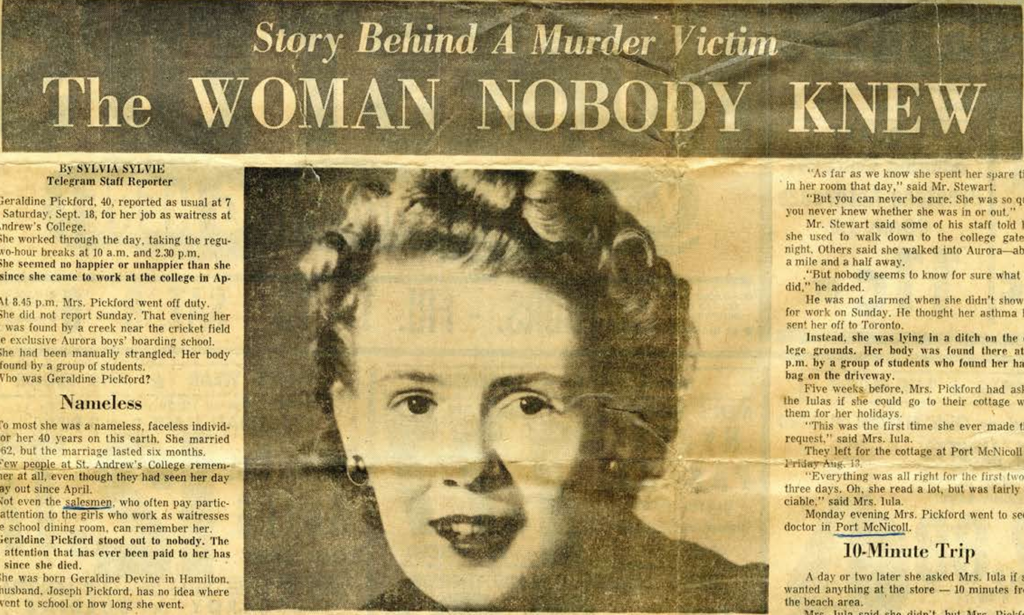
“The Woman Nobody Knew: The Story Behind a Murder Victim,” Toronto Telegram, September 20, 1965, p. 1.
But if you Google Pickford, you’ll find a recent uptake in interest, which includes podcasts, message board entries, and a walking tour. Why? My guess is that the interest stems from one of the few publicly available sources: a Toronto Telegram article about her case titled “Story Behind a Murder Victim The WOMAN NOBODY KNEW.” The article contains commentary from people in Pickford’s life, enough of it salacious to be intriguing, and a fair bit of conjecture. For me, the writing underscores the idea that how the story is told is important for maintaining public interest. This point was clearly illustrated in Kristen Gilchrist’s work “Newsworthy” Victims? wherein she compared the newspaper space given to Indigenous and white women victims of crime. In contrast to the personal stories and intimate photos of white victims, Gilchrist observes how the shorter, less personal articles devoted to Indigenous women contributed to invisibilizing them as victims of crime.
Within the proliferation of true crime narratives, historians can make meaningful contributions. Using the Pickford case, I reflect on three interpretive lines to explore what true crime would look like if more historians helped produce it. To do so, I explore the following topics:
- voices that are in and missing from the historical record;
- the idea that proximity offers truth in evidence; and
- the importance of understanding victims as full human beings with complicated lives.
I’ve chosen to focus on Pickford here because the evidence is biased and incomplete; nevertheless, many are fascinated by the story.
In the Toronto Telegram article about Pickford’s death, several voices are included: her brother, employer, estranged husband, and a long-term “friend” who is also a sometime landlord, Margo Iula. The friend’s comments to the reporter call to mind the adage, “with friends like this, who needs enemies.” However, the colourful narrative that Iula provides is also likely what has kept Pickford’s case alive. The depiction of Pickford is vivid.
From her brother we learn their mother died when Pickford was nine, she quit school in grade 8, she was quiet, a reader with no other hobbies, and that even he didn’t know how she acquired the significant scar on her shoulder blade. From her estranged husband, we learn that Pickford was “very moody. If company came she might talk to them or she might not.” During the course of their six-month marriage, Pickford became “more and more remote,” then quit her job and left. The friend’s comments seem to be criticisms, but they make Pickford into a compelling subject. She confirmed Pickford was an avid reader, but also a picky one: “she seldom read all a book. She would skip pages if she was bored or came to a section she didn’t like.” Iula continued, disparaging Pickford: “When she did say something, she would often lie. You never knew when to believe her.” And inadvertently enticed with this observation: “She could be aggravating to another woman. She could be particularly aggravating to a man.”
Of course, the missing voice is Pickford’s. As the victim, she had no opportunity to affirm or counter these characterizations. We see this a lot in true crime. Sometimes so little information is available about a victim, that they are reduced to one-dimensional characters depicted in ways that are not verifiable. Historians wouldn’t necessarily have access to information that other people don’t. But, here, context is key. For example, to flesh out our understanding of the victim, we might look more closely at how Pickford–as she is described–conformed to or defied cultural norms and what can we suggest from that information.
One of the moments that drove me to write this piece, came from casual viewing of true crime. While we were watching one show, my attention was piqued because the narrator on the screen was labelled a “historian,” which is not a common title used in these shows (although I have started to see it used more frequently). As I listened to the speaker talk, it became clear that she was the daughter of the police officer who had led the initial investigation into the crime; the daughter commented on the case from her (now deceased) father’s perspective. There was no indication that she had any formal training as a historian. I’m not typically one to gatekeep titles, but using “historian” in this case was clearly meant to confer authority on someone who had no apparent authority. It speaks to the question about proximity too – are we to believe this “historian” is reliable because she’s the police investigator’s daughter? Her having expertise would have required her father to disclose confidential information. And, while I am not naïve enough to think such casual disclosures don’t occur, surely such a discussion would not have entailed a fulsome accounting of the evidence. The source (beyond, presumably, conversations with her father) and the nature of her knowledge of the case was never explained.
In the case of Pickford’s unsolved murder, Iula’s voice dominates. What’s interesting about her voice is that it is given authority because of their friendship/living situation. We have no way to judge how Pickford perceived Iula or their relationship. This is a line that is often lost in true crime documentaries. Proximity is not the same as authority or truth, but it is often treated as such. This is where historians typically shine. We already relentlessly evaluate our sources. We look for biases, we interrogate language. We understand that such testimony is not the same as truth telling; sometimes it is entertainment, sometimes mythmaking, sometimes the motivation remains unclear.
What the articles suggests, is that Pickford was not an “ideal” victim.[ii] She was, however, an intriguing one. In addition to the characteristics noted above, which earned Pickford a reputation for having a ‘difficult’ personality, the article also portrays her as mysterious — and not as a compliment. For example, it is said that Pickford would disappear for a month or two, and when she reappeared, “She usually said she had been going out with somebody. She would never say who.” Iula also indicated that Pickford never had any money and observed that the money shortage began 18 years ago following a time when Pickford disappeared for a year and a half. Iula speculated Pickford was being “blackmailed,” although she had no evidence to support this suspicion. Speculating further, Iula suggested Pickford had a child during that period whom she was quietly supporting. Is it any wonder readers are mesmerized by this article? It is the primary document that keeps on giving.[iii]
The line between storytelling and exploitation can be very thin and is easily missed. In our efforts to share hardships and struggles, we often rely on individual stories to illustrate harms. The risks of this approach include sensationalism, voyeurism, and narrowing people to the worst moments of their lives.[iv] As historians, it’s worth considering how we can contribute to these conversations in important ways. I don’t propose that other historians join my true crime obsession. But I think historians are well-positioned to engage with these narratives in meaningful ways.[v] We excel at interrogating sources (including missing voices), establishing context, scrutinizing authority, living with ambiguity, and approaching subjects ethically. In so doing, we could help move the focus away from a sensationalized focus on crime, to more fulsome recounting of fragmented, interrupted lives.
Shannon Stettner is a historian specializing in reproductive health and activism, oral history, and lived experience. She is an avid traveller, dog enthusiast, world class putterer, and a regular contributor to Active History.
[i] On this, see Laura Browder, “Dystopian romance: True crime and the female reader,” The Journal of Popular Culture 39, no. 6 (2006): 928-953.
[ii] Nils Christie, “The ideal victim,” in From crime policy to victim policy: Reorienting the justice system, pp. 17-30 (London: Palgrave Macmillan UK, 1986): 12-13.
[iii] The article also goes into some depth about Pickford’s suspicious comings and goings in the weeks leading up to her death. I won’t recount those here because I’ve already outlined the ways Iula’s speculations have fueled interest in the case.
[iv] On this, see Christine Linke, and Lisa Brune, “Intimate Yet Exploitative: Representations of Gender-Based Violence in Platformed True Crime Narratives,” Media and Communication 13 (2025), https://doi.org/10.17645/mac.8964.
[v] A recent excellent example of how historians can tackle these stories, is Ian Radforth, Deadly Swindle: An 1890 Murder in Backwoods Ontario that Gripped the World (University of Toronto Press, 2024).

Excellent piece! I’m also a true crime fan, and also someone who grapples with the ethics of this and with how to do historical research on crime. I found this really helpful. The questions produced by the glimpses we get into interrupted lives are so valuable; we can learn more by sitting with those questions and assessing the fragments rather than trying to tidy them up. Really thought-provoking!