
Kristen C. Howard
In today’s increasingly online world, historians, researchers, and students want and expect online access to historical documents offered by galleries, libraries, archives, and museums. This includes not only journal articles and ebooks, but also primary sources and archival documents, which researchers increasingly expect to find online in searchable, digital formats. In turn, cultural heritage institutions have responded by trying to meet these demands, with various levels of success, for items ranging from census data to yearbooks to photographs. But offering access to digital and digitized collections has a very high cost, in terms of planning, scanning, adding metadata and accessibility features, and most crucially maintenance and long-term preservation. The invisible costs and labour behind online collections are frequently overlooked by researchers. This raises a question that few of us pause to ask: who did the work that made our digital sources accessible, and under what conditions?
This question matters because some of the digitization and data verification work that enables our online access to historical documents relies on the labour of incarcerated people—labour that is, I argue, exploitative. As researchers who depend on digitized primary sources, we have a responsibility to reckon with the hidden human costs of the online access we increasingly take for granted.
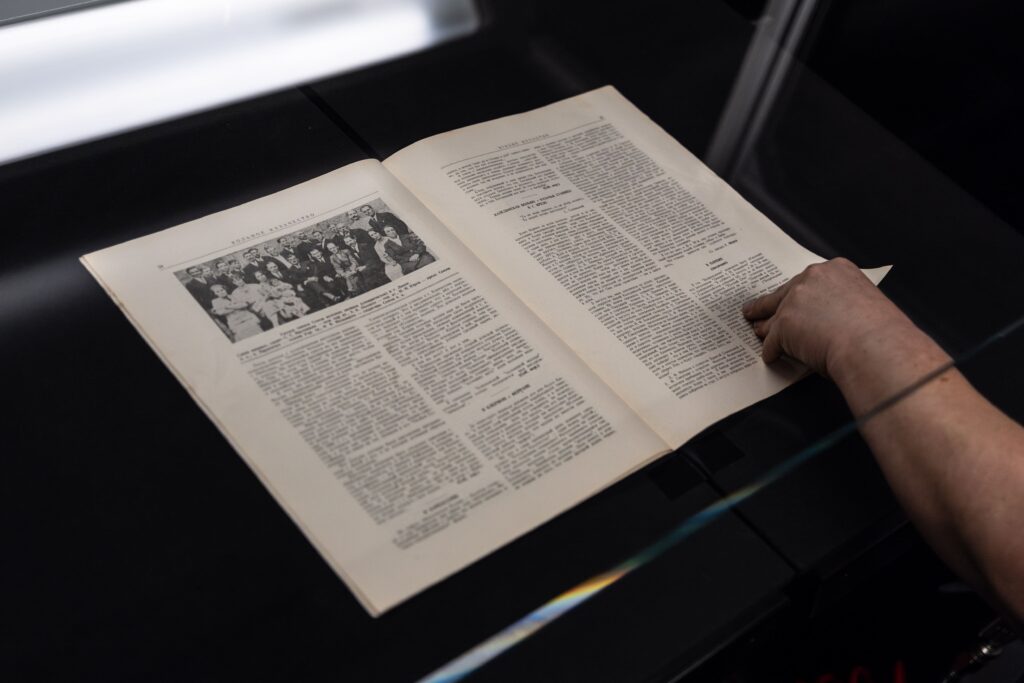
A worker operates a book scanner at a library digitization centre. The labour that makes digital collections accessible to researchers is often invisible to those who use them. Image: Book scanner digitization, CC BY-SA 4.0.
Consider the Yearbook Project, a digitization initiative that operated in Oklahoma prisons from at least 2013 until its suspension in 2022. The project scanned and processed high school yearbooks at no cost for high schools, libraries, museums, and historical societies across the United States, justified by the recognition that yearbooks are of irreplaceable historic value. How was the Yearbook Project able to offer this service for free? As a former coordinator candidly explained, it was possible because of the low labour costs associated with employing incarcerated people. According to reporting by Wendy Suares, workers on the project earned $1.45USD per hour, while the Oklahoma Department of Corrections earned $7.25 for each hour of their labour. Between 2020 and 2022 alone, the Yearbook Project generated over $600,000 in revenue for the Department of Corrections.
Prison labour of this kind is unethical. According to philosophers Matt Zwolinski and Alan Wertheimer, “to exploit someone is to take unfair advantage of them: to use another person’s vulnerability for one’s own benefit.” In mutually beneficial exploitation, both parties benefit, but the interaction remains exploitative because it is fundamentally unfair. The exploiter derives far more value than the exploited. This is the case in prison labour: the incarcerated derive some benefit from their work, such as earning money, gaining skills, or simply passing the time, but remain unfairly exploited. For example, in the United States, incarcerated people earn, on average, between $0.86 and $3.45USD per day – not per hour. In Canada, the range is from $5.25 to $6.90CAD per day. Even when incarcerated people gain something, such as this pittance, from their labour, the system degrades and disrespects them.
The Yearbook Project is not an isolated case. Incarcerated people in South Dakota enter state census data into databases for $0.25USD per hour. The American federal prison industries program UNICOR advertises that its digitization contracts will significantly reduce costs for labour-intensive work. In Utah, Idaho, and New Mexico, incarcerated people have indexed genealogical records for FamilySearch, the freely accessible platform operated by the Church of Jesus Christ of Latter-Day Saints (Mormon Church). This last example raises a genuinely complicated moral question. Some of these individuals volunteer for indexing work and describe it as personally meaningful, even spiritually fulfilling, and FamilySearch offers similar volunteering opportunities to people who aren’t incarcerated. But the conditions of incarceration, where options for how to spend one’s time are severely limited, make the notion of truly free choice difficult to sustain. As one incarcerated person in Utah told a recruiter for the program: “I would have done anything to get out of my cell.”
Notably, I have not found evidence of similar practices with regards to memory work (e.g., digitization, data entry, and the like) in Canadian prisons, although the federal correctional industry, CORCAN, offers a number of goods and services, including office furniture, industrial laundry, printing and engraving, and even, controversially, the creation of Indigenous-made handicrafts such as moccasins. However, Canadian researchers should not assume that they are insulated from this issue. Companies with ties to prison labour operate internationally: FamilySearch, for example, has well-documented ties to prison labour for indexing in the United States, and Ancestry has profited from offering content produced through prison labour, such as yearbooks digitized by the Yearbook Project. Both companies partnered with Library and Archives Canada on the recently released 1931 Census of Canada; LAC has confirmed that the census project did not directly benefit from prison labour. It is worth noting, however, that digitized sources with ties to the United States or to companies that operate internationally may have benefited from exploitative labour in ways that are not always transparent to the end user.
In a 2023 article published in the Library Quarterly, I proposed an intervention for librarians and archivists to increase transparency with researchers: that we clearly and honestly label items, collections, and databases that have benefited from exploitative labour. This intervention was inspired by the concepts of metadata justice and inclusive metadata: using accurate and appropriate language in library and archival systems and catalogues to promote transparency and accountability. This could take the form of neutral, informative statements that appear alongside the collections researchers access, noting the role played by incarcerated labour. On my genealogy guide at the McGill Libraries, for example, I note that “many genealogical companies and websites rely on the use of un/underpaid and exploitative prison labour in order to make genealogical materials such as census records available online and easy-to-use. Keep this ethical consideration in mind when deciding to undertake a genealogical project.”
This kind of labelling is beginning to happen elsewhere. A librarian at the Johnson County Library encountered my research in 2023, and was inspired to implement such a statement on her institution’s online holdings of yearbooks digitized by the Yearbook Project. The process took eighteen months – longer and, by the librarian’s own account, more complicated than she had anticipated. But the statement is now in place. This example demonstrates that institutional change is possible, even when it is slow and difficult. It also suggests that the conversation I hoped to begin is reaching beyond the pages of a scholarly journal.
Here, I hope to start a conversation with a different audience, beyond librarians and archivists: with historians and other researchers who use digitized primary sources, as well as members of the public who access digital collections for personal or genealogical research. Researchers are, after all, the driving force behind many digitization projects.
As researchers interested in learning—and teaching—about the lives of historical actors and in untangling power dynamics, we should extend this consideration to the invisible labour that makes available the resources we rely on finding not just in the archives, but online. It is extremely difficult in many cases to learn who digitizes historical materials, and under what conditions.
We may not have the power to end the practice of exploitative prison labour. But we can ask about the labour behind our sources. We can seek out and, when needed, demand transparency from the institutions and companies that provide our digital collections. We can consider whether these practices are acceptable as part of our research process. And we can insist that the practices taken in the name of making our heritage materials available meet our expectations and ethical demands.
Further Reading
Kristen C. Howard, “Digitization and Exploitation: Acknowledging and Addressing the Use of Exploitative Prison Labour by Libraries and Archives,” Library Quarterly 93, no. 3 (2023): 241–55. https://escholarship.mcgill.ca/concern/articles/s4655n73p
Shane Bauer, “Your Family’s Genealogical Records May Have Been Digitized by a Prisoner,” Mother Jones, August 13, 2015. Link
Kristen C. Howard is a liaison librarian and associate member of the Department of History and Classical Studies at McGill University. In addition to her library degree, she has a PhD in history (University of Arizona, 2020). Her research examines the ethical use of information, primary source literacy and pedagogy, and the emerging uses of generative artificial intelligence.
This work is licensed under a Creative Commons Attribution-NoDerivatives 4.0 International License. Blog posts published before October 28, 2018 are licensed with a Creative Commons Attribution-NonCommercial-ShareAlike 2.5 Canada License.