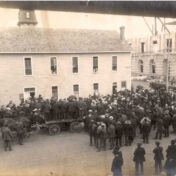
Each of these datasets was built to answer a narrower question, by people who never expected their work to end up joined to others. Building a settlement typology out of them is where an LLM came in. I did not use it to generate the findings, but it facilitated my work in merging disparate community sources into one. It helped by converting them into spreadsheets, importing them into a relational database (Neo4j), filtering this database for relevant information, standardizing the data against chronological change, and then effectively and accurately querying the results to answer new questions asked of old material. A census enumerator’s tally sheet, a grain elevator inspector’s license log, and a local history society’s book were never built to talk to each other. Now they can.
In my MA thesis, I built one example of how GraphRAG can work for historians. From 20,000 early modern documents, I constructed a knowledge graph of 218,000 entities and 692,000 relationships, then tested eight retrieval systems on thirty historical questions of escalating difficulty and then grading each of them. Plain RAG scored 48.4 percent against the metrics of groundedness, completeness, accuracy, synthesis, and usefulness. The best off-the-shelf system reached only 61.6 percent, an unacceptable result for a careful historian.
Part of the reason those systems created these kinds of errors was that they were not created for historical research. However, looking at these errors from a historian’s lens allowed me to create a better solution for history. Additionally, I noticed that those systems had a tendency to repress those entities which appear only rarely in the corpus. Sometimes, the most valuable entities, the obscure people and the once-mentioned places, are the very heart of where historical discovery is found. Fixing the systemic problems, and surfacing these obscure entities, were my goals in creating my own solution.
The outputs of many OCR technologies were developed for training LLMs, but that are frequently of little use in the humanities. They can be used by people with specific data mining and data science purposes, like researchers doing Named Entity Recognition. But these are still rather niche, and the majority of archival researchers and historians who want to access these OCR outputs would instead benefit from the document processing of OCR resulting in searchable archives. This is another area where AI-driven OCR is helpful, as it has the capacity to easily transform OCR outputs into specific and bespoke formats for the needs of the researchers who are using these outputs.
Kevin M. Anzzolin Since publishing my first book in 2024, I’ve turned my attention to gathering material for a second. Provisionally titled A View from the North: Lost Anglo-American Literature on Mexico from the Twentieth Century, I am exploring pulp novels, young adult adventure stories, tales of espionage, tourist guides, and yes, even postcards — in hopes of showing the… Read more »
talkie’s poor representation of history is a side effect of a larger problem. The model was conceptually built as an experimental tool to see if language models can accurately predict the future, also known as “forecasting.” The blog post assertively claims the models predictive capabilities, yet is devoid of evidence enabling researchers to reproduce their experiment. The version that could serve serious research is gated behind compute, and is the same version released with no guardrails at all.
Dani K. Inkpen “History should make you feel weird.” So proclaims a widely touted slogan of history nerds. While there is much in the world foisting weirdness upon us today, too rarely do we intentionally seek the off-beat. History students should. “Weird,” though it has come to mean uncanny or bizarre, has its roots in the idea of the turning… Read more »
Kristen C. Howard In today’s increasingly online world, historians, researchers, and students want and expect online access to historical documents offered by galleries, libraries, archives, and museums. This includes not only journal articles and ebooks, but also primary sources and archival documents, which researchers increasingly expect to find online in searchable, digital formats. In turn, cultural heritage institutions have responded… Read more »
This week marks the 10th anniversary of Unwritten Histories, a project created by Andrea Eidinger that has shaped how many of us think about the past—how it’s written, shared, and understood. In the coming weeks, the site will be taken offline. The material won’t be lost: Andrea is in the process of building a Pressbook to house the content, and the… Read more »
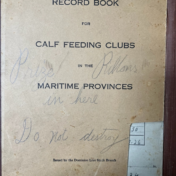
By Sarah Kittilsen In the summer of 2025, I was rifling through a box of uncatalogued materials at the Farm Equipment Museum in Bible Hill, Nova Scotia, when I happened upon an old record book. Tattered and yellowed with age, it had been used by fourteen-year-old Frank Daniels in the early 1930s to document what he expended and earned while… Read more »