Each of these datasets was built to answer a narrower question, by people who never expected their work to end up joined to others. Building a settlement typology out of them is where an LLM came in. I did not use it to generate the findings, but it facilitated my work in merging disparate community sources into one. It helped by converting them into spreadsheets, importing them into a relational database (Neo4j), filtering this database for relevant information, standardizing the data against chronological change, and then effectively and accurately querying the results to answer new questions asked of old material. A census enumerator’s tally sheet, a grain elevator inspector’s license log, and a local history society’s book were never built to talk to each other. Now they can.
In my MA thesis, I built one example of how GraphRAG can work for historians. From 20,000 early modern documents, I constructed a knowledge graph of 218,000 entities and 692,000 relationships, then tested eight retrieval systems on thirty historical questions of escalating difficulty and then grading each of them. Plain RAG scored 48.4 percent against the metrics of groundedness, completeness, accuracy, synthesis, and usefulness. The best off-the-shelf system reached only 61.6 percent, an unacceptable result for a careful historian.
talkie’s poor representation of history is a side effect of a larger problem. The model was conceptually built as an experimental tool to see if language models can accurately predict the future, also known as “forecasting.” The blog post assertively claims the models predictive capabilities, yet is devoid of evidence enabling researchers to reproduce their experiment. The version that could serve serious research is gated behind compute, and is the same version released with no guardrails at all.
By Andrea Eidinger Roundup, noun: The Canadian Oxford Dictionary, 2nd edition, Online edition, 2005 The very first “roundup” appeared on Unwritten Histories on April 24, 2016. My original idea was that there was so much cool stuff being published online, and more people needed to know about it. The first one was 650 words long. Little did I imagine that… Read more »
Active History is on its annual August hiatus. In honour of syllabus-writing season, we are reposting a selection of teaching-related articles from the past year. Today’s repost features Paul McGuire’s 2 November 2023 article. While you’re here, we also invite you complete our survey. Paul McGuire This is the second entry in a monthly series on Thinking Historically. See the Introduction… Read more »
Active History is delighted to launch our digital history initiative, Active History on Display (en français: Expositions d’Active History). The project features two exhibits. The first, More Than a Face, engages with nine storytellers to challenge dominant narratives of what it means to be Asian Canadian – and indeed to challenge the very idea that such a capacious category can… Read more »
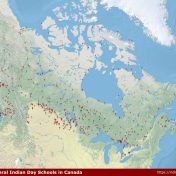
Jackson Pind and Sean Carleton Many Canadians are finally coming to terms with the truth that the Canadian government, in co-operation with Christian churches, ran a genocidal school system targeting Indigenous Peoples for more than a century. What most people do not realize, however, is that Canada’s system of “Indian education” was not limited to Indian Residential Schools. It also… Read more »
Jazmine Aldrich Anyone who has been conducting historical research (or attempting to do so) over the past two years, has likely faced challenges ranging from closed facilities to limited hours due to COVID-19. Archives, museums, historical societies, libraries and all manner of cultural heritage institutions have felt the impact of the COVID-19 pandemic. Even as the fog lifts and some… Read more »
Krista McCracken My work at the Shingwauk Residential Schools Centrecurrently includes a Canada History Fund funded project to create education modules connected to Residential Schools and colonialism. These modules are geared toward high school aged students and will be used as part of ongoing educational programming. When I wrote the grant proposal I included the idea that the modules would… Read more »
https://activehistory.ca/wp-content/uploads/2021/07/History-Slam-185.mp3Podcast: Play in new window | DownloadBy Sean Graham In 2011, a section of Bank Street in downtown Ottawa was designated The Village to commemorate the city’s LGBTQ2+ history. To denote The Village, there are street signs, pride flags, and a permanent rainbow intersection at the corner of Bank and Somerset. In addition to the designation, the Bank Street Business… Read more »