
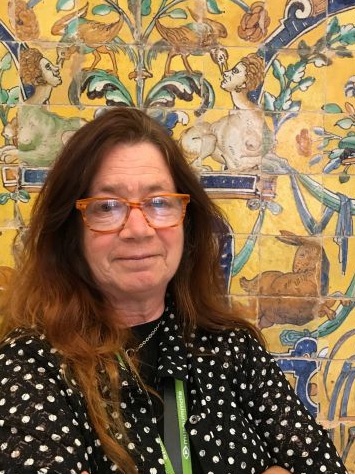
Karen Dubinsky, Professor Emerita of History and Global Development Studies at Queen’s University, brilliant scholar and generous friend to so many, passed away on 4 September 2026 after a brief illness. Karen was a longtime supporter of—and contributor to—Active History. We mourn her loss, even as we celebrate her life. Below are three reflections from friends and colleagues of Karen. The first, by Susan Lord and Scott Rutherford, is reprinted with light editing from the website of the Department of Global Development Studies at Queen’s.
Susan Lord and Scott Rutherford
Karen was a colleague, a friend, an intellectual co-conspirator, a fellow traveler, a teacher and mentor for many at Queen’s and beyond. After graduating from Carleton University with her BA and MA, Karen completed her PhD in History at Queen’s in 1991. Karen had brief teaching stints at the University of Toronto, Carleton University and McMaster University before taking a tenure-track appointment in 1993 in the History Department at Queen’s University. She was jointly appointed to the Department of Global Development Studies in 2010. Her retirement from Queen’s in July 2025 did nothing to slow down her down, as until her untimely passing she was doing research for a new book, “Cuban Roots on Canadian Soil: A History of Cuban Musicians in Canada.”
She reinvented herself as a historian at every turn—her topics of study ranging from Canadian gender and feminist history to transnational adoption, from queer tourism to Cuba-Canada cultural relations. There were many other collaborations along the way: edited books on the global 1960s, transnational history, Cuban musicians, and global development studies in Canada. As her mentor and friend Dr. Roberta Hamilton said at Karen’s retirement event last year:
“In her research and teaching she has never stood still—and her shifting theoretical perspectives find their way lightly but cleverly to inform her substantive work. Which always makes her work so enlightening, surprising, and interesting. Take the first of her sole-authored books: Improper Advances: Rape and Heterosexual Conflict in Ontario 1880-1929. … Amazingly undated given the huge swings in theoretical approaches, Karen’s study intertwines sex/gender, race, sexuality, patriarchy, morality and the social construction not just of femininity but also of masculinity, until then seen as simply the norm. More than all this she shows what became her signature style in all her work: telling a good story.”
The scope of her imagination was unparalleled, matched only by the most careful eye for detail, whether in the archives or in interviews. She gathered readers from across many borders. As professor David Austin (author of Fear of a Black Nation: Race, Sex and Security in Sixties Montreal, among numerous other titles) wrote about Karen’s book Cuba Beyond the Beach: “By cutting away at the debilitating romance, clichés, and dense propaganda that often characterizes narratives about Cuba, this wonderfully rich book provides the reader with a rare glimpse into a Cuba that continues to capture our imaginations, even as we somewhat nervously witness its dramatic history unfold.” American political commentator Ben Rhodes, who as a close Obama aide came to Canada to help steer US talks with Cuba, recently wrote to Karen about her award-winning 2025 book, Strangely Friends: A History of Cuban-Canadian Encounters:
“What really stood out to me was how you told this history through individual, intimate portraits rather than abstract diplomacy. Teachers, artists, and musicians whose personal choices to cross borders quietly built something that outlasted political ideology. It felt intentional, generous, and carefully researched in a way that’s hard to pull off without truly valuing the human stories underneath the larger geopolitical narrative. I especially appreciated the throughline from the classrooms of Havana to the jazz clubs of Toronto. It gives the book a rhythm that mirrors its subject, tracing connection through music and education rather than just tracking state policy. Those are the moments that separate a good history from one that actually lingers in a reader’s mind.”
This intentional and generous research was foundational to the spirit and labour of the course, Cuban Culture and Society, which she co-taught in a fifteen-year collaboration between Queen’s and the University of Havana. The course won two awards, took over 350 students to Cuba, and became a model of reciprocity and experiential learning. The exchange brought over twenty scholars, musicians, filmmakers, artists and curators from Cuba to Queen’s to participate in on-campus and community activities. Several Cubans undertook their MAs and PhDs at Queen’s as a result of the deep relationships cultivated through the research Karen and others developed over decades. Karen also opened the door for Cuban-Canadian artist Harry Tanner’s papers to be held in the Queen’s Archives and spearheaded Honorary Doctorates for Cuban musicians Carlos Varela and Alex Cuba.
Karen’s teaching and supervision demonstrated a lifelong commitment to curiosity and to helping students generate new ideas and ways of expressing critical understandings of the world around them. This reverence for learning was evident in the attention she gave students—from first year undergraduates on up—who showed an interest in learning beyond the boundaries of normative thought and practice. For Karen, asking and answering questions often required going far beyond the “either/or” to find deeper, muddier truths–a lesson she shared with the thousands of students whom she taught over 32 years in the classroom.
During Karen’s retirement event, former students Bay Ryley and Dave Seglins said, “We are the love children of HIST 565. We got married a few years later and had two of our own little ‘love children of HIST 565’.” Their eldest, Amy, has just started third year at Queen’s. Bay also noted about Karen: “The obvious love of her own work made her outstanding as an advisor and teacher. What is more inspiring than a writer who loves to write, a historian who loves history and their research, and a teacher who loves what and whom they are teaching? One wanted to write to impress. Not out of fear or obligation. I wrote for Karen and so I desired to do my very best.”
Karen leaves behind her partner Susan Belyea, her son Jordi Belyea-Dubinsky and an international village of family and friends.
A Door She Opened
Freddy Monasterio
There’s a popular way of thinking about the world as divided between two fundamental kinds of people: the “doers” and the “dreamers.” Historians, too, are often imagined in these terms. But what happens when you meet someone like Karen Dubinsky, who was both at once? You begin to see that dreaming and doing are not opposites. Karen moved effortlessly between ideas and action, between critical thinking and human connection, and in doing so opened for me a new door and a new understanding of how to be in the world.
The ways Karen transformed my understanding of scholarship, friendship, and responsibility remain alive in me. When I think about how much of the way I critically engage with the world, the past, and the future comes from working, eating, talking, and listening to music with Karen, I still cannot fully comprehend the influence she had on my life, not only as a scholar, but, more importantly, as a human being.
Karen taught me that scholarship is not only what happens in archives, classrooms, or publications. It also happens in conversations, friendships, shared meals, and acts of solidarity. Today, I work and research in a way that is highly relational, fluid, and messy. I am proudly part of Karen’s legacy, and I will continue moving forward in that spirit: unafraid of making mistakes, speaking back to power, and challenging injustice.
I will always remember the first time we met, on a balcony in Havana on a humid afternoon. The space was packed with Canadian students, old friends, and prominent scholars, yet she somehow made a stranger feel seen. She was curious about my life, my dreams, and my ideas. Everyone who had the privilege of knowing Karen will recognize this as part of her magic: she always made space in her heart and her mind for new relationships and new ways of understanding the world.
She loved a challenge, and Cuba, especially Cubans, gave her a big one. She pushed me to keep asking difficult questions about Cuba, and to remain open to its contradictions and possibilities. Today, I can say that I love and understand Cuba in a different and special way, and a large part of that comes from Karen. When I left Cuba and wanted to move on, she kept it alive in me.
I will miss her, and I certainly do. But the truth is that she does not feel gone. Her voice, her teachings, and her example remain present in my work and in the way I move through the world. The best tribute I can offer is to honour the loyalty, intelligence, and passion she brought into my life, and to carry those gifts forward. Karen showed me that it is possible to be both a dreamer and a doer. I will continue trying to live up to that lesson.
Almanacs, Perogies, and Cassette Tapes: A Short Tribute to Karen Dubinsky
Steven Maynard
Karen Dubinsky introduced me to ‘active history’ forty-one years ago. Of course, we didn’t call it ‘active history’ then, but sitting around the graduate seminar table as Karen’s classmate in 1985, one of my first clues about the connections between activism and history came in the form of an object Karen always kept close at hand: her EveryWoman’s Almanac. Produced by the Women’s Press collective (Toronto) beginning in the mid-1970s, the datebook featured a different theme each year—women and the peace movement, women and the environment—and often highlighted women’s historical contributions. What exactly Karen, in her left-slanted handwriting, recorded in her almanac, I can’t say, but the message in the seminar room was clear: for Karen, studying history was inseparable from her commitment to the feminist movement.
Karen’s immersion in feminist history as active history began before she was a grad student. As Karen wrote to me last year, “In 1978, when I was a baby feminist [she was 21], I had a summer job in Thunder Bay working for the Northern Women’s Centre interviewing old ladies.” (See p. 8 of the Northern Woman Journal, Dec/Jan 1978/79). One of those old ladies was Ksenia Dubinsky, Karen’s immigrant grandmother. As the oral history reveals, Ksenia Dubinsky, along with her husband, ran the International Café in Fort William during the Great Depression. Much of Karen’s conversation with her Ukrainian baba focused on food (attention food historians!). Nearly a decade after the interview, I had the good fortune to get a lesson from Mrs. Dubinsky in perogy-making (I can hear Karen correcting my Anglo ‘perogy’).
Karen always kept one eye on the past and the other focused clearly on the present. In 1985, the year Karen completed her Carleton MA thesis on women and the Knights of Labor in late 19th-century Ontario, she also authored a report for the Canadian Research Institute for the Advancement of Women. Titled “Lament for a Patriarchy Lost? Anti-feminism, Anti-abortion, and R.E.A.L. Women in Canada,” it represented one of the first assessments of the impact of the New Right on feminist politics in Canada. I recall Karen giving a talk a few years later in which she noted how the “New Right” already sounded quaint; in her characteristically droll fashion, she mused, “now we just call it the State.” Always linking analysis and activism, Karen led a group of us in Kingston in March 1987 to protest Gwen Landolt, leader of R.E.A.L. women, under the banner F.A.K.E. – Feminists for All Kinds of Equality.
The cassette tapes and transcripts of the oral histories, after languishing for almost fifty years, were recently deposited in the Lakehead University Archives, which has started a fundraising campaign, “Listening to Women’s History,” to digitize the tapes. I can’t think of a better way to honour Karen’s memory and early work in women’s history than by contributing to this ongoing effort to mobilize the archives of these immigrant and working-class women’s stories.
It is far too soon to be writing about Karen in the archival tense. Yet it’s because of these archives that we have the recording of Karen in conversation with her grandmother. Karen’s is not the resonant voice I associate with her more recent podcast and radio show on Cuban music. On the tapes, Karen sounds, well, younger, maybe a little tentative. And yet I can hear the Karen so many of us came to know: curious, caring, committed.
At one point in the interview, Karen says to her grandmother, “Tell me about Tim Buck.” Mrs. Dubinsky talks about going to hear the leader of the Communist Party of Canada speak in Port Arthur. She also mentions several times another speaker by the name of Smith (presumably Stewart Smith, another CPC leader). Karen admits she’s never heard of him. This lapse prompts Mrs. Dubinsky to gently chide, “Don’t say [to] baba that.” Listen to Karen’s admiring laugh as she acknowledges her grandmother’s lesson in radical immigrant history.
Susan Lord is a Professor in Film and Media at Queen’s University.
Scott Rutherford is an Associate Professor in Global Development Studies at Queen’s University.
Freddy Monasterio is Co-Director of the Feast Centre for Indigenous STBBI Research at McMaster University. Originally from Havana, Cuba, he was co-host with Karen Dubinsky of Cuban Serenade, a podcast about Cuban music in Canada and the experiences of the Cuban diaspora.
Steven Maynard teaches in the Department of History at Queen’s University, where he and Karen were graduate students together in the late 1980s, and friends and colleagues over the past four decades.
This work is licensed under a Creative Commons Attribution-NoDerivatives 4.0 International License. Blog posts published before October 28, 2018 are licensed with a Creative Commons Attribution-NonCommercial-ShareAlike 2.5 Canada License.