
Alan MacEachern
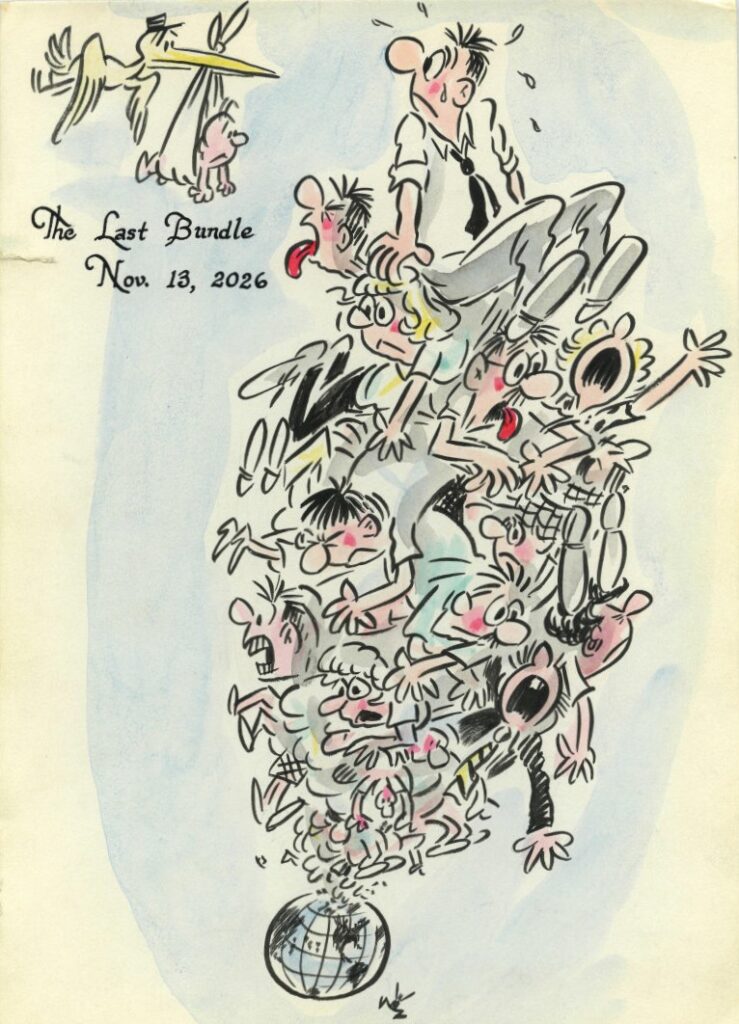
Cartoon by an unidentified grade 10 student from Honolulu, Hawaii, 1961. Courtesy of the University of Illinois Archives, Heinz von Foerster papers 11/6/26, box 62, folder “Doomsday Requests PPc Prints, 1960-61.”
In November 1960, Science, one of the leading scholarly journals in the world, published a paper with the sombre title “Doomsday: Friday, 13 November, A.D. 2026.” On that day, according to the authors – American physicist Heinz von Foerster and two of his students – the global human population will have soared so high that it will “approach infinity.” The sad truth was that “Our great-great-grandchildren will not starve to death. They will be squeezed to death.”[1]
The Doomsday article became something of a sensation. It was talked about in newspapers and magazines around the world, even becoming the subject of a series of Walt Kelly’s Pogo comic strips. Yet the very quality that made the essay most irresistible – its bare-faced absurdity – also made it enigmatic. Was it meant as a dire warning of population rise? A satire of postwar demographic fears? A mathematical parlor trick? That von Foerster never broke character – writing spirited defenses of the original article in response to critical letters to the Science editor – and then never wrote about human demography again made it all the more difficult to discern his underlying intent. While the Doomsday article is von Foerster’s claim to fame in some corners of the internet, it is not even mentioned in much biographical work on him.[2]
One could say that the article was perfectly in keeping with von Foerster’s background and interests. He had trained as a magician in Austria before moving to the U.S., and his sense of stagecraft infuses the essay – and ensured he would not give its game away entirely. More importantly, he was a leader in the new field of cybernetics, the science of how systems self-regulate, and the Doomsday article can be seen as a model of cybernetic thinking.[3] Whereas classical economist Thomas Malthus and his modern followers believed that when a population rose, it would inevitably be kept under check by famine, disease, or war, von Foerster saw the human species as uniquely capable of self-organizing – developing medicines and technologies and, above all, coordinating these – to avoid these threats. But this meant that our species could experience hyperbolic growth, carrying us off a mathematical cliff. Far better, then, that we self-regulate with intention, by working to reduce the global birth rate.[4]
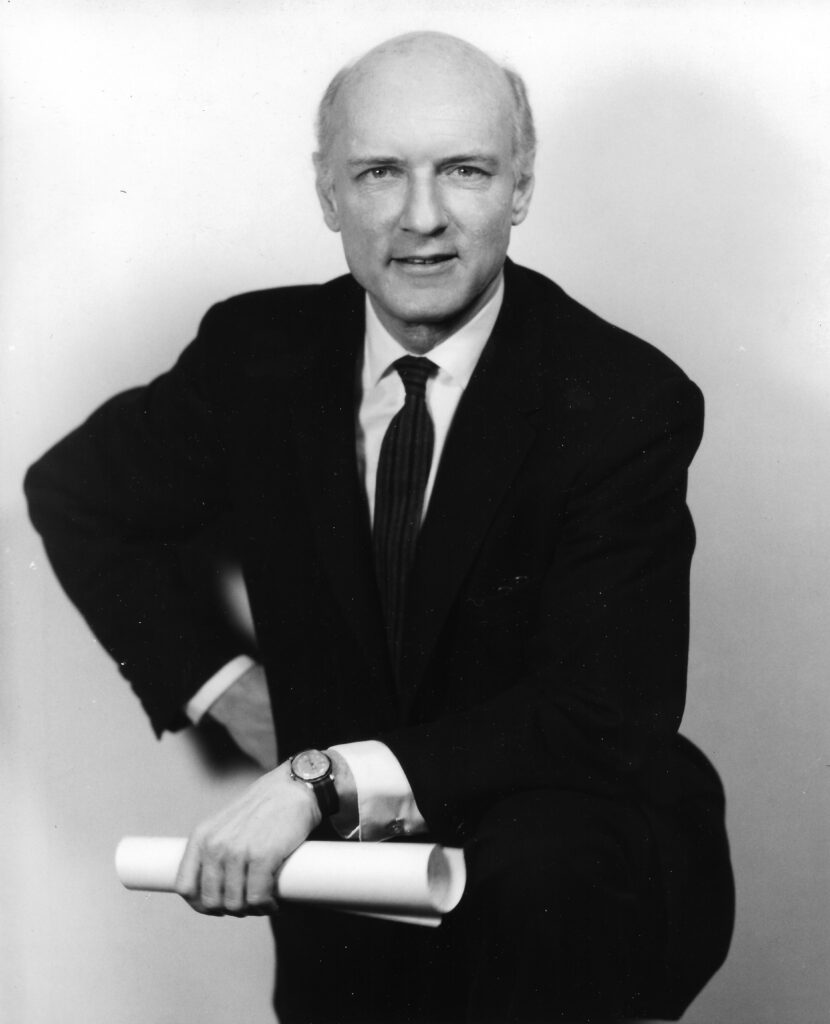
Heinz von Foerster, 1963. Photograph by the University of Illinois publicity department. Courtesy of the Heinz von Foerster personal file.
Yet the Doomsday article is opaque as to what exactly self-regulation should involve for humanity, when it comes to population. For some postwar thinkers, rising human numbers meant the need for reproductive rights and improved birth control for the whole world. For others, whose focus tended to be on the third world and have clear racial undertones, it might mean more draconian measures such as licensing childbirth or eliminating foreign aid. When von Foerster and his co-authors toyed with the idea of a “people-stat” to maintain the global population at a desired level, were they thinking in terms of birth control or coercion? [5]
Fortunately, Heinz von Foerster left archival papers that provide us behind-the-scenes information about the Doomsday piece.[6] They show, for example, that he and his co-authors originally planned to have it that humanity would “choke” to death on 13 November 2026; “be squeezed” is an objectively clearer – and funnier – mental image. His papers also show that the deadpan nature of the Doomsday article meant that von Foerster himself got caught up in the confusion about it. Science sent him a response to the article that it planned to publish and, believing the letter to be critical, he submitted a withering rebuttal. When informed at the eleventh hour that the letter had been in jest, he scrambled to revise his reply prior to publication.[7]
While von Foerster was thrilled with the attention his article had received – confessing to the Science editor that “I have sometimes the feeling that I am the one who is squeezed to death by the flood of responses” – his files retain very few letters from the general public.[8] But one exceptional piece of correspondence has survived: a long, urgent letter in November 1960 from a housewife from Wolfville, Nova Scotia.[9]
The woman had just read about the Doomsday piece in Time and felt compelled to contact him. She wrote,
if we women of this country, and no doubt others, were allowed to regulate our families and have only the children we wished to, our problem of over population would soon be regulated. In my country as in yours we have no real choice, given half safe birth control methods by our Doctors and then caught in unwanted pregnancies we have no choice, we must bring the child into the world.
She then shared agonizing stories with which she was familiar. A woman who spent her previous pregnancy confined to a wheelchair and afterward begged to be sterilized; she was with child and wheelchair-bound once again. A pregnant twelve-year-old who had been raped by two teenagers. And she herself, with two teenage daughters and a part-time job, now carrying a child once again in middle age. She understood the population crisis not in terms of an abstract global aggregate, but as an epidemic of forced motherhood. She asked that von Foerster might in some way “help to change the law to allow we women the dignity and happiness of bearing the children we want, not being forced by cruel & inhuman laws be the degrading class of state breeding cattle.”
Von Foerster wrote back that he was deeply touched by her letter and agreed wholeheartedly with all she said. He noted that he had been raised in a family that held strongly to the defense of the rights of women. (In an interview later in life, he would recall his childhood in Vienna, sitting beneath the desk of his grandmother, who had published the first European journal on women’s liberation, and listening to her and her friends debate philosophy and feminism.[10]) He promised the Nova Scotian woman that he would use whatever influence he had – “in the reach of my own microscopic radius of action” – to champion the cause of women’s bodily autonomy.
I cannot pretend that this brief correspondence rises to the level of a “Rosebud” moment, which allows von Foerster’s intentions for the Doomsday article to be finally and fully known – but it is compelling that he retained their letters to his death forty years later. There is nothing in von Foerster’s published or unpublished writings to indicate that he saw the population problem as one demanding coercive response. His wager instead may have been that if women were given the freedom to manage their own bodies, humanity would steer itself from disaster. If so, with the global birth rate today less than half the 1960 rate – and with no sign of squeezing in sight – he was proven right.
[1] Heinz von Foerster, Patricia M. Mora, and Lawrence W. Amiot, “Doomsday: Friday, 13 November, A.D., 2026” Science vol.132 no. 3436 (4 Nov 1960), 1291-5. doi: 10.1126/science.132.3436.1291. Quotations from 1291 and 1295. It is impossible to gauge Mora and Amiot’s degree of involvement in the original article, but von Foerster’s personal papers make clear that he alone wrote the responses to the letters to the editor of Science, which were credited to the three of them.
[2] See, for example, “Heinz von Foerster,” in Magnus Ramage and Karen Shipp, Systems Thinkers (Springer: 2009), 179-87.
[3] On cybernetics and von Foerster’s role in its development, see Ronald Kline, The Cybernetics Moment: Or Why We Call Our Age the Information Age (Johns Hopkins University Press, 2015); and Heinz von Foerster, The Beginning of Heaven and Earth Has No Name: Seven Days with Second-Order Cybernetics, eds. Albert Müller and Karl H. Müller (Fordham University Press, 2014).
[4] Alan MacEachern, “Scientists Predicted ‘Friday 13 November 2026’ Will Be Doomsday. Should You Be Worried?,” The Conversation, 30 September 2026.
[5] I have benefited in this paragraph from Thomas Robertson, The Malthusian Moment: Global Population Growth and the Birth of American Environmentalism (Rutgers University Press, 2012); and Matthew Connelly, Fatal Misconception: The Struggle to Control World Population (Harvard University Press, 2008). The household thermostat was a favoured example for cyberneticists of a technology that allows for self-regulation around a steady state.
[6] A great thanks to staff at the University of Illinois Archives for their assistance in locating, scanning, and sending me relevant material.
[7] Folder “Doomsday Article Rejects,” box 63, 11/6/26, Heinz von Foerster papers, University of Illinois Archives [henceforth, von Foerster papers]; and von Foerster to Graham Du Shane, Editor, Science, 7 March 1961, folder “Doomsday Letter ED Science, 1960-61,” box 62, von Foerster papers.
[8] Von Foerster to Du Shane, 7 March 1961, von Foerster papers.
[9] I have chosen to anonymize the woman here. While it is true that she wrote von Foerster unasked and gave her full name (her husband’s, actually), she makes private disclosures about her family life that she surely would be surprised might be communicated to the world six decades on. Letter to von Foerster, 16 November 1960, and from von Foerster, 1 December 1960, folder “Doomsday Requests PPc Prints, 1960-61,” box 62, von Foerster papers.
[10] Bruce Clarke, “Interview with Heinz von Foerster,” in Emergence and Embodiment: New Essays on Second-Order Systems Theory, eds. Bruce Clarke and Mark B.N. Hansen (Duke University Press, 2009), 26.
This work is licensed under a Creative Commons Attribution-NoDerivatives 4.0 International License. Blog posts published before October 28, 2018 are licensed with a Creative Commons Attribution-NonCommercial-ShareAlike 2.5 Canada License.