
By Andrew Nurse
This post is part of the Indian Act 150 series.
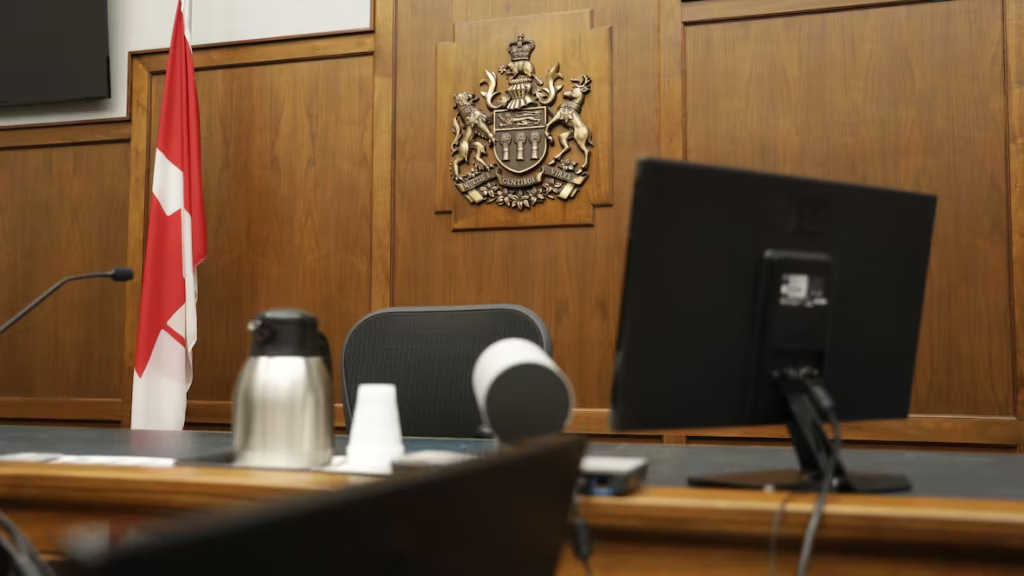
On March 11, 2026, Saskatchewan Court of King’s Bench Justice D.E. Labach issued a summary judgement against Darryl Leroux.1 The issue was whether Leroux, a well-known authority on “self-indigenization,” had defamed Michelle Coupal, a Canada Research Chair at the University of Saskatchewan, because he suggested Coupal used a fake Indigenous identity to advance her career. The Court ruled he had and awarded Coupal $70,000.00 in damages. This case was, as journalist Jorge Barrera wrote, “no random historical exercise.” Its details are important for historians because they illustrate how the very policies that are supposed to move Canada and First Peoples toward reconciliation—in this case, a land settlement—carry with them odd, potentially even bizarre, implications for the practice of history that serve to reinscribe the very colonialism they seek to overcome. History is already a battleground in the reconciliation process. Coupal v. Leroux illustrates how a conflict over family histories is connected to Indigenous identities and land claims.
The facts of Coupal v. Leroux are not in question. Coupal was born to a non-Indigenous family with no connection to any Indigenous community. She was also raised with very specific family lore about a great-grandparent, one of whose parents was supposedly Indigenous. On this basis, Coupal began to self-identify as Métis while teaching at Laurentian University, where she was tenured and promoted before being appointed to a Canada Research Chair focused on Truth and Reconciliation education at the University of Saskatchewan in 2018.
As Judge Labach’s decision explains, over time, Coupal shifted her self-identification from Métis to Algonquin and became a member of the Bonnechere Algonquin First Nation (BAFN), an unrecognized Indigenous community. As Labach explained in his ruling, this was in part because “she was made aware that it was politically incorrect to identify as Metis because of objections by the Red River Metis in Manitoba.” For reasons the transcript does not explain, Coupal “reached out” to the BAFN to apply for membership initially, it seems, based on family lore. After her application, the BAFN informed Coupal that her family traditions were inaccurate. What this meant was that the great-great-grandparent she believed to be Indigenous was not. But she was told she could still claim Indigeneity because another distant relative—mid-nineteenth-century Thomas Lagarde—was. Lagarde qualified as an “Algonquin ancestor” under an enrollment process started to define beneficiaries to the Algonquins of Ontario (AOO) land settlement negotiations. There is a range of criteria that establish an “Algonquin ancestor,” but one is that the claimant must be connected by family to an historic family member who was Algonquin.
It turns out that Lagarde was not Indigenous, but the mistake had real implications. Over 1,000 Algonquin identity claims—that carry with them the right to participate in the AOO land settlement—rested on recognition of Lagarde alone as an Indigenous root ancestor. The controversy was triggered by the criteria of the land settlement process. In 1983, Algonquin communities petitioned the crown for recognition of traditional lands. By 1992, both the federal and provincial governments had agreed to negotiate a land settlement. For their parts, both levels of government wanted to create a lasting agreement. Thus, as part of the agreement, they wanted all potential individual Algonquin claimants vetted and registered so no further future claims could be made. To this end, an umbrella organization—the AOO—was created to qualify Algonquin identity claims based on a series of criteria. The criteria have been subject to debate, but all claims require a “root Algonquin ancestor,” someone in a direct family line who was Algonquin.
In 1999, the AOO originally approved Lagarde as a potential root ancestor, a decision that was immediately controversial. This approval was reversed by “an internal screening committee” in 2000, then reversed again in 2000, before it was challenged again in 2011. In the meantime, there were increased concerns about the claims process and whether its criteria were too loose. The loose process, some believed, transformed people who had no demonstrable Indigenous heritage into Algonquin, at least for the purposes of the Settlement process. In response, in 2013, the AOO hired retired Ontario Superior Court Judge James Chadwick to assess a series of controversial root ancestors on which identity claims were based. He determined that Lagarde was Indigenous based almost entirely on evidence provided by William Mann, a civil servant, Freemason, and conspiracy theorist.
Mann believed that Jesus Christ married Mary Magdalene, with whom he had children, and fled Palestine. In Dan Brown’s novel The Da Vinci Code, Jesus and Mary come to live in France. Mann seems to believe that later descendants of Christ had moved to Montana, where they lived with Native Americans. Mann had long believed he was Indigenous, and Thomas Lagarde was central to his belief. The evidence he provided to Chadwick consisted of a copy of a letter, the provenance of which is unclear, although it bore the stamp of an archive in Quebec. Chadwick assessed the copy. The letter, dated 1845, purports to be from a priest named Brunet. In one sentence, the letter refers to a Thomas Lagarde who was a Mason—like Mann—of Algonquin descent and who had been sentenced to death for some unknown crime. In the letter, the priest claimed to have met Lagarde at a small mission near Ottawa. Chadwick found this evidence convincing.
For a range of reasons, others did not. First, no one has been able to find the original document. It is not in the archive whose stamp it bears, nor has it been found in any other archive to date, even after extensive searches. There are also problems with the handwriting, the letter’s terminology, and the events it describes. Lagarde, for instance, had previously been sent to jail for debt, but he was never under a death sentence. What is more, other than this letter, there is no empirical evidence that Lagarde was Algonquin.2 He and his family have now been subject to extensive genealogical research as part of the AOO land settlement process. Research into the Lagarde family, including Thomas’ ancestors and his descendants, has turned up no evidence of Indigeneity. Research into family history, baptismal records, Algonquin petitions, census records, Indigenous communities, marriage, and fur trade records turns up no evidence that Lagarde was Indigenous nor connected to an Indigenous community.
Joan Holmes, AOO Enrolment Officer, put together this information, and on its basis, Lagarde was again removed from the list of potential root ancestors by another body—the Algonquin Tribunal—set up to re-assess several controversial cases in 2023.
There is much to be concerned about in the Coupal v. Leroux case. It may set something of a precedent. It is not the only suit seeking damages after allegations of Indigenous identity fraud. Some Indigenous scholars are concerned that the judgement opened a loophole. Importantly, Coupal did not argue that she is Indigenous, but that she honestly believed she was, first on the basis of family lore and then on the basis of the AOO enrolment process, which used Lagarde as a root ancestor. Labach found that this was an honest belief and, hence, not an act of deception. The concern is that it provides a back door into false Indigenous identity claims because it creates a ready-made excuse—in effect, “I honestly believed what I said was true.”
I will leave it to people who are better informed than I am to address the legal issues in this case. To me, it also has significant historical implications. In the first instance, the history of Lagarde’s shifting identity and its effects is a product of the AOO land settlement process on which the state insisted. What appears like a dramatic growth in pretendianism is another aspect of this, but it was the state’s desire for a once-and-forever settlement—as opposed to, say, an ongoing collaborative relationship—that led to the formation of the AOO and the enrolment process in the first place.
It also highlights a process that re-legalizes Indigenous identity and makes the courts and tribunals the arbiters of history. The issue might be both who makes the decisions about the past and how. The original decision to approve Lagarde as an Algonquin ancestor was based on at best shaky historical methodology. Even if we omit the remarkably important question of exactly who should be making decisions about identity, the original decision to accept a document of unknown provenance, which had not been assessed for internal consistency, as authoritative virtually guarantees interpretive mistakes.
The history gets even odder. The only other evidence that Lagarde was Algonquin comes from troubling family traditions that cannot be verified. One claim to Indigeneity for Lagarde, for instance, was made based on the fact that a descendant trapped, hunted, and lived off the land. This kind of claim bears an odd similarity to claims for Indigenous heritage made on behalf of Mary Ellen Turpel-Lafond, connected to her father’s supposed “wild” behaviour and “drinking problems.” In these instances, family histories are being reduced to disturbing stereotypes.
Thomas Lagarde’s history gets even more bizarre. For Mann, the fact that Lagarde was supposedly a Mason seems of particular importance. It created some wider connection to history-as-conspiracy in which the descendants of Jesus Christ found their way to Montana to live with Native Americans.
Leroux will appeal this decision, but it raises one further question. What does it mean to be mistaken about the past? This happens all the time. I’ve made mistakes in my own work, and part of the duty of historians is to revisit the past to produce more accurate versions of it. I think that happens. I wonder, however, if all mistakes are the same. Kim TallBear once said that Indigenous identity fraud—making a false claim to be Indigenous—was a “final act” of colonialism. It both robbed Indigenous peoples of their identity and their ability to control it. I do believe Coupal, although I have other questions I’d ask if given the chance. In Coupal v. Leroux, Judge Labach correctly noted that she did not forge any documents. What happened might be even more concerning. She became part of an historical process that seems set up to misinterpret the past.
Andrew Nurse is a Professor of Canadian Studies at Mount Allison University.
This series was produced within the project Historicizing Our Times: Histories of Migration and Climate in the Digital Space, which is supported in part by funding from the Social Sciences and Humanities Research Council.
Note: The title quotation is drawn from Jorge Barrera, “Why a decades-old dispute over Algonquin ancestry is the key to a city hall controversy,” CBC News (February 18, 2021) <https://www.cbc.ca/news/canada/ottawa/algonquins-of-ontario-identity-membership-1.5910334>. Accessed March 24, 2026.
[1] A summary judgement is a particular kind of judgement. It occurs when the court determines that it has the information it needs to make an impartial decision without the need of trial. This can occur for more than one cause, but one reason is that the protagonists of the process seek it. That was the situation in this case. Both Coupal and Leroux asked that the process be expedited by summary judgement based on evidence and affidavits they submitted.
[2] There is some family lore. One later descendant believes Lagarde was Indigenous based on supposedly hearing their mother speak Algonquin.
This work is licensed under a Creative Commons Attribution-NoDerivatives 4.0 International License. Blog posts published before October 28, 2018 are licensed with a Creative Commons Attribution-NonCommercial-ShareAlike 2.5 Canada License.