Amy Swiffen, Keith Cherry, Hannah Wyile and Kris Millett This post is part of the Indian Act 150 series There is a harmful provision of the Indian Act that, until recently, has never been the object of sustained scholarly scrutiny: Section 141. In force from 1927 to 1951, this provision made it an offence for Indigenous peoples to raise funds or retain… Read more »
Daniel Sims This post is part of the Indian Act 150 series In May 2024, I attended a meeting of Parks Canada’s Indigenous Cultural Heritage Advisory Council in Sydney, British Columbia. One of our agenda items was the federal government’s commemoration of upcoming historical events, including the passage of the Indian Act in 1876. The hope was that we would tell the… Read more »
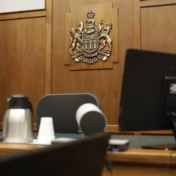
By Andrew Nurse This post is part of the Indian Act 150 series. On March 11, 2026, Saskatchewan Court of King’s Bench Justice D.E. Labach issued a summary judgement against Darryl Leroux.1 The issue was whether Leroux, a well-known authority on “self-indigenization,” had defamed Michelle Coupal, a Canada Research Chair at the University of Regina, because he suggested Coupal used a fake… Read more »
By Jenni Makahnouk This post is part of the Indian Act 150 series The Indian Act is commonly treated as a governance structure: an object to be interpreted, amended, or dismantled through policy reform. This framing assumes neutrality where there is appetite. This article argues that the Indian Act functions less as a static legal instrument and more as a… Read more »
Daniel R. Meister In the first part of an article I published with Active History in February 2024, I contested the authenticity of a quote frequently attributed to Pierre Elliott Trudeau. The quote in question: “We’ll keep them in the ghetto as long as they want” with regard to First Nations in Canada. However, while in search of a different quote recently,… Read more »
By Bob Joseph This post is part of the Indian Act 150 series. This year, 2026, marks 150 years of the Consolidated Indian Act of 1876. This serves as a timely opportunity to discuss the dismantling of this destructive and restrictive piece of legislation. The Indian Act has constrained and controlled the lives of Status Indians for generations, and reconciliation… Read more »
By Katie Carson, Sarah Kittilsen, and Sean Carleton Canada 150—the sesquicentennial celebration of the country’s confederation—was marked with pomp and circumstance, as the Federal Government encouraged Canadians across the country to commemorate what it called “one of Canada’s proudest moments.” April 12, 2026 will mark another sesquicentennial: 150 years since the Canadian government passed the Indian Act, the cornerstone of the legislative apparatus that continues to govern… Read more »
Donald Wright When I learned that Jim Miller had died, I reached out to his partner, Lesley Biggs, to express my condolences. A few weeks later, she invited me to share a few words about him that would be read at his celebration of life. “It would be my honour,” I replied. And I meant it. Jim was something of… Read more »
This summer, the Government of Canada helped to promote visits to museums through the Canada Strong pass. While initially focused on seven of the country’s nine national museums, other provinces and territories also opted to offer reduced and free admission. Ultimately, 87 museums across the country were part of the initiative, and early data indicates that it helped to boost attendanc. While the removal of admission fees increases accessibility, and – in turn – public enjoyment and appreciation of museums, the reality is that museums across the country are suffering from a lack of resources. To be effective stewards of the cultural heritage that they care for, museums need adequate financial support.
Ten years ago, the Truth and Reconciliation Commission (TRC) issued its final report on the history of residential schools in Canada. Mandated to “inform all Canadians about what happened in residential schools”, the “TRC documented the truth of Survivors, their families, communities and anyone personally affected by the residential school experience.” It found that residential schools were part of a… Read more »