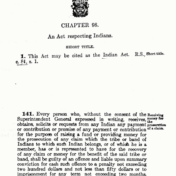
Amy Swiffen, Keith Cherry, Hannah Wyile and Kris Millett This post is part of the Indian Act 150 series There is a harmful provision of the Indian Act that, until recently, has never been the object of sustained scholarly scrutiny: Section 141. In force from 1927 to 1951, this provision made it an offence for Indigenous peoples to raise funds or retain… Read more »
Daniel Sims This post is part of the Indian Act 150 series In May 2024, I attended a meeting of Parks Canada’s Indigenous Cultural Heritage Advisory Council in Sydney, British Columbia. One of our agenda items was the federal government’s commemoration of upcoming historical events, including the passage of the Indian Act in 1876. The hope was that we would tell the… Read more »
By Jenni Makahnouk This post is part of the Indian Act 150 series The Indian Act is commonly treated as a governance structure: an object to be interpreted, amended, or dismantled through policy reform. This framing assumes neutrality where there is appetite. This article argues that the Indian Act functions less as a static legal instrument and more as a… Read more »
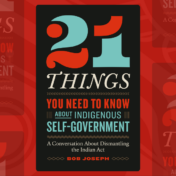
By Bob Joseph This post is part of the Indian Act 150 series. This year, 2026, marks 150 years of the Consolidated Indian Act of 1876. This serves as a timely opportunity to discuss the dismantling of this destructive and restrictive piece of legislation. The Indian Act has constrained and controlled the lives of Status Indians for generations, and reconciliation… Read more »
By Katie Carson, Sarah Kittilsen, and Sean Carleton Canada 150—the sesquicentennial celebration of the country’s confederation—was marked with pomp and circumstance, as the Federal Government encouraged Canadians across the country to commemorate what it called “one of Canada’s proudest moments.” April 12, 2026 will mark another sesquicentennial: 150 years since the Canadian government passed the Indian Act, the cornerstone of the legislative apparatus that continues to govern… Read more »
https://activehistory.ca/wp-content/uploads/2021/09/History-Slam-192.mp3Podcast: Play in new window | DownloadBy Sean Graham In 1994, Lynn Gehl applied for registration as an ‘Indian’ with the federal government. Unable to provide evidence as to the identity of her paternal grandfather, meant that, under the terms of the Indian Act, she was not entitled to registration, despite her paternal grandmother having status. What followed was a… Read more »
Sean Carleton Despite growing up near St. Paul’s Indian Residential School in North Vancouver, I did not learn about residential schools as a child. I did not learn about Chanie Wenjack (misnamed “Charlie” by his teachers), a 12-year-old Anishinaabe boy who ran away from the Cecilia Jeffery Indian Residential School in Kenora, Ontario in October 1966. It was not until… Read more »
This is the twelfth post in a two week series in partnership with Canada Watch on the Confederation Debates By Gabrielle Slowey In 2015 Justice Murray Sinclair, chair of the Truth and Reconciliation Commission, declared: “Reconciliation is about forging and maintaining respectful relationships.”[1] Why did he point this out? The reality remains that Canada and Canadians are not respectful of our relations with Indigenous… Read more »
By Daniel Sims As a recent hire at the University of Alberta’s Augustana Campus, the student newspaper, The Dagligtale, interviewed me. Upon reading the printed story – and much to my surprise – I found that my home community of Tsay Keh Dene had become Tsay Keh Dane, but that it was also a reserve. The first error, I attributed to… Read more »
By Andrew Watson and Thomas Peace After reading comment after uninformed comment, both online and in the media, ActiveHistory.ca decided to compile a short list of books written by historians that address the issues being discussed by the Idle No More movement. Click on a link below to read a brief summary of the book. Peggy Blair, Lament for a… Read more »