Walter T. Cassidy
The Windsor Star reported an incident on May 28th, 1954—as did papers all over North America—about a Port Colborne, Ontario woman being arrested in Buffalo, New York, for trying to enter the United States “illegally” after being in an accident in the neighbouring American town. It was her second time trying to cross the border, the first time was in Windsor, in 1950, where she was simply turned away. What makes this experience unique was because of what she said to the arresting officers. She declared herself the “Canadian Christine Jorgenson.”[i]
Marie Jeffersons’s story is vastly different than Jorgensen’s. One significant distinction was that Jorgensen was not Intersex. It was reported that Marie was “born with both male and female characteristics” and that her mother had twelve doctors called in to decide on her sex and advised her mother to bring Marie up as a boy.[ii]
Trans and intersex communities should not be seen as the same but instead as communities whose experiences, at times, intersect. Most people with Intersex conditions do not identify as Trans and, as stated in The Intersex Society of North America website, “only a small portion of intersex people experience” issues with their gender identity. Marie’s story is not the typical narrative of the Intersex experience. Her story is one of those rare examples at a time when being Intersex was not seen as its own identity. If the doctors would have decided that she was female, she may not have ever been written about at all.
What makes Marie’s story so valuable is that she participated in shaping her own narrative and worked to spare others from the hardships she endured. Unfortunately, she failed to make quite the effect she wanted to, and her story was lost to history.
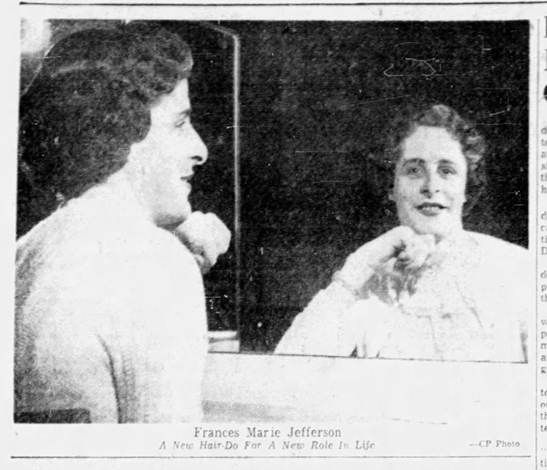
Ottawa Citizen. March 22, 1954, page 4.
From March 19th to the 23rd, 1954, there were multiple daily articles in the Toronto Evening Telegram about her, written by various authors including herself. The first article was mostly based on an interview that Ron Kenyon did with Dr. Stewart Wilson, an urologist from Welland, Ontario and Marie’s last of many doctors. Marie is not named in the article, and it even stated that Wilson would “not release her name until he had gained permission to do so.”[iii] I can only assume the doctor or someone else at the Clinic leaked her story to the press even though Wilson assured the media that the hospital kept the operation under “utmost secrecy.”[iv]
After being hounded by the press, Marie came forward and told her side of the story. She gave details on how alone she felt and how she felt “confused, bewildered, with little help available.”[v] She also stated that the “conventional solutions for conventional people” were no help to her. Marie stated that sex “is much more than just your reproductive organs. It’s a matter of mind, too […] I don’t think I exactly wanted to be a woman; I think it was more that I was meant to be a woman, and I couldn’t really be anything else, no matter how hard I tried.”[vi]
Marie was born on July 30th, 1929, in Bridgetown, Nova Scotia. She explained that her childhood was difficult, and she was very depressed when she was young. Two of her brothers, Donald and William, were also interviewed for the Telegram and described Marie’s school years as cruel. “Every visit to a washroom was an embarrassment to him, and every visit to a public locker room an agony of mortification.”[vii]
During puberty, Marie noticed that her voice did not change, she was not developing facial hair and was beginning to develop breasts. Her mother suggested she go see a doctor. The doctor recommend that she stay a “boy” and she ended up having top surgery. She regretted that decision later in life and so did her future Windsor doctor.
When the Telegram story broke out, the paper interviewed various people, including Marie’s family, neighbours, and people who lived in the same apartment as her parents. Mrs. Freeman Cadwell, who lived above the Jeffersons, stated that she was “positive Marie had been born with all-female characteristics. She could cook and sew with the best of us.”[viii] The conversations were, predictably for the era, steeped in the gender norms of the time. It was reported that since the age of six, she knew she was “different” in many ways. As a child, she liked to stay by herself and not play with the other boys and instead helped her mom clean the house, wash dishes, and bake. She seemed to have strong parental support. Her mother said that “if becoming a woman is going to make Marie happy that’s all I care about.”[ix]
The surprise of the Port Colborne community, who knew her before the story, was not that she was a woman but that she had gender-affirming surgery. Marie reported that she went through eleven operations. She eventually gave permission to the doctors to disclose the information about her operations to the press. Wilson “said the one he did was comparatively minor and involved plastic surgery to remove scars. The other operations were performed in Halifax, Saint John N.B., Toronto, Windsor, and Hamilton.”[x] There were no articles about the Saint John and Hamilton surgeries, but there were details about the Windsor operation. It happened in October 1953. She had five doctors come to her bedside to make it truly clear that, if she decided to go through with the operation, that there would be no way she could become male again. That she would be a woman until she died. She responded, “That was what I wanted.” The operation was done by Dr. Walter L. Percival at Hotel Dieu Hospital. He created a “birth canal” for her by taking skin from her stomach. It was a two-hour operation. Jefferson was in the hospital for over a month recovering. When she was well enough for the first time, she walked along Ouellette Avenue in women’s clothes. She thought everyone was looking at her “but I felt I was doing the right thing.”[xi] After the operation, she was put on hormones. She reflected on her journey, saying, “I think the operation I had done in Windsor, that finally made me a woman.”[xii] When she got out of the hospital, her parents went to see her, and they walked right past her because they didn’t recognize her. Marie’s story was covered all over North America.
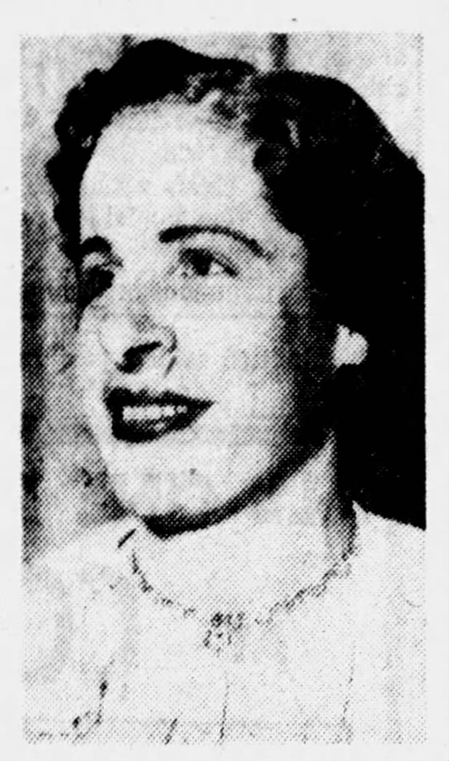
Quad-City Times. Davenport, Iowa. March 21, 1954, page 3
Two months after her declaration, articles started to appear again, this time focusing on her getting into a car accident. Many of the articles were misogynistic with captions like “Those Women Drivers.” It was reported in the Buffalo News on May 24th, 1954, that she was charged with driving while intoxicated and leaving the scene of an accident. Marie was given a two-year suspended sentence after pleading guilty.[xiii]
Her story soon went cold, until August 18th, 1954, the Hamilton Spectator reported that she was attacked and robbed by two American tourists in a hotel room. She ended up going to the hospital for cuts and bruises. The article also gave information that she was currently employed as a “domestic.”[xiv] Marie’s father’s obituary had her living in Windsor in 1959.[xv] In her mother’s obituary in 1960, she is not listed.[xvi] After this, I have not found any more information about her. With that her story and her claim to fame was forgotten.
Marie’s extraordinary story happened over seventies years ago and I think we can still find many parallels to what various Queer, Trans and Intersex communities are battling right now. The simple idea of just wanting to live one’s authentic self, out in public, instead in the shadows of societies judgements is still a struggle many experience today. The statement that Marie made in her final published article was that she knew all to well “how to deal with a shameful secret.” Her advice was “if you’re afraid people are whispering about you in the street, don’t hide your secret deeper and skulk away. Drown the whisper with noise. Shout your secret from the housetops, so even the deafest can hear.”[xvii]
Walter Cassidy has been an educator in Windsor for the past 26 years. He just finished a two-year educational residence with the Canadian Museum for Human Rights. He is a local Windsor Queer historian, and activist. He has curated two exhibits in Windsor area; one at the Chimczuk Museum and one at the Amherstburg Freedom Museum. He also contributed to the Love in a Dangerous Time Exhibit, currently at the CMHR, which is the largest queer exhibit in Canadian history.
[i] Christine Jorgensen (1926–1989) was a famous American transgender woman who, two years earlier, was outed after she had gender-affirming surgery in Denmark. Jorgensen’s very publicized transition started conversations in North America about gender identity and helped shape more inclusive ideas about the subject. She even had a successful career as an actress, singer, and recording artist.
[ii] Daily Standard-Freeholder. Tue, Mar 23, 1954, p.9.
[iii] The Hamilton Spectator. Fri, Mar 19, 1954, p. 8.
[iv] The Ottawa Journal. Mar 20, 1954, p.36
[v] The Evening Telegram. Mar 20, 1954, p.3.
[vi] The Evening Telegram. March 23, 1954, p.3.
[vii] Ibid.
[viii] The Evening Telegram. Mar 22, 1954, p.3.
[ix] Ibid.
[x] The Calgary Albertan. Mon, Mar 22, 1954, p.2.
[xi] The Evening Telegram. Mar 22, 1954, p.3.
[xii] Ibid.
[xiii] The Buffalo News. Fri, May 28, 1954, p.6.
[xiv] The Hamilton Spectator. Wed, Aug 18, 1954, p.18.
[xv] The Toronto Star. Tue, Aug 25, 1959, p.32.
[xvi] The Toronto Star. Mon, Sep 19, 1960, p.37.
[xvii] The Evening Telegram. Mar 23, 1954, p.3.
This work is licensed under a Creative Commons Attribution-NoDerivatives 4.0 International License. Blog posts published before October 28, 2018 are licensed with a Creative Commons Attribution-NonCommercial-ShareAlike 2.5 Canada License.