
Peter L. Twohig
On 16 April 2026, five thousand long-term care (LTC) workers in 56 facilities throughout Nova Scotia began a strike. A tentative agreement ended the labour action after eight weeks, another example of a lengthy labour dispute in a nursing home. Indeed, some of the longest strikes in recent Canadian history have been in LTC.[i]

Striking long-term care workers in Halifax, Nova Scotia, June 2026. Author photo
I have previously argued that focusing on nursing home workers opened up new analytical paths and that these offered an opportunity to contribute to the revitalization of Canadian working class history. My interest in this question was inspired by another Active History post.[ii] Specifically, I saw the opportunity to focus on groups that are, largely, without a history of their own. This would include continuing care assistants (CCAs), the largest group of caregivers in LTC. Striking CCAs in Nova Scotia earned $18.77 per hour when the dispute began, barely above the provincial minimum wage.[iii]
As Pat Armstrong, a leading scholar of LTC, has repeatedly highlighted, “the conditions of work are the conditions of care.”[iv] The labour dispute in Nova Scotia was, then, not only about wages but also the demanding nature of caring work. During the strike, the Canadian Union of Public Employees (CUPE) collected two thousand submissions on its website Stories of Care that document the challenges that health care workers face every day.[v]
One worker noted that “CCAs are over worked and tired.” Another highlighted that the work was “physically and mentally exhausting” and that it could also be “dangerous.” Many of the accounts link the poor pay in LTC to the issue of staff retention. This, in turn, leads to high rates of turnover and ‘working short’, which is a euphemism for being understaffed. One noted that the “wage gap matters” and that workers will protest with their feet, looking for better opportunities elsewhere. She added that the poor pays “affects staff retention and the consistency of support for vulnerable individuals.” Another CCA said “I know how difficult this job can be, what its like to be mandated to work double shifts, to work short handed, to have a work load that beyond a single person’s capability.”
These stories also open a window onto what Eric Tucker recently described as the ‘third wave’ of occupational health and safety (OHS).[vi] According to Tucker, this wave was characterized by “stubbornly high injury rates, growing awareness of occupational disease … and by the emergence of militant worker health and safety movements.” Tucker helpfully focuses attention on how ideas about occupational health expanded in the late 20th century to encompass a greater range of issues and more workers, including health care workers.
Despite a brief flurry of interest in the early days of the COVID-19 epidemic, there is not much written about the history of occupational health and safety in health care. Labour and working-class historians have, of course, been attentive to the many risks associated with factory work and the hard labour of mining, forestry, and fishing.[vii] Other historians have examined a select group of occupational diseases, including silicosis, black lung, brown lung, and radiation poisoning.[viii] Some have explored the history of protective legislation for women and children and the history of worker compensation laws.[ix] Beyond the confines of industrial workers, however, there are few histories of OHS.
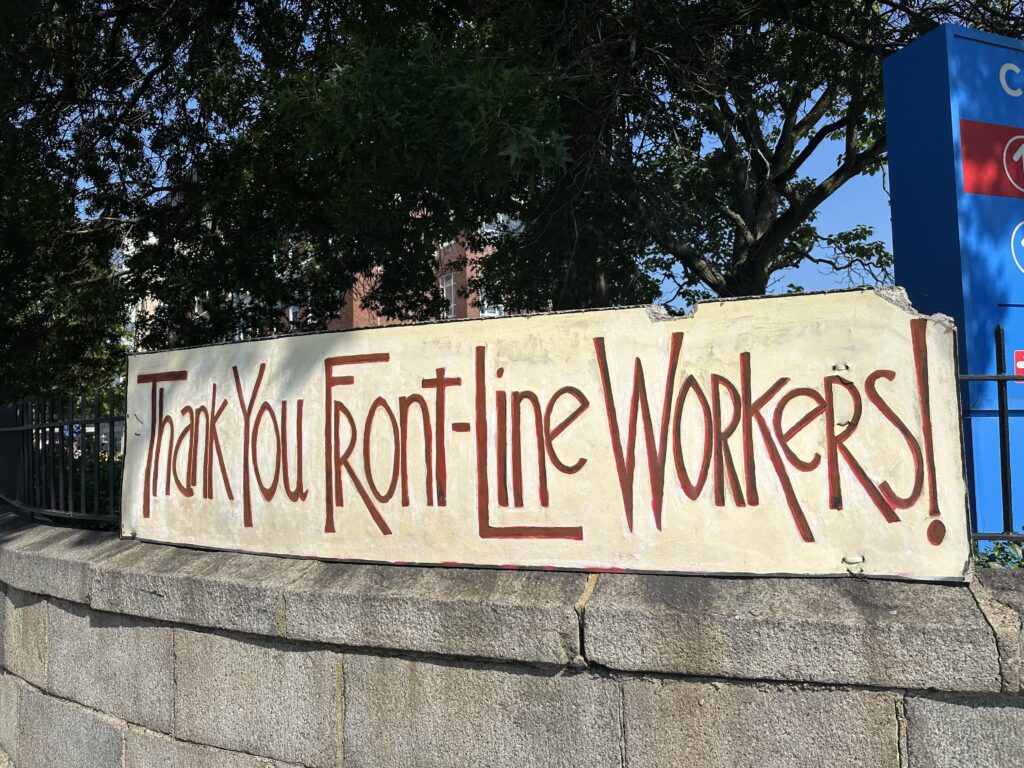
Thank you workers. A sign that has seen better days but one that was still hanging on a fence outside a Cambridge, Massachusetts, hospital in the summer of 2025. Author photo.
Evidence also suggests that health care was hardly at the leading edge of occupational health and safety in the late 1970s. According to a National Institute for Occupational Safety and Health study completed in 1976, only 8% of surveyed hospitals in the United States met the minimal criteria for an effective health and safety program. Almost one third of them did not have a formal occupational health program.[x]
In these years, health care workers grappled with several occupational health issues, including exposure to infectious materials, toxicological hazards, radiation exposure, and other unique problems.[xi] In the summer of 1978, CUPE completed a survey of hospital hazards. It was the first such study in Canada and it documented the range of threats to worker health.[xii]
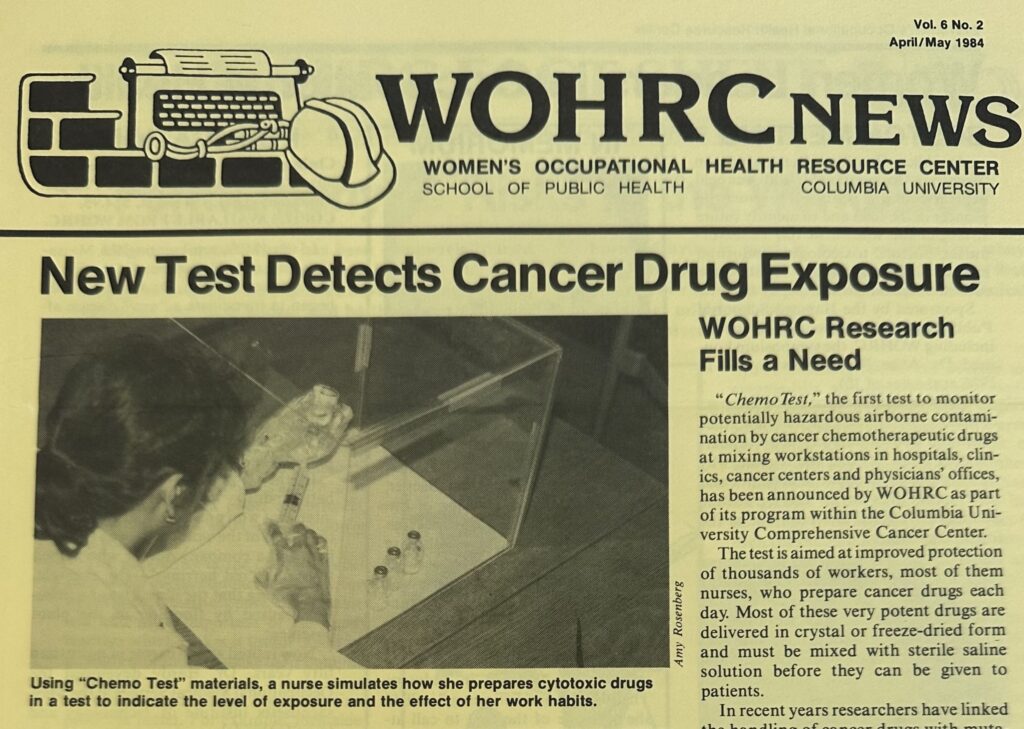
Newsletters like WOHRC News shared information and promoted awareness of the occupational health hazards faced by women workers. WORHC News, 6, 2 (April/May 1984). Schlesinger Library, Radcliffe Institute, Harvard University. Used with the permission of Dr. Jeanne Stellman.
The risk of exposure to pathogens like hepatitis B and HIV captured the attention of workers, and their unions, in the late 1970s and early 1980s. One article found that 7% of health care workers reported a history of hepatitis, more than twice the rate experienced by the general public, because of exposure on the job.[xiii] The risk of transmission through needlesticks or dealing with soiled laundry prompted the rise of universal precautions, such as wearing gloves when handling blood. In 1983, the CDC released a “Guideline for Infection Control in Hospital Personnel.”[xiv] This was the first time the CDC addressed this issue, an illustration of the slow progress of safety culture in hospitals.
In an article published in Occupational Health Nursing in 1982, Jeanne Stellman, a distinguished researcher and the director of the Women’s Occupational Health Research Center at Columbia University, highlighted the hazards of hospital work. Stellman was an important ally to both union and women’s groups, and an important advocate for improved worker safety. In the article she noted that hospital workers were injured at twice the rate of workers in other service industries. However, it was likely that the numbers were underreported, since employees did not always report their issues. Stellman noted that “Employees … are often too busy or untrained or have become so accustomed to these accidents that they neither report accidents nor seek treatment for them in employee health services.”[xv]
Workers, too, had to change the way they did tasks. Among the problems identified were “insufficient and sloppy garbage disposal facilities” and “improper pipetting practices” which exposed workers to unnecessary risks. An American survey found that 82% used their mouths when pipetting liquids “at least occasionally” and half of the respondents had at taken liquid into their mouth at least once. Workers who routinely used their mouths when dealing with samples was a common practice, and they had three times the risk of workers who had not ingested liquids. This issue could have been solved by using automatic pipettes but they “were not routinely provided or used in most hospital laboratories.”[xvi] Employers proved all too willing to sacrifice worker health and safety if there is a cost involved but workers, too, needed to be attentive to their own work culture and ensure that they were acting as good fellow servants.

An example of safe pipetting.WOHRC News, 4,4 (September 1982), 2. Schlesinger Library, Radcliffe Institute, Harvard University. Used with the permission of Dr. Stellman.
The history of occupational health in health care presents a rich opportunity to explore the expansion of occupational health and safety in the late 20th century to encompass more workers and a greater range of issues. Importantly, the efforts of workers and their unions also helped to improve health and safety for other workers too, including office workers and those in the service sector. Cumulatively, examining such workers, who are the largest part of the labour force, will result in new perspectives on the history of of occupational health and safety.
Peter L. Twohig writes and reads history in Halifax, Nova Scotia. His current research is on the history of occupational health since 1950, supported in part by a grant from the Social Sciences and Humanities Research Council. His latest book, The Labour of Care, will be published in July 2026 by University of Toronto Press.
[i] For example, a strike at Parkland nursing home in Edmonton lasted for four years at the end of the 1970s. A strike at Keddy’s Nursing Home in Halifax lasted for 16 months over 1983 and 1984. In between these, there were long strikes in nursing homes across Canada. I explore several of these strikes in my forthcoming book The Labour of Care (Toronto: University of Toronto Press, 2026). I have written previously about the strike at Keddy’s in Twohig, “COVID-19 and the Labour of Care,” Acadiensis 50, 2 (Autumn 2021): 96-114.
[ii] Christo Aivalis, Greg Kealey, Jeremy Milloy, and Julia Smith, “Back to Work: Revitalizing Labour and Working-Class History in Canada,” 21 September 2015. https://activehistory.ca/blog/2015/09/21/back-to-work-revitalizing-labour-and-working-class-history-in-canada/
[iii] I explore several of these groups in The Labour of Care.
[iv] See an interview with Armstrong, at https://www.healthcoalition.ca/the-conditions-of-work-are-the-conditions-of-care-says-pat-armstrong/
[v] CUPE NS, https://storiesofcare.ca/
[vi] Eric Tucker, “Regulating Health and Safety and Capitalist Workplaces: History, Practices and Prospects,” 2023. https://digitalcommons.osgoode.yorku.ca/all_papers/364/
[vii] There are too many fine studies to list but for an excellent recent analysis, see David Rosner and Gerald Markowitz, Building the Worlds That Kill Us: Disease, Death, and Inequality in American History (New York: Columbia University Press, 2024).
[viii] For an early historical account, see George Rosen, “On the historical investigation of occupational diseases: An Aperçu,” Bulletin of the Institute of the History of Medicine, 5, 10 (1937), 941-46. See also David Rosner and Gerald Markowitz, eds., Dying for Work: Workers Safety and Health in Twentieth Century America (Bloomington: University of Indiana Press, 1987); Alan Derickson, Black Lung: Anatomy of a Public Health Disaster (Ithaca: Cornell University Press, 2014); and Robert Emil Botsch, Organizing the Breathless: Cotton Dust, Southern Politics, and the Brown Lung Association (Lexington: University Press of Kentucky, 2014); Christopher C. Sellers, Hazards of the Job: From Industrial Disease to Environmental Health Science (Chapel Hill: University of North Carolina Press, 1997).
[ix] See David von Drehle, Triangle: The Fire that Changed America (New York: Penguin, 2011) and Kate Moore, The Radium Girls: The Dark Story of America’s Shining Women (London: Simon & Schuster, 2016). Greenlees argues that at the turn of the 20th century, cotton factories in Britain and the United States, which employed large numbers of women, were “the first factory environments where questions about health at work and the forces that determined them came to the fore.” Janet Greenlees, When the Air Became Important: A Social History of the New England and Lancashire Textile Industries (New Brunswick: Rutgers University Press, 2019), 2. On compensation, essential studies would include Eric Tucker, Administering Danger in the Workplace: The Law and Politics of Occupational Health and Safety Regulation in Ontario, 1850-1914 (Toronto: UTP Press, 1990); Julia Moses, The First Modern Risk: Workplace Accidents and the Origins of European Social States (Cambridge: Cambridge University Press, 2018); Robert H. Babcock, “Blood on the Factory Floor: The Workers’ Compensation Movement in Canada and the United States,” in Raymond B. Blake and Jeffery A. Keshen, eds., Social Fabric or Patchwork Quilt: The Development of Social Policy in Canada (Peterborough: Broadview Press, 2006; Michael J. Piva, “The Workmen’s Compensation Movement in Ontario,” Ontario History, 67 (1975), 39-56.
[x] Hospital Occupational Health Services Study. U.S. Department of Health Education and Welfare, Public Health Service, NIOSH, Division of Technical Services, Vol. 1-7. Cincinnati, Ohio, 1976 and Robert Lewy, “Prevention Strategies in Hospital Occupational Medicine,” Journal of Occupational Medicine, 23, 2 (February 1981), 109.
[xi] Robert Lewy, “Prevention Strategies in Hospital Occupational Medicine,” Journal of Occupational Medicine, 23, 2 (February 1981), 109.
[xii] “The Hazards of Hospital Work,” Health Alert, 3, 1 (October 1978), 1.
[xiii] “Health and Safety in the Clinical Laboratory,” Women’s Occupational Health Research Center News, 1,1 (Jan/Feb 1979), 2-3.
[xiv] “CDC’s new personnel health guideline praised,” Hospital Employee Health, 2, 9 (September 1983), 113
[xv] Jeanne Stellman, “Safety in the Health Care Industry,” Occupational Health Nursing, October 1982, 7. On Stellman, see Amanda Lauren Walter and Elizabeth Faue, “In the Shadow of Tragedy: Jeanne M. Stellman and the Work of the Women’s Occupational Health Resource Center,” Journal of Women’s History, 34, 1 (Spring 2022): 93-114.
[xvi] “Health and Safety in the Clinical Laboratory,” Women’s Occupational Health Research Center News, 1, 1 (Jan/Feb 1979), 2-3.
This work is licensed under a Creative Commons Attribution-NoDerivatives 4.0 International License. Blog posts published before October 28, 2018 are licensed with a Creative Commons Attribution-NonCommercial-ShareAlike 2.5 Canada License.