
Michael Dawson
Today’s visitors to Venice are hard-pressed to ignore the locals’ frustration with their presence. In 2025, CNN lamented the impact of overtourism on this popular destination “hollowed out by vacation rentals.”[1] In 2024, the BBC noted that the city had introduced a daily entry fee, a ban on loudspeakers, and a limit on tour group size – all in an effort to counteract tourism’s negative impact on the local community.[2] When I visited the city that same year, the Ponte di Rialto, the Canal Grande, and Piazza San Marco competed for my attention alongside train-station graffiti urging “Tourists” to “Go Home” and strategically placed stickers featuring smiling cartoon excrement proclaiming that “Tourists Are Killing Venice.” Over the past decade, Venice has been at the forefront of a backlash against overtourism in Europe.[3] But the roots of Venice’s love-hate relationship with tourists go back at least as far as the middle of the twentieth century.
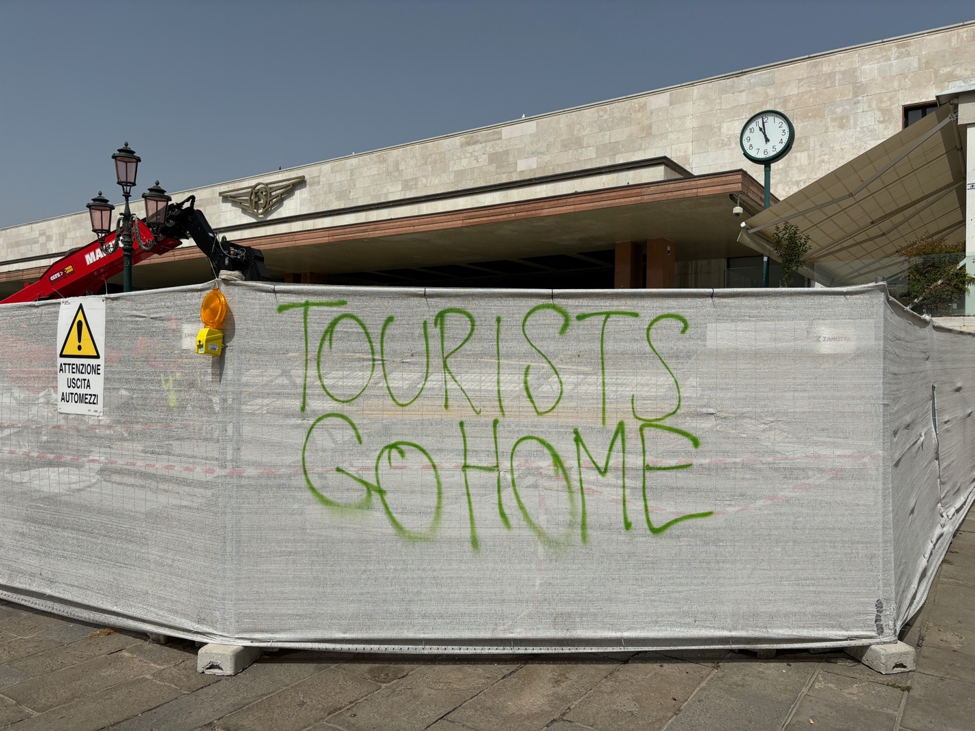
Anti-tourist graffiti outside Venice’s Santa Lucia train station. June 2024. Author’s photo
In the 1940s, Italian officials viewed Venice’s tourism allure as a key component of their postwar economic reconstruction plans. But in 1949, a visiting Australian correspondent struggled to grasp how this might be the case as he came face to face with the city’s poverty. “[M]ost of the Venetians,” Douglas Wilkie observed, “live in hovels.” Venice resembled other Italian cities, he noted, “where antique beauty, irresponsible wealth, and utter destitution go hand in hand.” In this context, Wilkie remained pessimistic. Pursuing “tourism to relieve Italy’s economic crisis,” he suggested, “seems about as helpful as wringing the necks of the pigeons in St. Mark’s Square to feed the beggars.”[4]
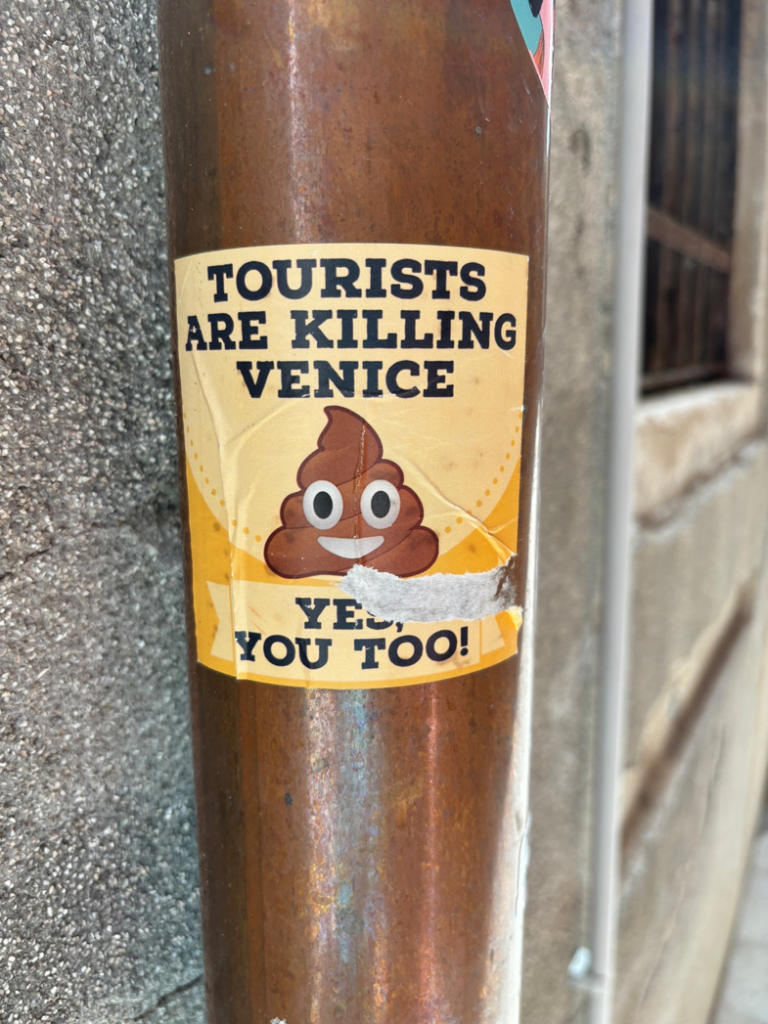
Anti-tourist sticker. Venice, June 2024. Author’s photo
Three years later, a Texan visitor similarly underscored the divergence between visitor and host community experiences. For tourists, especially children, Edward Harte explained, the City of Canals was a place where “fancy reigns.” Even the existential threat of the archipelago’s “rotting foundations” and “rising high-water marks” added to the experience. “For tourists,” Harte suggested, “there is a ‘sunset’ quality about all of Venice.” For “the old part of the city,” where tourists concentrated, “is in the twilight of its history.” Decline and degradation, from this perspective, were part of the allure. However, for the locals, Harte surmised, “[l]ife in Venice must be filled with frustrations.” The canals, so endearing to visitors, were a source of endless frustration and inefficiency for locals. Indeed, Harte concluded, “One cannot envy modern Venetians, hanging their ragged laundry to dry over quaint but garbage-choked canals, working and living in unimaginable congestion.”[5]
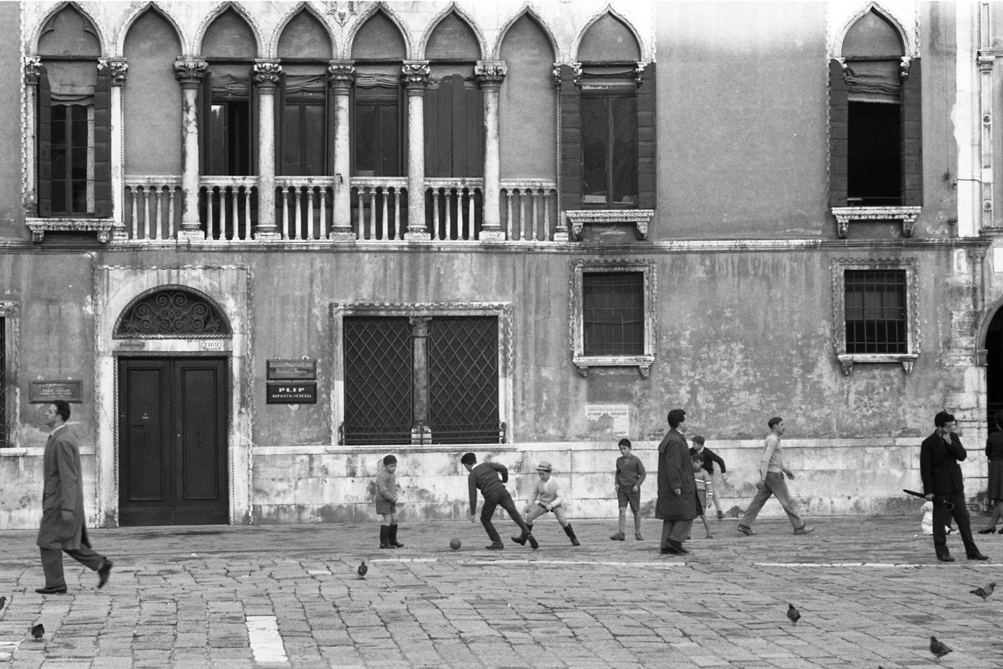
Local Venetians playing football, c. 1960. Source: Paolo Monti, CC BY-SA 4.0, via Wikimedia Commons.
Despite the discrepancy between tourist and resident experience, city officials pressed on with their attempts to expand tourism. In 1959, their focus settled on the declining fortunes of Lido beach. Accessible only by water, it struggled to attract visitors in comparison to beaches elsewhere along the Adriatic. The answer, according to the city’s former chief architect, Eugenio Miozzi, was a 4-mile-long underwater automobile tunnel. Miozzi’s supporters assured the doubters that the tunnel would facilitate the efficient and silent delivery of much-needed visitors to the beach. However, many Venetians balked at the proposal, suggesting it would threaten the city’s character and cost far more than the $9 million Miozzi predicted.[6] The project was shelved.
A few years later, the city’s gondoliers would also rally in defence of the city’s character and traditions. By the mid-1960s, roughly 400 gondolas serviced the city. They were a far cry from the 10,000 or so that had traditionally navigated the city’s canals but the gondoliers remained a powerful lobby. In 1965, for example, 54 gondoliers servicing Piazza San Marco withheld their services to protest the city’s decision to issue four docking permits for motorboats – a threat to their livelihood. Four years later a similarly agitated group of gondoliers faced arrest after taking issue with a city decision to prohibit their use of a particular canal. According to one report, the gondoliers, “broke up a city council meeting, smashed an 18th Century chandelier and pulled down a waterpipe, flooding the council chambers.”[7]
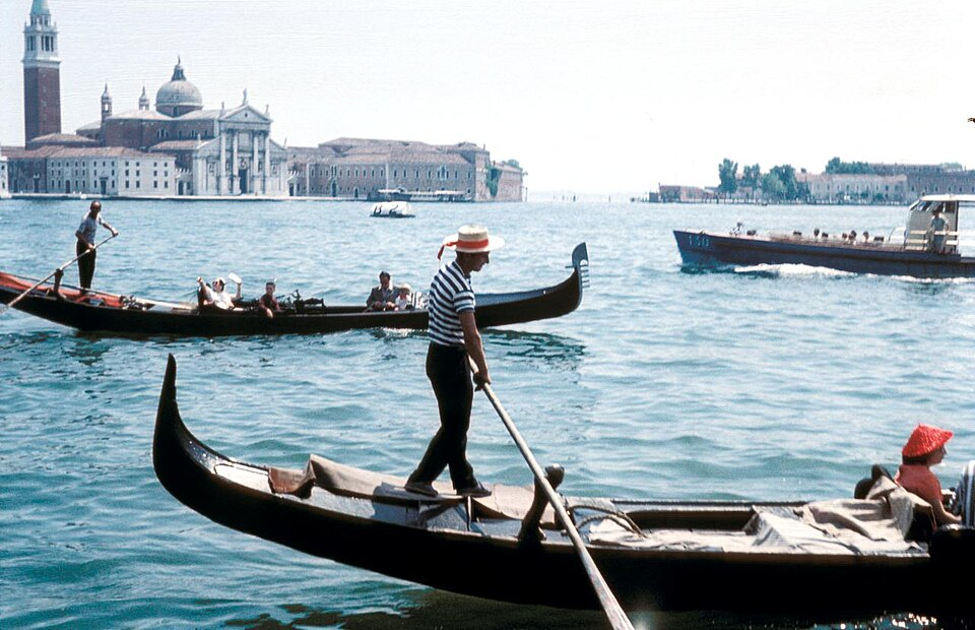
Venetian Gondoliers, 1960. Source: My Past from Norway, CC BY 2.0 https://creativecommons.org/licenses/by/2.0, via Wikimedia Common.
By the late 1960s, the debate over the city’s economic viability openly pitted industrialists against conservationists. The former emphasized the need to expand the city’s port operations and develop new canals to link Venice more effectively with central Europe. The payoff, they emphasized, would be much-needed jobs and a reversal of the city’s declining population. Some opponents countered that more dredging would disturb the city’s tides and accelerate its descent into the Adriatic. Others doubled down on the city’s reliance on tourism and “advised turning the city into a sort of historical Disneyland, which would subsist solely on tourism.”[8]
Indeed, beyond traditional advertising campaigns, the city pursued a wide range of idiosyncratic pro-tourism initiatives. In 1973, to “preserve the city’s architecture and sculpture,” officials endeavoured to dramatically reduce the city’s pigeon population “by resettling them in other cities and freeing them in wooded areas.”[9] Three years later the city hosted its second annual “Back and Forth Over the Bridges of Venice foot race.” Organized by the Regional Center for Youth and Social Tourism, the race featured over 11,000 participants, including a turkey named Astacchino. The winning (human) participant completed the 7.4-mile, 47-bridge, course in roughly 40 minutes. Astacchino’s time was not recorded.[10]
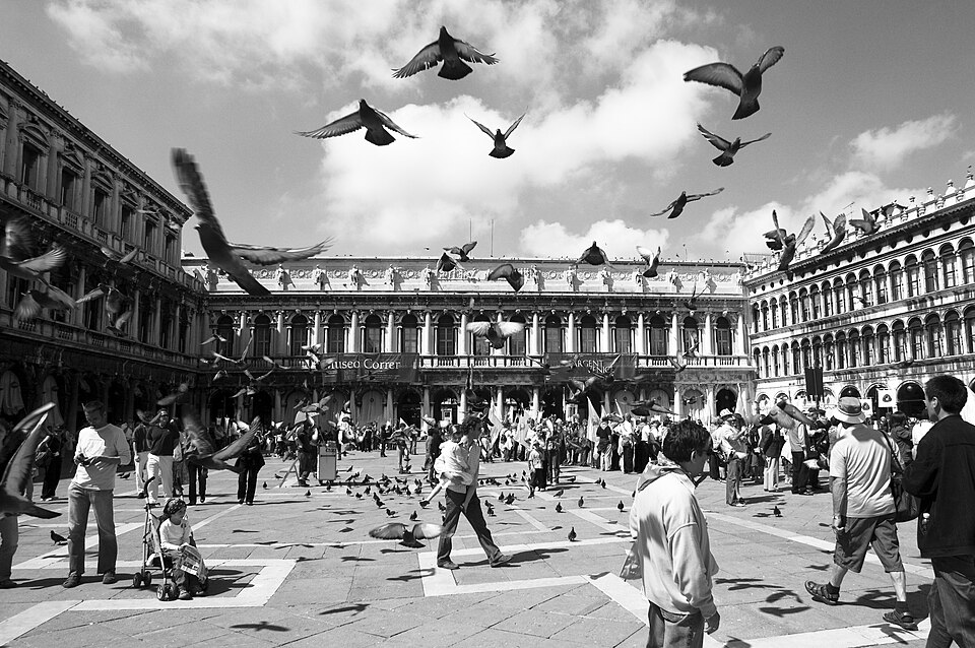
Pigeons in the Piazza San Marco. Source: I, Nattfodd, CC BY-SA 3.0 Wikimedia Commons; https://commons.wikimedia.org/wiki/File:Piazza_san_marco.jpg.

However, an anti-tourism backlash was gaining momentum. In the mid-1980s Venice tourism official Augusto Salvadori introduced a law imposing fines on visitors who slept outdoors in Piazza San Marco. Keen to encourage tourists to pay for accommodation and not antagonize locals, politicians in other Italian cities embraced similar measures in what became known as a “war” on the “sleeping-bag people.” Inspired by Salvadori’s initiative, for example, the Communist mayor of Riccione declared it illegal for tourists “to sit, sprawl or picnic on the pavement or in gardens and public parks, to sleep in parked cars or turn on [a] sound-producing apparatus with windows and doors left open.”[11] In 1987, Venetian authorities called an “emergency meeting” to deal with unsustainable crowds. That spring over 100,000 tourists descended upon the city on three consecutive weekends, more than doubling the city’s population each time. This prompted officials to close a key bridge and introduce “one-way pedestrian systems.”[12] By the end of the decade, inflated real estate prices had priced many Venetians out of their city. The city’s population had dropped by 70% since the late 1960s. And many young Venetians now gravitated to Mestre on the mainland for entertainment and social interaction. “We are in danger of becoming a stage without actors,” one Venetian lamented.[13]
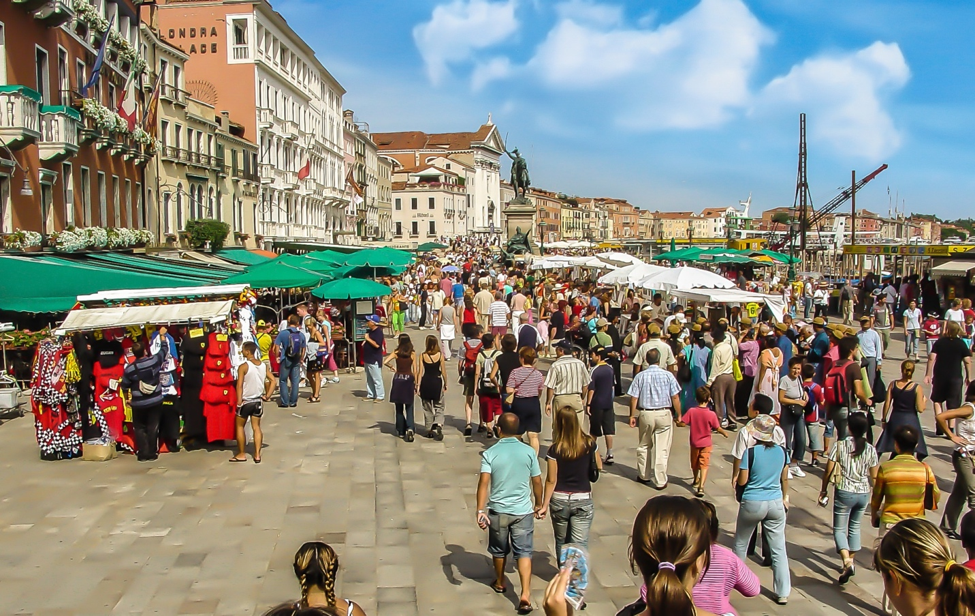
Crowds at Venice. Source: https://www.publicdomainpictures.net/en/view-image.php?image=215327&picture=crowds-at-venice; Public Domain.
And yet the lure of foreign currency and international prestige proved too tempting to resist. In 1989, Venetian authorities agreed to host a Pink Floyd concert in Piazza San Marco. Local opposition was fierce. Augusto Salvadori pointedly suggested that the Piazza was an inappropriate place for a rock concert. In response to concerns about the impact of music vibrations on the city’s architecture, the band agreed to lower its decibel level by 40% and perform on a stage floating in the lagoon roughly 200 yards from the Piazza. In the end, it was the visitors, themselves, that did the most damage. Officials estimated that they “left behind 300 tons of garbage and 500 cubic meters of empty cans and bottles.” And with a dearth of available bathrooms, “concertgoers relieved themselves on the monuments and walls.” Public outrage – “[Y]ou’ve turned Venice into a toilet” – forced the resignation of the mayor and city council.[14] Perhaps that’s where local activists got the idea for their scatologically-themed anti-tourism stickers.
Michael Dawson is Professor of History at St. Thomas University where he teaches courses on Canadian history, the global history of sport and tourism, Disney and World History, and the comparative history of national identity and popular culture in Canada, New Zealand, and Australia.
[1] Julia Buckley, et al, “Rising waters and overtourism are killing Venice. Now the fight is on to save its soul.” CNN, May 12, 2025, cnn.com.
[2] Adam Durbin, “Venice bans large tourist groups and loudspeakers,” BBC, June 1, 2024, bbc.com.
[3] For a fine survey of contemporary overtourism and its opposition, see Elizabeth Becker, Overbooked: The Exploding Business of Travel and Tourism (New York: Simon & Schuster, 2013).
[4] Douglas Wilkie, “Hope Tourist Trade Will Beat Poverty,” Courier-Mail [Brisbane], February 19, 1949,
[5] Edward H. Harte, “Venice Still Paradise For Tourists But Not For Home,” San Angelo Standard-Times, November 12, 1952, 1B.
[6] Eugene Levin, “Canal City Eyes Tunnel For Autos,” The Herald-Palladium [Benton Harbor, MI], April 23, 1959, Sec. 2, 14.
[7] “Aid Asked by Gondoliers,” Pensacola News Journal [Pensacola, FL], March 6, 1965, 2A; “That Does It For Gondoliers,” Evansville Press [Evansville, IN], April 30, 1965, 4; “Nine Extra Gondoliers Charged,” Kitsap Sun [Bremerton, WA], August 12, 1969, 3.
[8] Dennis Redmont, “Venice Dilemma: Invading Waters,” The State [Columbia, SC], July 7, 1968, 6F.
[9] “De-Pigeoning Venice,” Sun Post News [San Clemente, CA], October 17, 1973, 12.
[10] “Defending Champ Holds Crown,” Rushville Republican [Rushville, IN], March 15, 1976, 2.
[11] Uli Schmetzer, “Italy says arrivederci to sleeping-bag people,” Chicago Tribune, August 17, 1985, Sec.4, 12.
[12] “Venice seeks ways to slow tourism,” The Palm Beach Post [Palm Beach, FL], May 4, 1987, 8A.
[13] Robert Fox, “Bad news from the Rialto,” The Daily Telegraph [London, UK], March 18, 1988, 23.
[14] Dave Lifton, “35 Years Ago: Pink Floyd Brings Down Venice’s Government,” UltimateClassicRock.com, updated July 15, 2019, https://ultimateclassicrock.com/pink-floyd-venice-1989/
This work is licensed under a Creative Commons Attribution-NoDerivatives 4.0 International License. Blog posts published before October 28, 2018 are licensed with a Creative Commons Attribution-NonCommercial-ShareAlike 2.5 Canada License.