
James Cullingham
Canada and Mexico approach an historic juncture in their relations with the United States. Both countries face a July 1 deadline over the Canada–United States–Mexico Agreement (CUSMA) which replaced the North American Free Trade Agreement (NAFTA) in 2020 under the auspices of Justin Trudeau, Donald Trump and Andrés Manuel López Obrador. CUSMA is due to be formally extended for 16 years or to be continued under annual reviews. The Trump administration has already run roughshod over some aspects of the agreement and the unpredictable Donald Trump sometimes even seems prepared to walk away.
It’s not the first time both Canada and Mexico have simultaneously confronted a moment of such significance with a wallop from the United States.
On June 19, 1867, the French appointed Emperor of Mexico, Maximiliano de Habsburgo, was executed in Querétaro some 220 kilometres north of Mexico City. On July 1, 1867, many citizens of the Dominion of Canada celebrated the creation of a new nation state.
Consequently, each country can date the dawning of its independence within two weeks in the early summer of 1867. This independence is unofficially recognized in Mexico because while 1821 saw the overthrow of Spanish imperial rule, the official date of Mexican independence is September 16 with celebrations starting in the evening of the 15th to commemorate the beginnings of revolt against Spanish rule in 1810. The year 1821 marked the beginning of a highly conflicted independence that featured almost half a century of war between Mexican conservatives and liberals. Also in that period, war with the United States led to the loss of just over half of Mexico’s territory by 1848. Then in 1862, the French under Napoleon III invaded Mexico at the urging of some Mexican conservatives.
Both the French invasion of Mexico and Canadian confederation were motivated to a significant extent by events in the United States – specifically the bloody American Civil War 1861 – 1865. Napoleon III miscalculated that the south would win, become his ally, and renounce the Monroe Doctrine. After the North prevailed on April 9, 1865, Napoleon III withdrew his troops and abandoned Maximiliano and the Mexican conservatives who supported him. Meanwhile in what would become Canada, British North American politicians like Macdonald, Brown and Cartier worried about an expansionary United States after the war, and having seen the internecine chaos to the south, wanted a form of union that would preserve the British political connection rather than emulating American style republican government. In sum, the American Civil War served as political accelerant on both sides of the United States border.
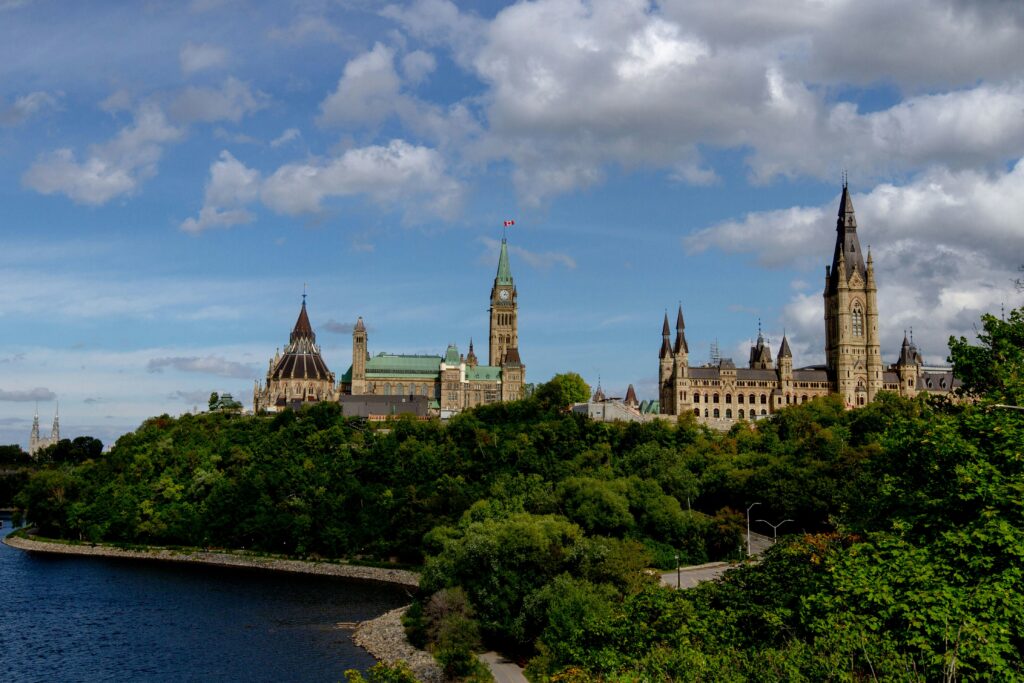
Photo of Parliament Hill courtesy of Chris DeSort on Unsplash
Maximiliano and those loyal to him were defeated by the forces of President Benito Juárez, an Indigenous person from Oaxaca, in that spring of 1867 in Querétaro. To many observers of Mexican history, including this writer, that deadly moment for the complicated, doomed and fascinating Maximiliano, who like Juárez was a classic 19th century liberal, marks the beginning of true Mexican independence. It meant the termination of more than three centuries of Spanish rule and waves of interference from the Americans, British and French. Juárez’s insistence on the execution of Maximiliano, which was opposed by many outside Mexico, including international champions of human rights such as Victor Hugo, affirmed Mexico’s stature as a nation within its present borders.
British North America morphed into The Dominion of Canada after years of fraught negotiations. Ultimately, Canada West (Ontario), Canada East (Québec), New Brunswick and Nova Scotia entered confederation under the British North America Act, enacted in March 1867 and taking effect on July 1, 1867. It was a limited independence and perhaps thankfully so for the new Canadian leaders because it was British regulars who helped defeat the forces of Louis Riel’s Métis during the Red River Resistance in the years immediately following confederation. The Red River Expedition of 1870 under the command of British General Garnet Wolseley allowed for westward expansion. It launched Canadian style manifest destiny featuring rapid settler colonialism and the subjugation of Indigenous peoples from the prairies to the Pacific Ocean. The execution of Louis Riel in 1885 was among the capstones of that process. Canada would gradually further its independence following its outsized performance in World War I and with the Statute of Westminster in 1931. Until at least that point ties with Great Britain had much more than symbolic meaning.
Since the late 19th century until the present day, both Canada and Mexico have had spats with the United States over migration, tariffs and various trade matters. In 1994, neoliberal champions of free trade in the three countries hoped many of these issues would be resolved for good with NAFTA. Inequities in Mexico between an industrialized north benefiting from a maquiladora industrial boom and an impoverished south where small-scale agriculture has suffered from NAFTA, raise questions about what’s best for Mexico in looking again at CUSMA. In some parts of Canada, including Peterborough (Nogojiwanong), long existing industries were hollowed out following NAFTA. Ironically, resentment over cultural and economic damage to American rust belt states, which was attributed to NAFTA, contributed to the rise of Republican politicians such as JD Vance and even Donald Trump. These days Prime Minister Mark Carney’s government wants to preserve CUSMA while maintaining aspects of Canadian protectionism in matters like culture and the dairy industry.
Mr. Carney owes a great debt of political gratitude to Mr. Trump. In the election campaign of 2025, his Liberals successfully employed an “elbows up” posture vis à vis the Americans by highlighting Mr. Trump’s insults directed Canada’s way and clinging to the Canadian flag while simultaneously demonizing the Conservative leader Pierre Poilievre as ‘Trump lite.’ Once in power, Mr. Carney has charted a progressive conservative course which is sometimes not far removed from Mr. Poilievre’s campaign planks and even some of Mr. Trump’s policy priorities. It’s been a 21st century master class in the well-honed shape shifting Liberal playbook which has kept the party in power for most of Canada’s history as a nation state.
In Mexico, Presidenta Claudia Sheinbaum has projected the appearance of maintaining a more calm, dignified and steady attitude with the Americans. This has earned her some credit with the White House, but contradiction and peril lurk. The ongoing crisis provoked by organized crime in the country compromises Ms. Sheinbaum and bedevils relations with Washington. Sadly, the Sheinbaum administration is the latest Mexican government proving itself incapable of protecting journalists who continue to be prey to organized crime. Drug trafficking is a plague in all three countries. Chaos is not the best posture in the lead up to renewing CUSMA which is Ms. Sheinbaum’s stated aim.
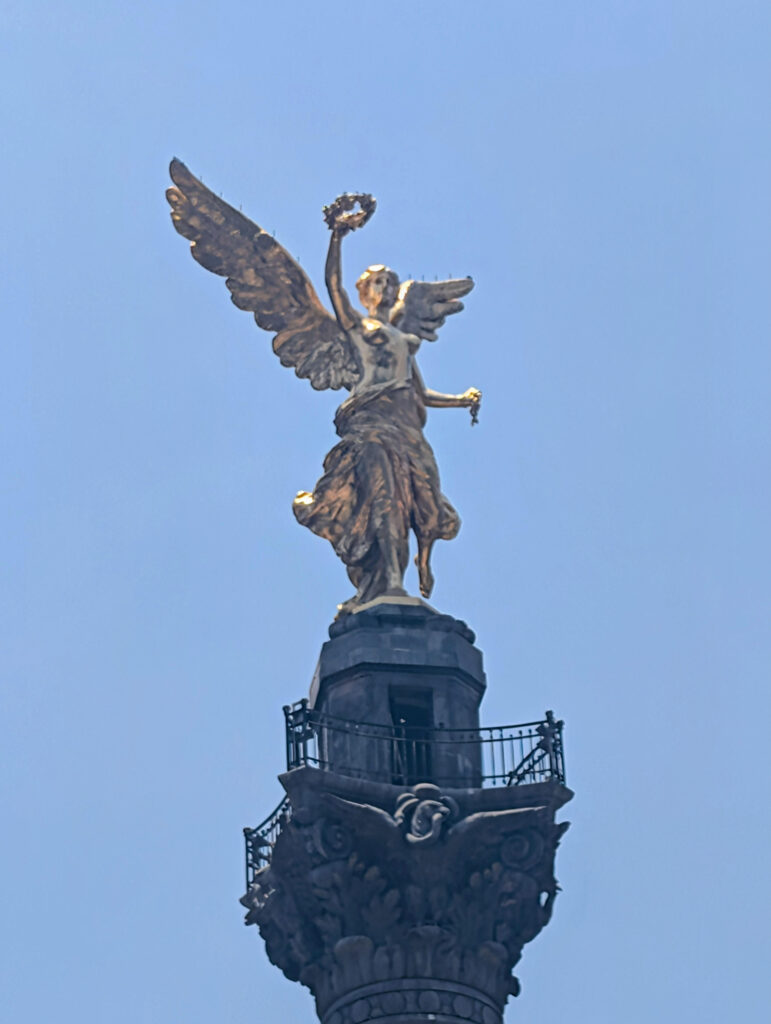
Photo of Angel of Independence in Mexico City courtesy of author
In 2026, 159 years following the decisive summer of 1867, this moment for CUSMA arrives with Donald Trump casting his ponderous shadow over the proceedings. His offensive musings about turning Canada into a 51st state and his threats about taking the fight directly to drug cartels inside Mexican territory are among the provocations that Mr. Trump has sent Ottawa and Mexico City’s way. The ambitions of both Canada and Mexico regarding CUSMA will face a severe test up against the unpredictable and sometimes contradictory policies of the Trump administration. It’s a test unlike any other that Canada or Mexico have faced in their histories of relations with the United States.
The next days and weeks will tell us much about the future of CUSMA. It will be the latest twist and a significant turning point in the long effort of both Canada and Mexico to maintain friendly, but cautiously sovereign relations with the behemoth between them.
James Cullingham is a filmmaker, historian and journalist based in Nogojiwanong – Peterborough ON. He is an adjunct graduate faculty member at Trent University. Dr. Cullingham is currently writing a book entitled In The Shadow of The Eagle: Canada, Mexico and the United States.

Very helpful history! Thanks for the context and the clarity!