
Shannon Stettner
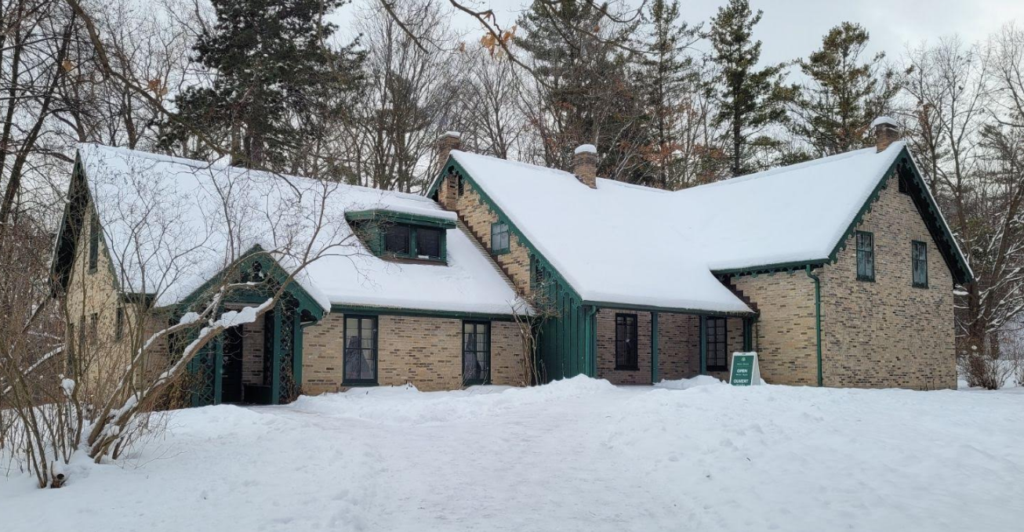
Exterior of Woodside National Historic Site. Photograph by the author, December 2025.
Last December I visited Woodside National Historic Site, the boyhood home of Canada’s tenth Prime Minister, William Lyon Mackenzie King (WLMK). It was my first visit to the house since 1998 when I was a public history graduate student at the University of Waterloo. Back then, I wrote a paper on the portrayal of gender at Woodside. Decades later, while sorting through file boxes, I found the paper and wondered whether the interpretation had evolved in the intervening years. I don’t know if it has changed all that much, but my impression of it has.
In 1998, as part of my research, I accompanied a group of eight-year-olds on their school tour. While I got to witness their enthusiasm for the house, not surprisingly, the tour didn’t touch on my own interests. Instead, the emphasis was on portraying “Willie” as a “regular” kid. My assignment fell a few pages short, so I included an experiential analysis of my visit. It is an understatement to say that approach made my professor uncomfortable (he used the word “fretted” in his feedback). Nevertheless, I wrote about how walking through the house made me feel. I was a little disappointed that the house portrayed gender in the familiar ways we would expect of a Victorian house museum. I left wondering is that all there is? This was not a criticism of the staff or the story that was told. Rather, I was frustrated by what I perceived as the limitations of how gender could be conveyed in a Victorian household; 1998 me couldn’t relate.[i]
Prior to visiting in 2025, I contacted Woodside with an ambitious list of interpretive and operational questions. When I arrived, Holly took me on a tour of the house. What was planned as an hour-long visit turned into two. Because Holly knew my interests ahead of time, she pulled out specific artefacts for me to look at. For example, she found an etiquette book on the shelves of the library, showed me a telegram from WLMK to the South Waterloo Women’s Liberal Association, and shared a dance card from a July 15, 1889, party in the King’s parlour.
On this visit, I found myself noticing everything, from the wallpaper and furniture to the dishes and trinkets. In part, this new attention to detail reflects an assignment I developed for a gender and technology course I taught. I asked my students to visit a local museum and write a critique about the portrayal of gender there. Many chose house museums, and several examined the technologies available in the kitchens: pump sinks, cooking implements, sources of heat for heating and cooking, among others. I’m partial to big tent definitions of technology, and my students included some inventive examples. As I moved through the house, I found myself looking for technology beyond the kitchen, trying to see through my students’ eyes.
My second favourite room was the pantry. It’s my second favourite room in my house too. I stood in the pantry taking in the canning jars, dishes, and crocks. Would 1998 Shannon have been as drawn to the pantry? Unlikely. What has changed? For one, I now understand the complexities represented by pantries. They are not just storage spaces, but also workrooms. They are places of privilege and consumption, preparation and preservation, illuminating the skills involved in feeding a household. They are political, spanning from “apocalyptic hoarding” to the “pleasure…and conviviality of the shared table.”[ii] And, of course, I’m drawn to the aesthetics and organization.
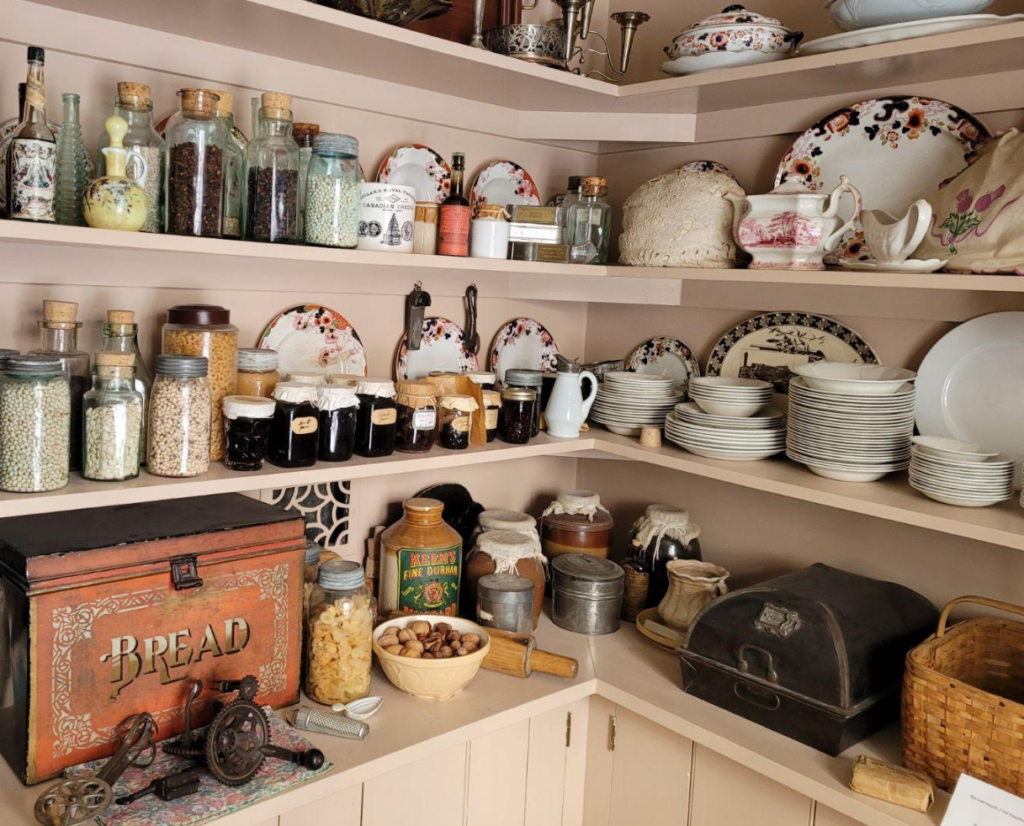
Pantry of Woodside National Historic Site. Photograph by the author, December 2025.
As we made our way through the rooms – kitchen, dining room, library, parlor, guest bedroom, family bedrooms – it was easy to see how a typical gendered portrayal emerges naturally. In my twenties, I was frustrated by what I perceived as limitations. Now I am better able to see pockets of agency within constraints. For example, Holly related that Mrs. King had a wall removed to enlarge the dining room because she so enjoyed hosting. Her sewing tools were in a corner of the library, so that she could be with the family while sewing. I’m also less concerned with evaluating the portrayal of gender in broad terms. I’m more interested in the material environment: how specific artefacts prompt questions we may not otherwise ask, and how we can use such items to help us reconstruct lives.
This played out for me, in particular, in John King’s study (“the library”). On my tour, I was invited “behind the velvet rope.” Holly and I sat at the desk for about half an hour. The deep burgundy and dark wood create a soothing atmosphere, and I was content to linger. As we sat, we talked about which of the furnishings were specific to the King family, which were time-appropriate, and which had been added to fill the space. For me, this was the most impactful part of the tour. I think this reflects Alevtina Naumova’s observations about the Mackenzie House Museum, that the “experience of materiality of the space and objects within it authenticates the story.”[iii] In my previous visit to Woodside, I felt very much like a detached observer. This time, sitting where the family sat, examining artefacts, it was easy to imagine the family gathering cozily on a winter’s afternoon.
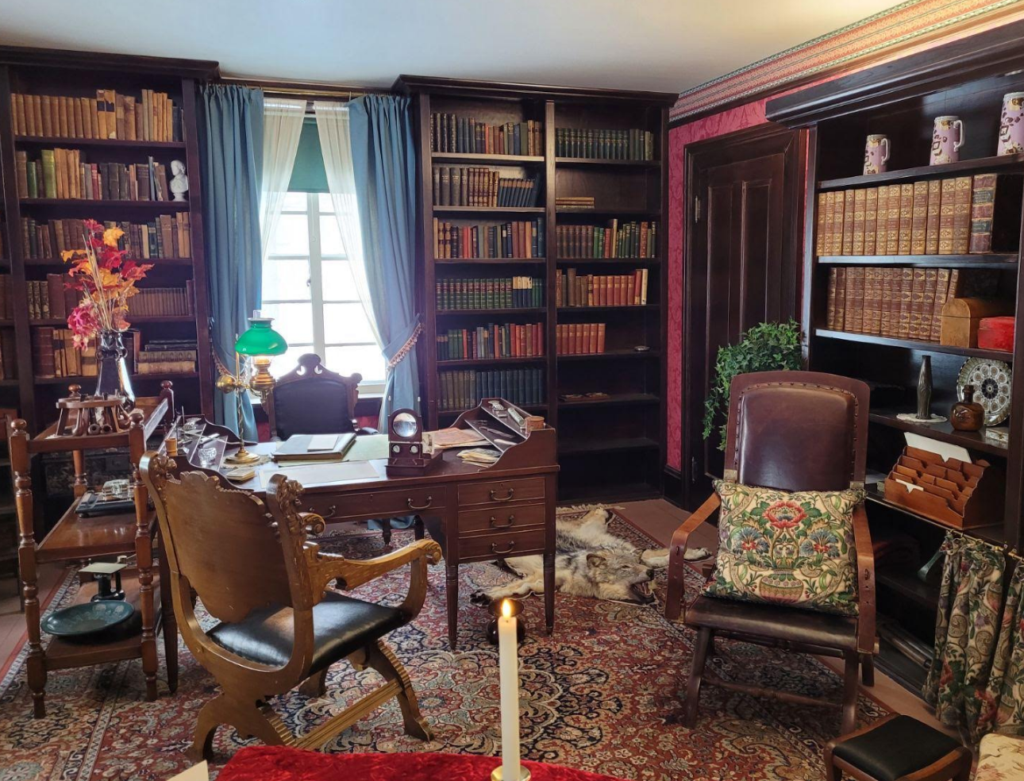
William Lyon Mackenzie King’s study, Woodside National Historic Site. Photograph by the author, December 2025.
While my experience of Woodside has changed, the site has also undergone considerable changes, including its ability to welcome visitors. Visitor numbers for Woodside have varied considerably over the years. Flooding, renovations, budget cuts, and the Covid 19 Pandemic have all affected opportunities to visit. Changes to the Ontario school curriculum also require programming revisions for school tours. When I visited Woodside in 1998, attendance figures suggested that visitor numbers had already fallen from an earlier peak. In 1990, there were around 28,000 visitors.[iv] By 1997-1998, that number was recorded as 17,834. In the 2025-2026 fiscal year, the reported figure was 1,083. These numbers point to a significant change in visitation, although they must be considered alongside the site’s availability and operating conditions. Woodside occupies a distinctive space within Parks Canada; it is a relatively small site embedded in an urban community. Its description in Parks Canada materials as an “urban oasis” underscores that relationship.
This local importance is a long-standing characteristic. A closer look at the 1997-1998 figures shows that of the almost 18,000 visitors, 70 percent were local residents of the Kitchener-Waterloo area. In addition to Thanksgiving and Christmas celebrations, they held summer teas, and hosted citizenship ceremonies on Canada Day. In these ways, the house served a community function in addition to its heritage one. Now that the house is only open three months per year, the opportunities to build and sustain community relationships are more limited (the grounds remain open year-round).
Another difference might be the popularity of the King family. When I was doing my MA, Charlotte Gray’s biography Mrs. King: The Life & Times of Isabel Mackenzie King (1997) was tremendously popular; such that theme of 1998 was “the Year of Mrs. King.” The former Superintendent noted that visitors would show up to the house holding a copy of the book and would ask questions about what they had read. In this way, the book gave readers an accessible account through which to connect to the house. Almost thirty years later, how might Woodside create a comparable connection between its history and the public imagination? This year, the calendar includes a murder-mystery weekend, which taps into public fascination with crime. Such interactive programming offers a compelling path forward.
Initially, I returned to Woodside to revisit their interpretation of gender. I can’t say whether the house has changed all that much, but my gaze has. My latest visit to Woodside was one of the more enjoyable museum experiences I’ve had, and the possibility of more bespoke museum experiences excites me. At a time when heritage sites face significant operational challenges, a memorable individual experience is valuable. Whether such experiences can contribute to the long-term sustainability of historic house museums remains an unanswered question.
Shannon Stettner is a historian specializing in reproductive health and activism, oral history, and lived experience. She is an avid traveller, dog enthusiast, world class putterer, and a regular contributor to Active History.
[i] For a more detailed analysis of women’s and gender history at Ontario historic sites, see for example, Katherine MJ McKenna,. “Women’s history, gender politics and the interpretation of Canadian historic sites: Some examples from Ontario.” Atlantis: Critical Studies in Gender, Culture & Social Justice 30, no. 1 (2005): 21-30.
[ii] Michael Mikulak, The politics of the pantry: Stories, food, and social change (McGill-Queen’s Press-MQUP, 2013), 21.
[iii] Alevtina Naumova,. “Touching” the past: Investigating lived experiences of heritage in living history museums.” International Journal of the Inclusive Museum 7, no. 3/4 (2015): 1-8.
[iv] This figure was from a draft site management plan cited in my 1998 paper.
This work is licensed under a Creative Commons Attribution-NoDerivatives 4.0 International License. Blog posts published before October 28, 2018 are licensed with a Creative Commons Attribution-NonCommercial-ShareAlike 2.5 Canada License.