
By Sarah Kittilsen
As a tour guide, I answer a lot of questions. Some are related to the tour itself, but many are not. Guests ask about my life just as much as, if not more than, they ask about the history of Montreal. I wasn’t surprised, then, when a woman turned toward me one summer morning and asked,
“So, what do you study?”
I’d answered this question enough times to perfect my response. Most guests were looking for small talk, so I kept it brief, including just enough detail to inspire confidence in my competence.
“I’m finishing a master’s degree in modern Canadian history this fall,” I said.
Guests usually offered a word of encouragement or nod of support in reply, or if they were chatty, an anecdote about a cousin’s husband’s daughter who also had a history degree. But not this woman.
“What are you ever going to do with that?”
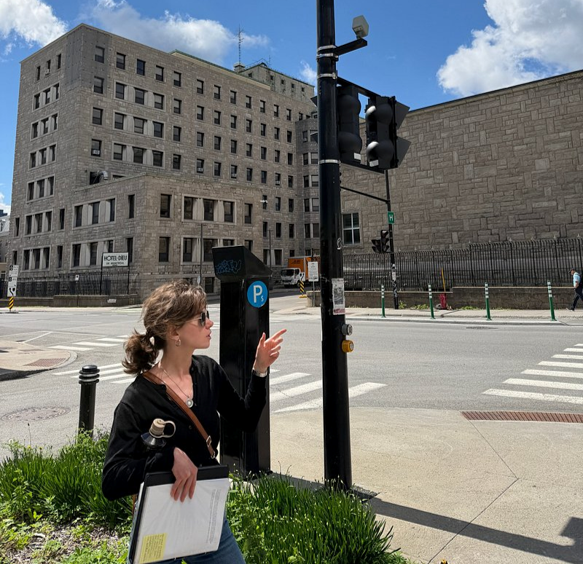
Like most history students, I’d faced versions of this question for years. When I decided to study something other than medicine, engineering, or finance, it seemed that everyone—from my relatives, to my coworkers, to my dental hygienist—was concerned that my history degree would leave me without work. Some expressed faith in my choice at first, but lost it once I told them I didn’t plan to go to teachers’ college or law school. When I started my studies at McGill University, I expected professors to be more optimistic, but oftentimes, they painted a picture that was just as grim. The more I heard about rising youth unemployment rates, the AI-ification of the hiring process, and the crisis of the Canadian university, the more I began to worry that everyone was right. Maybe I wouldn’t be able to find a job with my history degrees. Or, to my horror, maybe the Useless History Degree would become a self-fulfilling prophecy.
I felt lucky and a bit vindicated, then, when I landed a summer job at a not-for-profit museum in Montreal. Not only was I earning a fair wage through the Young Canada Works program, but I was also gaining experience in public history. Maybe this would put an end to the infinite loop of Useless History Degree comments and the self-doubt that accompanied them. Needless to say, it didn’t take long for a woman on her high horse to prove me wrong.
But something was different this time. There was an unmistakable, almost comical, irony to her question. At the risk of sounding obvious, I was doing something with my degree. I was leading a historical walking tour, and she had paid to join it. How could a client of a historical walking tour, I wondered, still view their tour guide’s degree as at best, a dead end, and at worst, a useless piece of paper?
The Useless History Degree narrative doesn’t just speak to the challenges that history graduates, like many young people, face in a competitive and oversaturated job market. It also demonstrates a dissonance between how people think about history degrees and how they engage with them in daily life. This dissonance has pervaded not only how the public and politicians perceive the social and economic value of history, but also the way the academy discusses it. If we are to counteract the Useless History Degree narrative, we need to recognize the myriad ways in which history graduates are involved in public life and consider how and why they’ve adapted to Canada’s hostile economic environment.
To be clear, history graduates do face a challenging job market. Youth unemployment in Canada is at a historic high. Thanks in part to the rise of generative AI, employers are cutting entry-level positions, making it challenging for young people to break into the job market. At the same time, federal and provincial governments are defunding cultural and educational institutions, making it difficult for people in the humanities and liberal arts to find gainful employment. In Nova Scotia, my home province, protests made headlines when Premier Tim Houston announced plans to defund the arts and culture sector in the province. “These cuts…will devastate us,” explained artistic director Ken Schwartz, “we’re going to lose our jobs.” Meanwhile, PhD students might stave off the effects of a dismal job market for the six to seven years it takes to complete their degrees, but upon graduation, the crisis facing Canadian universities limits their opportunities to work as tenure-tracked academics, a longstanding ambition for these candidates.
Without understating these challenges, history graduates have more success on the job market than the Useless History Degree narrative suggests. A 2018 survey of Ontario university graduates found that six months after graduation, 92 percent of humanities graduates were employed. A quick perusal through the Canadian Historical Association’s (CHA) blog highlights that history graduates find work in many different areas, from archives to nonprofits to video game companies. In short, many people interact with history graduates in their daily lives, they just don’t know it.
Moreover, as the Nova Scotia example demonstrates, the decision to defund arts and culture has little to do with the sector’s success. Premier Tim Houston presented his cuts as a practical, if painful, way to balance the provincial budget, a tired tactic that neoliberals use to pass off their small-state and anti-intellectual ideology as a matter of common sense. But as Sarah Faber, a part-time employee of the Cabot Trail Writers Festival, argued, the premier’s comments are at odds with the economic importance of the arts and culture industry, which is growing faster in Nova Scotia than any other Canadian province and creates “more jobs for every dollar invested than oil and gas, agriculture, or manufacturing, adding $65-billion to the national GDP in 2024 alone.”
Based on my anecdotal experience, I’m not surprised. The millions of tourists who visit Montreal each year are keen to learn about the city’s history and cultural life. My guided walking tour is usually just one stop on their itineraries, which feature visits to the Old Port and various museums across the city. These activities are popular with locals, too. During La Nuit Blanche, for example, roughly 300,000 people seize the opportunity to visit heritage and cultural institutions at night, for free.
It’s not just politicians and members of the public, however, who fail to recognize the value of a history degree. The Useless History Degree narrative has made its way into an unexpected place: the university history department.
To be fair, in my undergraduate classes, professors were enthusiastic. Studying history, they argued, helped students realize themselves while also endowing them with transferable skills, like researching, writing, and critical thinking, to work in the public and private sectors. Once I expressed interest in graduate studies, however, the tone changed. Before even asking about my career aspirations, well-intentioned professors offered the same piece of advice. Skip the degree and head straight for the job market, they said, academia is a sinking ship and there’s no sense in staying aboard just to listen to the music.
It’s no secret that universities are facing a financial crisis, and when it comes to downsizing, the humanities are often the first on the chopping block. Professors are quick to discourage students from pursuing graduate studies in history—especially their PhDs—pointing out that tenure-track positions, the gold standard of academic employment, are few and far between. This is true. According to a CHA report only 58 of the 562 people who received their history PhDs in Canada between 2016-2022 found tenure-track employment, less than half of whom got the position immediately. As a result, many find themselves working precarious jobs as sessional instructors and contract faculty.
While I agree that we should grapple with the perils of the academic job market, we shouldn’t discount the gainful employment that history graduates find outside of the academy, neither to the public or students themselves. Many history PhD recipients find work in the private and public sector, and their career accomplishments are nothing to shake a stick at. Of those 562 people who received their PhDs between 2016 and 2022, for example, 20 found work as civil servants, 23 as private historical researchers, and 21 as NGO staffers. We should advocate for the job security of these history graduates too and listen to them when they say their degrees equipped them with invaluable skills and life experience. We should also, as others have argued on this site, think about how graduate programs might better equip history students for the job market without sacrificing the intellectual heart of the program.
To be clear, I’m not arguing that everyone and their dog should get an undergraduate or graduate degree in history. There are real and prohibitive economic and social barriers to studying history, not least of which are tuition costs and the opacity of graduate funding. I do think, however, that if we are to challenge the Useless History Degree narrative, we need to be more careful and intentional about how we think and talk about history graduates and their impact on society, both inside and outside the academy.
Ultimately, I’m grateful for the tour guest who probed my Useless History Degree. Although her question was familiar, I saw it in a new light, which opened my eyes to the value of my own studies. If I could talk to her today, I’d share these thoughts and hope she could see the value of my studies, too.
But people ask a lot of questions on a historical walking tour, and I have, on average, 250 meters between stops to answer them. So, on that summer morning, I opted for something shorter.
“Maybe I’ll lead historical walking tours.”
Sarah Kittilsen is a graduate student at McGill University and a Junior Fellow with Active History. Her ongoing M.A. thesis examines the history of rural youth clubs in Nova Scotia.
This post was produced within the project Historicizing Our Times: Histories of Migration and Climate in the Digital Space, which is supported in part by funding from the Social Sciences and Humanities Research Council.
This work is licensed under a Creative Commons Attribution-NoDerivatives 4.0 International License. Blog posts published before October 28, 2018 are licensed with a Creative Commons Attribution-NonCommercial-ShareAlike 2.5 Canada License.