
This post is an introduction to the series Tomorrow’s Historians: A Reflection on the Graduate Student Experience
By Katie Carson and Tiffany Chénier
In a persuasive climate of anti-intellectualism and cuts to humanities programs, the decision to pursue a degree in history is an existential one. It is not uncommon, however, for prospective students applying to PhD programs to receive “The Talk.” It typically begins by cautioning that the academic job market remains dire and that it is unlikely you will secure a tenure-track appointment upon completing a degree.
These talks didn’t end once you received your acceptance letter. The malaise of an uncertain future hangs heavily over graduate students as they try to balance completing a degree with planning for an unpredictable postgrad career.
The reality that studying history can be an isolating experience adds insult to injury. As a history graduate student, you’re likely to spend many solitary hours doing archival research, analyzing your sources, and drafting your chapters. You might also be the only student in your department studying a given sub-discipline, adding a layer of intellectual loneliness to the equation. Taken together with the grim job market, this isolation makes the decision to pursue a graduate degree increasingly daunting.
And yet, each year, new students embark on this journey.
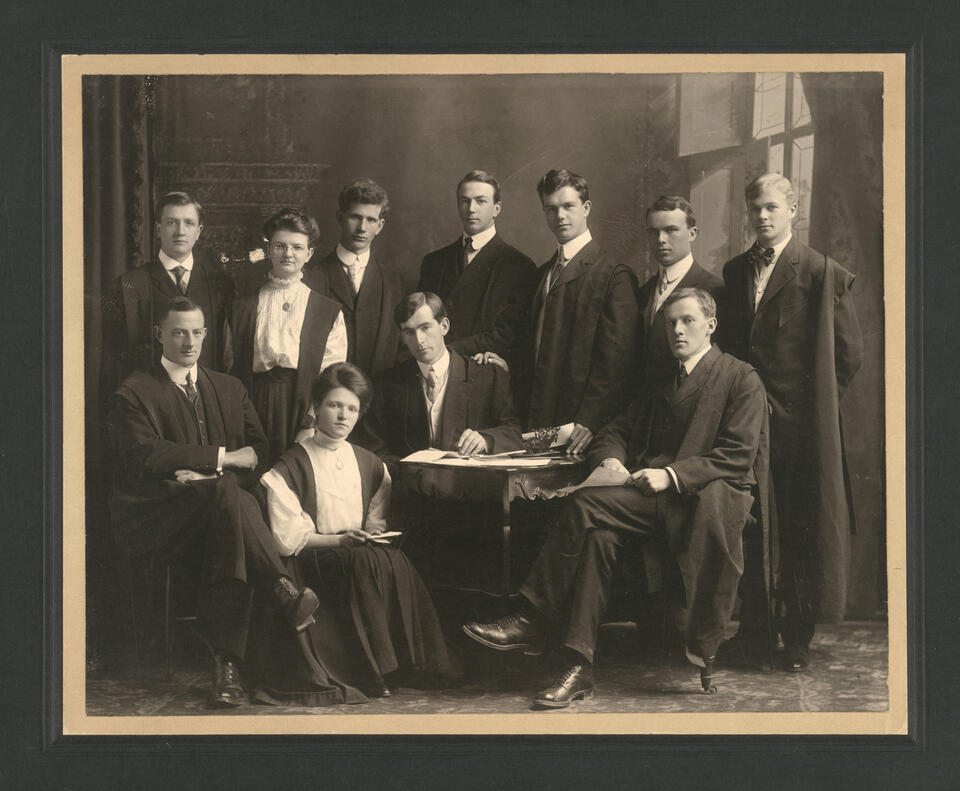
The significance of this state of affairs is not lost on these students, and it is not lost on your authors. We do, however, want to use this series to start a much less common conversation.
Why do graduate students stay?
What does it mean to pursue a graduate education in the current climate? To be told you have no future, and then to face that future all the same?
Across the country, graduate students find meaning, personal and professional fulfillment, and community through their studies. Graduate work, while producing a thesis or dissertation, is much more than the final product. It is the culmination of the many connections that make up the graduate student experience. Whether at conferences, the archive, or late-night grading sessions, the mentorship and camaraderie gained throughout counteract the idea that graduate work happens in isolation and instead highlight the collective experience at the heart of our studies. Curating strong relationships remains a constant and immovable feature of intellectual and personal growth.
Yet, finding and building these vital networks with peers can be a slow process. This is only exacerbated by the large distances between our institutions. As two PhD students studying in Montreal, we are privileged to find ourselves in a city with an expansive academic community fostered by four graduate history programs. Not all graduate students have this luxury. Given the challenges that confront graduate students, it is more important than ever to build strong networks between emerging scholars. Graduate students have much to learn from one another. If we choose to stay, what can we accomplish when we choose to stay together?
To this end, the Canadian Historical Association’s Graduate Student Committee (CHA GSC) is partnering with Active History (activehistory.ca) to organize a bilingual, coast-to-coast series for current graduate students to reflect on their experiences at institutions across the country. We hope this collection will serve as a “state of the field,” shedding light on emerging research and fostering understanding and connection among graduate students, postgraduates, and faculty. This series will contribute to the CHA GSC’s efforts to foster country-wide information sharing and support emerging scholars in a changing academic landscape.
Katie Carson is a senior fellow and lead editor of the Active History team at McGill University. Her current doctoral research focuses on the intersection of transnational labour solidarities and human rights activism in the postwar period.
Tiffany Chénier is the McGill graduate student representative on the Canadian Historical Association’s Graduate Student Committee. Her current doctoral research examines the global movement of Canadian-generated timber capital throughout the nineteenth century.
This post was produced within the project Historicizing Our Times: Histories of Migration and Climate in the Digital Space, which is supported in part by funding from the Social Sciences and Humanities Research Council.
This work is licensed under a Creative Commons Attribution-NoDerivatives 4.0 International License. Blog posts published before October 28, 2018 are licensed with a Creative Commons Attribution-NonCommercial-ShareAlike 2.5 Canada License.