
By Theodore Aretakis
In the recent 2026 Québec elections, one topic once again captured the electorate’s attention: immigration. The Parti Québecois (PQ), which formed a minority government, presented twelve points on immigration during their campaign, notably setting permanent targets to roughly 35,000/year—a stark drop from last year’s figure of 60,000. PQ leader Paul St-Pierre Plamondon describes this initiative as important to the “protection of the French language, [the party’s] ability to deliver public services, and in terms of housing, and equal opportunities.”[1]
While this policy presents itself as a response to contemporary concerns, debates over immigration are nothing new for the francophone province. For decades, Québecois have grappled with the complexities of immigration in the context of their national project and perceived standing in Canada. However, this is not simply a two-sided debate. The Confédération des travailleurs catholiques du Québec (CTCC), whose statements and policies during the post-war period spanned both support and opposition, complicated the binary between “pro-” and “anti-” immigration. Examining the context and reasoning behind the contradictory sentiments of CTCC leadership and the rank-and-file provides insight and nuance into the development of the immigration debate in Québec.
The union’s periodical, Le Travail, offers a window into this complexity. In these pages, articles appealed to new arrivals by advertising their immigration support services and defending immigrants’ position in Québec society. At the same time, writers criticized government immigration policies and quotas, blaming them for high unemployment rates and the housing crisis.

By the 1950s, the CTCC had undergone reforms that enabled it to tackle the “immigrant question.” At its inception in 1921, the union aimed to be a Canadian organization “with no affiliation to international federations” that organized the country’s Catholic workers. Following the Second World War, however, its mandate shifted under the administration of President M. Gérard Picard and General Secretary Jean Marchand. Under their leadership, in 1947, the CTCC affiliated with the International Confederation of Christian Unions, reformulated its membership requirements, and reframed its religious character. Instead of requiring members to be Catholic, workers simply had to “align their words and actions […] with the CTCC’s guiding principles.”[3]
The final change came when the CTCC proclaimed its belief in “true political democracy,” a system that Québec historian Jacques Rouillard described as “guaranteeing citizens’ freedoms” and affirming the equality of all humans.[4] The union’s opposition to any unfair treatment on the grounds of language, nationality, race, gender, and religion thus solidified. In line with this new openness, CTCC representatives attended the National Conference on Immigrant Issues in Spring 1951, held under the auspices of Catholic Action Canada in Montréal. The event’s theme, “They are Our Brothers,” provided organizations with the chance to “familiarize themselves with all aspects of immigrant issues” and equipped them to take “positive and practical action.”[5] At the end of the conference, attendees unanimously passed a series of resolutions. Most notably, every organization in French Canada was expected to establish a special committee to address the obstacles immigrants faced.
In response to this resolution, Le service d’immigration de la CTCC was founded in 1951, reflecting a commitment to helping newcomers. In the January 1952 article announcing the service’s arrival, union president François Krakowski noted it would be “a massive undertaking to help these people find jobs, adjust to life in the country, and settle their families, especially at a time when many people are either fully or partially unemployed.”[6]
Le Travail’s writers would go on to write extensively about the service. As per one article, between 1951-52, the CTCC’s service assisted roughly 6,000 immigrants seeking information on “labour laws, wage levels […] and union organization.”[7] Moreover, according to Krakwoski, the union served workers from a variety of backgrounds, including Poles, Ukrainians, Russians, Belarusians, Romanians, Hungarians, Serbs, Croats, and Bulgarians. The prominence of migrants from traditionally Eastern Orthodox regions signalled the CTCC administration’s commitment to representing non-Catholics. Furthermore, Krakowski pushed back against the myth of the unskilled immigrant, explaining that professionals, including two female medical graduates from the University of Brussels and army officials, were helped through the service.[8]
Le Travail similarly positioned itself as a defender of immigrants, reinforcing the union’s humanitarian philosophy. In a 1952 open letter, an anonymous reader expressed frustration that the CTCC helped immigrants while Canadians struggled to find employment. They accused the union of helping “the Russians and the other communists” while they were “waging war on us too” in a xenophobic tirade. Closing the letter off, the authour wrongfully blamed Soviet émigrés of “[killing their] sons” in Korea.[9]
In response, the CTCC editor reiterated their official stance on the matter, differentiating between supporting immigration during times of high unemployment and helping workers “who [had] been cast into utter destitution here.”[10] The editorial defended immigrants’ claims to institutional support, writing that they deserved the same aid as any other Canadian. Furthermore, living up to the union’s policy of “real political democracy,” they addressed the readers’ generalization, writing that those they helped were not responsible for developments overseas.
At the same time, the CTCC remained critical of mass migration. The union claimed the federal government brought “poor people here to be unemployed” when they could have “earned an honest living in their own country, where they could have easily waited for conditions to improve.”[11] According to the union, the issue was not the immigrants themselves so much as it was the government’s policy towards them.
Oftentimes, the CTCC tied its disapproval of federal policy to two contentious issues: the housing crisis and unemployment. Le Travail writer H. G. Howith remained particularly concerned with both matters in 1957, authoring several articles stressing the severity of the situation. In one, he argued that the National Housing Act (NHA, 1956), “designed to help the consumer purchase or build his home,” failed to provide a safety net for Canada’s poor. He warned readers that “with the population increase, and the heavy immigration expected to continue,” the problem would persist.[12]
Howith’s concerns were not unfounded. In a second article, he stressed how immigrants contributed to increases in both family formations and population. In this context, he reminded the government of their responsibility to help the newcomer, or “the little fellow,” exercise his right to own a home.[13] He discussed unemployment in a similar vein in his article “Unemployment has Everyone Worried,” where he denounced the Tories and encouraged economic planning and social welfare for the unemployed or other “people of misfortune.”[14]
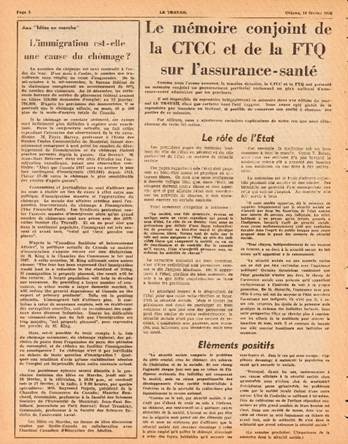
During periods of high unemployment, immigration was a central topic of discussion. So much so that the CTCC addressed its role in a February 1958 article titled “L’immigration est-elle une cause de chômage?” Pushing back against xenophobic narratives, Le Travail argued that immigrants created jobs either “in establishing their own businesses or by investing capital in diverse industries.”[15]
While the union encouraged readers to blame government policy, which it described as “not properly planned,” it occasionally found itself at odds with immigrant workers. This was the case on August 30, 1957, when the CTCC called for an investigation of the placement of immigrants in Murdochville. These calls stemmed from a workers’ strike at Gasper Copper Mines Limited, where management called in strike breakers, many of whom were immigrants of German, Hungarian, and Scandinavian descent who, on August 19, threw rocks at union representatives.
In response to this attack, President Picard demanded the strike-breakers’ “deportation as provided for by immigration law under these circumstances.”[16] This case highlights the limits of CTCC policy towards migrants. Although the union had previously committed to treating all labourers equally, it drew the line when they mobilized against one another. Moreover, in emphasizing the breakers’ ‘otherness’, Picard highlighted underlying anxieties towards migrants during periods of high unemployment and labour unrest.
The recent elections offer an opportunity to reflect on how Québec has approached immigration in the past. The case of Confédération des travailleurs catholiques du Québec is particularly poignant, given that it maintained a nuanced stance on the immigrant question by refusing to fully commit to a “pro-” or “anti-” policy. Indeed, while it criticized quotas and policies in times of high unemployment, union leadership made efforts to draw a line between themselves and xenophobic rhetoric, though not without exception.
It also reminds us of the complexities of immigration discourse. Especially in the Québecois context, where certain parties prioritize language and cultural preservation. While the political landscape continues to change, some ideas do not go out of style. Looking to the future, we can draw on past examples of how to greet new arrivals enthusiastically and help them as they try to find their place in Québec.
Theodore Aretakis is an MA history student at McGill University and is supported by a Canada Graduate Scholarship from the Social Sciences and Humanities Council of Canada. His research focuses on Montréal’s Greek community to explore the phenomena of intra-ethnic conflict and inter-ethnic solidarity among post-war immigrant workers during Québec’s Quiet Revolution. He is currently a research assistant for the Immigrec project and an Active History fellow.
This post was produced within the project Historicizing Our Times: Histories of Migration and Climate in the Digital Space, which is supported in part by funding from the Social Sciences and Humanities Research Council.
[1] “Plan En Immigration,” Parti Québécois, December 8, 2024, https://pq.org/independance/plan-immigration/.
[2] CCQCA, “Chronique Historique: L’expansion Syndicale (1933-1945),” Conseil Central du Québec-Chaudière-Appalaches, accessed October 24, 2026, https://www.ccqca.csn.qc.ca/2018/04/17/chronique-historique-lexpansion-syndicale-1933-1945/.
[3] Jacques Rouillard, Histoire de la CSN: 1921-1981 (Boréal Express, 1981), 178.
[4] Rouillard, Histoire de la CSN, 176.
[5] « Ils sont nos frères, » Le Travail, 23 March, 1951.
[6] « Un véritable inventaire des problèmes des immigrants, » Le Travail (Montréal, QC), 4 May, 1951. Le Travail, 18 January, 1952.
[7] « Six mille immigrants ont été secourus, » Le Travail (Montréal, QC), 12 December, 1952.
[8] Le Travail, 1 February, 1952.
[9] « Un lecteur nous critique, » Le Travail (Montréal, QC), 15 February, 1952.
[10] Le Travail, 15 February, 1952.
[11] Le Travail, 12 December, 1952.
[12] H. G. Howith, “More and Better Federal Housing Aid Badly Needed,” Le Travail (Ottawa, ON), 2 August, 1957.
[13] H. G. Howith, “The Housing Squeeze Pinches the Low Income Group Hardest,” Le Travail (Ottawa, ON), 23 August, 1957.
[14] H. G. Howith, “Threat of Unemployment has Everyone Worried,” Le Travail (Ottawa, ON), 15 November, 1957.
[15] « L’immigration est-elle une cause du chômage? » Le Travail (Ottawa, ON), 14 February, 1958.
[16] « La C.T.C.C. demande une enquête sur les agissements des immigrants à Murdochville, » Le Travail (Ottawa, ON), 30 August, 1957.
This work is licensed under a Creative Commons Attribution-NoDerivatives 4.0 International License. Blog posts published before October 28, 2018 are licensed with a Creative Commons Attribution-NonCommercial-ShareAlike 2.5 Canada License.