
By Katherine Diamond
St. Paul’s Chapel is, by its very existence, emotionally evocative.
The eighteenth-century church, nestled in the bustling heart of Lower Manhattan, has stood sentinel through the city’s greatest triumphs and hardships since 1766. The building’s miraculous survival through the 9/11 attacks, despite being located only a block away from the World Trade Center, defined its modern identity as one of New York’s most iconic landmarks. It is, I imagine, impossible to visit St. Paul’s without being consumed by emotion.
Still, I doubt many tourists can describe their visits as ironic.
The source of that irony met me on the chapel’s eastern façade, in the form of a funerary urn and a commemorative plaque. I distinctly remember feeling as if I was greeting an acquaintance, though not one who liked me very much.
I’m sure Richard Montgomery would have preferred anyone but a Quebecer to visit his gravesite.
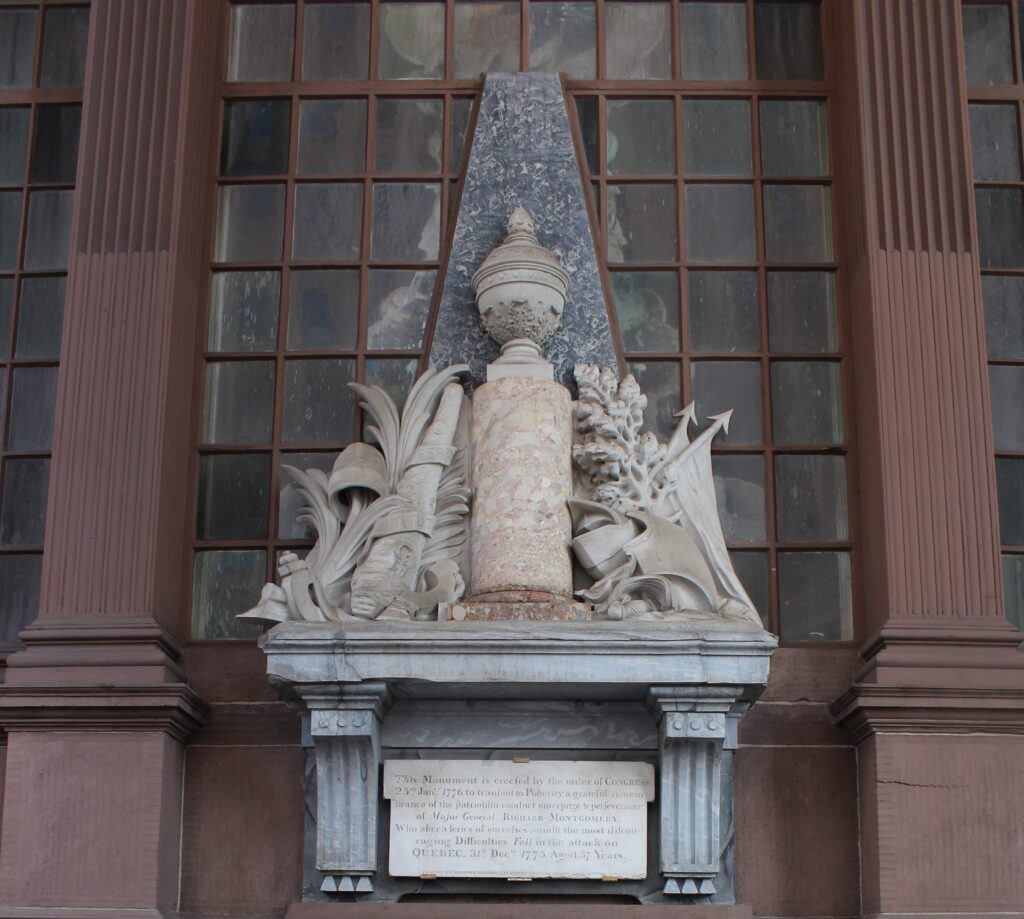
Major General Richard Montgomery (1738-1775) was an army officer tasked with undertaking the Continental Army’s first major military initiative, the Invasion of Québec. His goal, imposed on him by Congress, was titanic. Montgomery was ordered to convince French Canadians to support the burgeoning Patriot cause.
However, in the wake of the Quebec Act (1774), which offered Catholic French Canadians unprecedented religious and legal freedoms, a Continental victory would be hard-won. The civilian population proved uninterested in the tenets of American liberty, and the British military’s presence in the province was formidable.
Still, Montgomery managed to secure several unexpected military triumphs for the Patriot cause in 1775. Over the span of six months, Montgomery not only seized Fort Saint-Jean, which offered the Continental Army strategic control over the Richelieu River, but also successfully captured the city of Montréal on November 13, 1775.
The Invasion of Québec ended when the full force of the Continental Army’s expedition attempted to storm the British military’s most formidable bastion, the city of Québec. While breaching the city walls during a snowstorm, Montgomery and a small party of soldiers were met with a wave of grapeshot from a nearby guardhouse. Montgomery was shot in the head, killing him instantly. In one unforeseen attack, the Continental Army’s ambitious invasion plan came to an end on December 31st, 1775. The Province of Québec never joined their southern neighbours as their fourteenth colony.
The military disaster that was the Invasion of Québec has since faded in the collective cultural memories of Americans and Canadians alike. Montgomery has become a footnote in the broader history of the American Revolution. In fact, most members of the North American public consider the Revolutionary War to have only started six months after Montgomery’s death, with the signing of the Declaration of Independence.
To many, Montgomery’s legacy has become as static as his tomb at St. Paul’s. Passersby might pay him a glance, or pause to hum over the vague familiarity of his name. Otherwise, they move on quickly, hoping to encounter more exciting and recognizable chapters of American history nearby.
But Montgomery’s influence is far from dead.
During a private meeting in Mar-a-Lago in December 2024, President-elect Donald Trump referred to former Prime Minister of Canada, Justin Trudeau, as the “governor” of the “Great State of Canada.”[1] This comment, alongside further calls for Canadian annexation, defined the early years of US-Canada relations during President Trump’s second term. The call for Canada to become the now infamous “51st state” culminated in Prime Minister Mark Carney’s May 2026 declaration that Canada is “not for sale and it won’t be for sale ever.”[2]
Canadians have understood the call for annexation as a product of Trump’s presidency. However, the notion that Canada should join the United States—whether for military, economic, or political benefits—is older than the history of the country itself. Richard Montgomery may have been lost to the annals of history, but the cause for which he gave his life has risen from the dead.
When I tell family, friends, and fellow students that I’m studying American history, I’m frequently met with confusion, sympathy, or disappointment. Canadian and American relations are undoubtedly strained. Yet the overlapping chapters in our national histories are anything but black and white. No better can this be seen than by studying Montgomery himself.
Born in Ireland into a family of Ulster-Scots, Richard Montgomery spent much of his early adulthood serving in the British army during the Seven Years War. Montgomery fought alongside major historical figures in Canadian popular memory, including Guy Carleton and James Wolfe. However, he grew disillusioned with the army after being unable to secure a promotion beyond the rank of captain. In 1772, he moved to King’s Bridge, New York, intending to start a life as a farmer. Instead, he married into the Livingston family, staunch supporters of the Patriot cause. Within three years of his arrival in the Thirteen Colonies, Montgomery was back in military service, this time fighting on behalf of the Continental Army.
Montgomery was not as impassioned by the Patriot cause as the commemorations to his memory would have the public believe. In private letters to his European friends, Montgomery described his hope for political reconciliation with Great Britain. While he respected Congress’ desire to seek independence, he worried about encountering compatriots from his old British regiment, who would now be forced to fight against him. His reluctance to leave domestic life behind, which he repeatedly expressed in his personal writings, challenges posthumous portrayals. Though he may have died for liberty, Montgomery was not an unflinching patriot, as Congress’ memorial to him at St. Paul’s Chapel might have onlookers believe. He was a British citizen, immigrant, and veteran whose complex personal views on American independence complicate our modern understanding of the invasion he led and Canadian annexation as historical phenomena.
After his death, Montgomery was lauded by Congress and civilians alike. Instead of a military failure, he became a martyr around which patriots across the colonies could rally. Montgomery became the subject of speeches, plays, pamphlets, and paintings. His service may have lasted only six months, but his deeds were reframed as noble and sacrificial. Richard Montgomery was, in short, transformed into a figurehead from which future soldiers could take inspiration. After December 1775, American independence was suddenly a cause for which soldiers would not only fight, but die for.
In death, Montgomery had undergone a transformation that ignored his complex and multifaceted past. Studying his participation in the American Revolutionary War provides historical context for understanding modern U.S.-Canadian relations. My stop at St. Paul’s Chapel bridged the gap between contemporary international affairs and the birth of the American nation itself.
Dead men may tell no tales, but they aren’t voiceless. Their words and actions echo into discussions on our modern news networks, political disagreements, and day-to-day anxieties.
Yes, my visit to St. Paul’s Chapel was ironic.
But the man I went to visit didn’t stay quiet about it.
Katherine Diamond is a Master’s student of History at Université Concordia. She is currently studying the role of political commemoration in the development of national American identity during the Revolutionary period. Her experiences working in postsecondary, museological, and heritage spaces have impassioned her to seek out ways to foster the love of history in the general public, primarily through the development of publicly accessible research tools and educational programs.
This post was produced within the project Historicizing Our Times: Histories of Migration and Climate in the Digital Space, which is supported in part by funding from the Social Sciences and Humanities Research Council.
[1] Jessica Murphy, “Trump Takes Jab at ‘governor’ Trudeau,” BBC News, December 10, 2024, https://www.bbc.com/news/articles/ckgx1ezpx52o.
[2] John Paul Tasker, “Carney tells Trump Canada is not for sale, president praises PM as a ‘very good person’,’” CBC News, May 6, 2025, https://www.cbc.ca/news/politics/carney-trump-first-meeting-washington-1.7527102.
This work is licensed under a Creative Commons Attribution-NoDerivatives 4.0 International License. Blog posts published before October 28, 2018 are licensed with a Creative Commons Attribution-NonCommercial-ShareAlike 2.5 Canada License.