
Daniyal Elahi and Harris Elahi
In December 2025, ActiveHistory.ca published our first piece on Private Hasan Amat, a soldier of the 1st Battalion, Canadian Expeditionary Force, killed at the Battle of Hill 70 on August 20, 1917. To our knowledge, he is the first identified Muslim soldier killed in action serving with the CEF. He is also one of twenty-two known Muslim soldiers to have served in Canadian uniform during the First World War.
This article is about how we found him. It is also about what we did with that knowledge after the file was closed.
How the Search Started
In 2024, before we had ever opened an LAC personnel file, we were doing background reading for an academic article on Canadian and South Asian service in the First World War. In one of the secondary sources, a passing footnote mentioned a Muslim soldier killed at Hill 70 in 1917. The footnote did not name him and there was no reference. We bookmarked it and moved on.
In November 2024, a junior cadet at our corps, 337 Queen’s York Rangers in North York, told Daniyal that he wished he could see more people who looked like himself in Canadian remembrance. That sentence stayed with us. We had a corps standing parade the following week, and the gap between the cadet’s question and what we could answer felt larger than it should have.
We went back to the footnote. We wanted to find out who he was. What followed was about ten months of searching. Most of the work happened in two places: Library and Archives Canada (LAC) and the Commonwealth War Graves Commission (CWGC) database. Both are open access, but neither is straightforward.
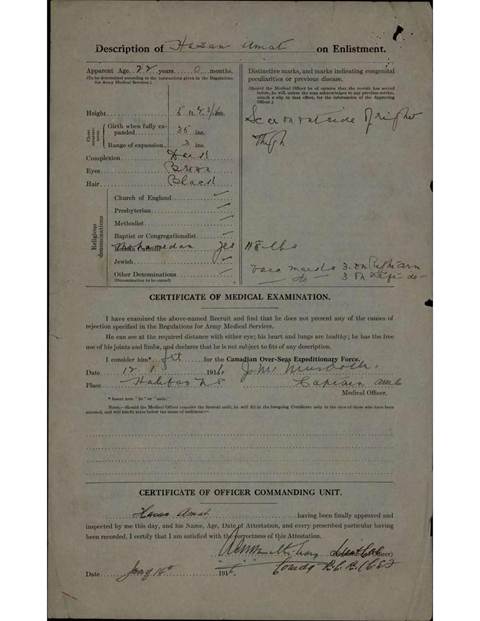
Figure 1. From the attestation papers of Pte. Hasan Amat, attested at Halifax, Nova Scotia, on 14 January 1916. The handwritten entry alongside “Mohamedan” under religious denominations is the field that made him visible in the LAC personnel database. Source: Library and Archives Canada.
The Attestation Paper
Every CEF soldier’s file at LAC begins with an attestation paper. It records name, age, birthplace, occupation, next of kin, and religion. For most soldiers it is the most informative single document that survives.
The first problem is the names. Colonial-era clerks recorded non-anglophone names phonetically. French, South Asian, Eastern European, and other names were transcribed inconsistently between documents. The LAC database requires near-exact matches, so a researcher who tries only the obvious spelling often finds nothing. The footnote we had been working from gave us a partial spelling that returned no result. We tried several variants, but nothing came up.
The fix was to search by unit. Once we knew the soldier had been killed at Hill 70, we cross-referenced the 1st Battalion nominal roll against deaths from August 1917 and filtered by birthplace. One soldier was listed as born in Singapore and enlisted at Halifax in January 1916. We opened his file. The first line of his attestation paper read “Hasan Amat.” Under religion: “Mohamedan.”
Religion as a Filter
“Mohamedan” is an outdated term, but it is consistent across CEF records, and the LAC database treats it as a searchable field. This is not a small detail. In CEF files, Christian denominations were standardized while minority faiths were inconsistently recorded or sometimes omitted completely. The explicit entry in Amat’s file is what made him visible inside an archival system that often obscures the very identities it should preserve.
Once we knew the field was searchable, we cross-referenced it with the LAC personnel database. The query returned a manageable list of CEF soldiers recorded as Mohamedan, Sikh, Hindu, and other minority faiths. Most of them survived the war. Amat was the only one currently confirmed killed in action.
The Personnel File
The personnel file is where biography emerges. The attestation paper is a snapshot. The rest of the file is the story.
Amat’s file shows his path was not direct. He was born in Singapore and employed as a seaman before the war. He enlisted in Halifax in January 1916 and was medically discharged from his first unit, the Royal Canadian Regiment, and re-enlisted within weeks. He trained in England. He fell ill more than once. While the medical entries are brief, the dates accumulate. He was eventually transferred to the 1st Battalion, a veteran formation that had been in France since early 1915.
The document that gave us pause was his military will. CEF soldiers signed wills before deployment. Amat’s is dated August 17, 1916, while he was serving with the 4th Overseas Pioneer Battalion. He left everything to a John R. McLellan of New Glasgow, Nova Scotia but we do not know who McLellan was. Amat lived another year. He was killed at Hill 70 on August 20, 1917.
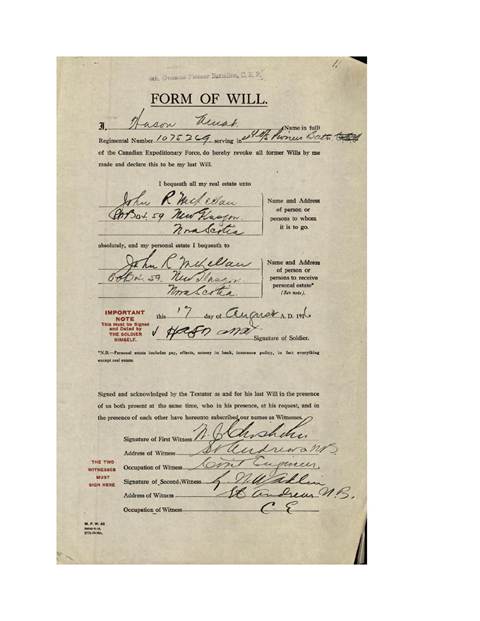
Figure 2. Military will of Pte. Hasan Amat, 4th Overseas Pioneer Battalion, C.E.F., signed 17 August 1916. He bequeathed his real and personal estate to John R. McLellan of New Glasgow, Nova Scotia. Source: Library and Archives Canada.
That sequence is not in any database. It comes from reading the file in order, page by page, and noting the dates as they appear. The personnel file is often skipped after the attestation paper, which is a common pitfall. It is often the only document that turns a name and rank into a person.
The War Diary & The CWGC Record
Every CEF unit kept a war diary, digitized through LAC. The 1st Battalion’s diary for August 1917 covers Hill 70 in operational detail. It does not name Amat. War diaries rarely name individual soldiers below the rank of officer. What the diary gives is crucial context. For Amat, the August 20 entry describes the battalion holding captured ground against German counterattacks at heavy cost. The distance between “killed at Hill 70” on the casualty list and what that meant on the ground runs through the war diary.
The Commonwealth War Graves Commission database is free and fully searchable. Every Commonwealth soldier killed in both World Wars has an entry. For Amat, the CWGC record confirmed that his body was never recovered. His name is engraved on the Vimy Memorial among Canada’s missing, without reference to birthplace or religion. In death, at least, he is commemorated as a Canadian soldier among Canadians.
However, the uniformity of the inscription honours every soldier equally. It also obscures what made each one specific. The CWGC record tells you he died. It does not tell you how he lived. For that, you must go back to LAC.
What Followed
The research was complete. What remained was the question of how to share it. The December 2025 Active History piece was the first public output. From there the project moved outward in directions we did not initially plan for.
The cadet corps where the project began has formally adopted the lesson. The commanding officer of 337 Queen’s York Rangers, Capt. James Kelly, CD, confirmed in writing that “Leadership Under Fire: Lessons from Hill 70,” the leadership module we wrote around Amat’s transfer and the August 20 action, will be on the 2026–2027 training calendar. The lesson teaches small-unit decision-making at section and platoon level using a Canadian Muslim soldier as the worked example. It runs annually.
In Canadian secondary schools, the same archival material has been adapted into an Ontario-curriculum-aligned module. The first pilot was delivered cold by a Grade 10 history teacher at Stephen Lewis Secondary School in the Peel District School Board in February 2026, without us in the room. Crescent School followed in April. The Toronto District School Board is reviewing the materials for use in Islamic Heritage Month programming.
Beyond the cadet corps and the classroom, a commemorative poster carrying Amat’s portrait and a short biographical summary is on permanent display at the Islamic Forum of Canada, a North York Mosque with approximately a thousand weekly congregants, and at Crescent School in Toronto. In December 2025, we gave a forty-minute talk to a few hundred senior students at the Right to Play Community Centre near Lahore, Pakistan. Six Pakistani national television networks covered the event. Project content reached a broad public audience online between November 2025 and May 2026, with paid promotion supported in part by a Veterans Affairs Canada Commemorative Partnership Program grant.
Other commemorative outputs are in train with Legion Magazine, Veterans Affairs Canada, the Commonwealth War Graves Commission, and the Vimy Foundation.
A bench and plaque in Amat’s name have been commissioned by the Hill 70 Memorial Foundation for the memorial site at Loos-en-Gohelle, France. The installation is fully funded through private donations we raised. To our knowledge, it will be the first dedicated permanent commemorative memorial to a Canadian Muslim soldier of the First World War. A site survey is scheduled for June 2026 ahead of the 109th anniversary of the battle in August.
Recovering a soldier like Amat adds to Canadian wartime history without changing it. The story is the same. There is now more of it to tell. What began with a footnote and a junior cadet’s question now has a permanent memorial in France and a place on the 337 Queen’s York Rangers training calendar.
Why This Matters Beyond Amat
The method we used is not specific to one soldier. Attestation papers, CWGC records, personnel files, and war diaries exist for every CEF soldier who served. Most of these records are free and online. The barrier is knowing what to look for and working through how a colonial military bureaucracy recorded the people it documented.
Our reading of CEF records suggests there are other minority soldiers whose service has been recorded but not surfaced. Some are recoverable. Others may not be. The work is incremental and slow. What we have tried to show with Amat is that even one file, read carefully, is enough to put a name back into the historical record and, with the right partners, into stone.
We are two cadets from North York. We started with a footnote and a public archive. So can anyone.
Daniyal Elahi, a Warrant Officer, and Harris Elahi, a Sergeant, are cadets with the Royal Canadian Army Cadets at 337 Queen’s York Rangers in Toronto. They founded Our Shared Sacrifice in September 2025 to recover underrepresented soldiers of the Canadian Expeditionary Force. The Hill 70 Memorial Foundation has adopted their research and commissioned a memorial bench and plaque in Pte. Amat’s name at Loos-en-Gohelle, France. In 2026 they received the Lieutenant Governor’s Ontario Heritage Award for Young Heritage Leaders.

I have two posts of interest to you, https://cefrg.ca/private-laal-m-singh-in-the-great-war/ and https://cefrg.ca/private-sunta-gougersing/. Many Sikh, Hindu and Muslim soldiers are not properly commemorated in CWGC cemeteries (and they know it), but Sir Fabian Ware decided in 1926 that the mistakes were far too costly to correct.