
Nastasha Sartore
Earlier this year, over forty people logged in to Zoom to attend a CHA webinar titled “Generative AI and the Practice of History.” Introduced as a “show and tell” for AI tools and strategies, the webinar included a panel of three expert historians who each presented on a distinct topic related to agentic AI, the tech that’s been dominating headlines since the release of Chat GPT to the general public in November 2022.
While I was hoping for a lively conversation about AI and creative thinking, writing, labour, and capitalism, much of the discussion centred around “best practices,” revealing what I felt was a relatively uncritical acceptance of these dynamic platforms. During the Q&A, most discussants sought answers on how to apply AI tech “responsibly” in their pedagogical and scholarly work. I, on the other hand, was left wondering about a much more essential, epistemic question, one that gets to the root of our role as scholars, teachers, and citizens of the world: how will the process of cognitive “offloading” shape, and potentially harm, the creative potential of our scholarship? Will there be any space left in our praxis for curiosity? Wonder? Possibility?
I suddenly felt I had missed something in recent months. How and when had we reached the consensus that offloading and outsourcing our more arduous tasks was decidedly “good,” for history as practice, for the university, and for our engagement with the world more broadly?
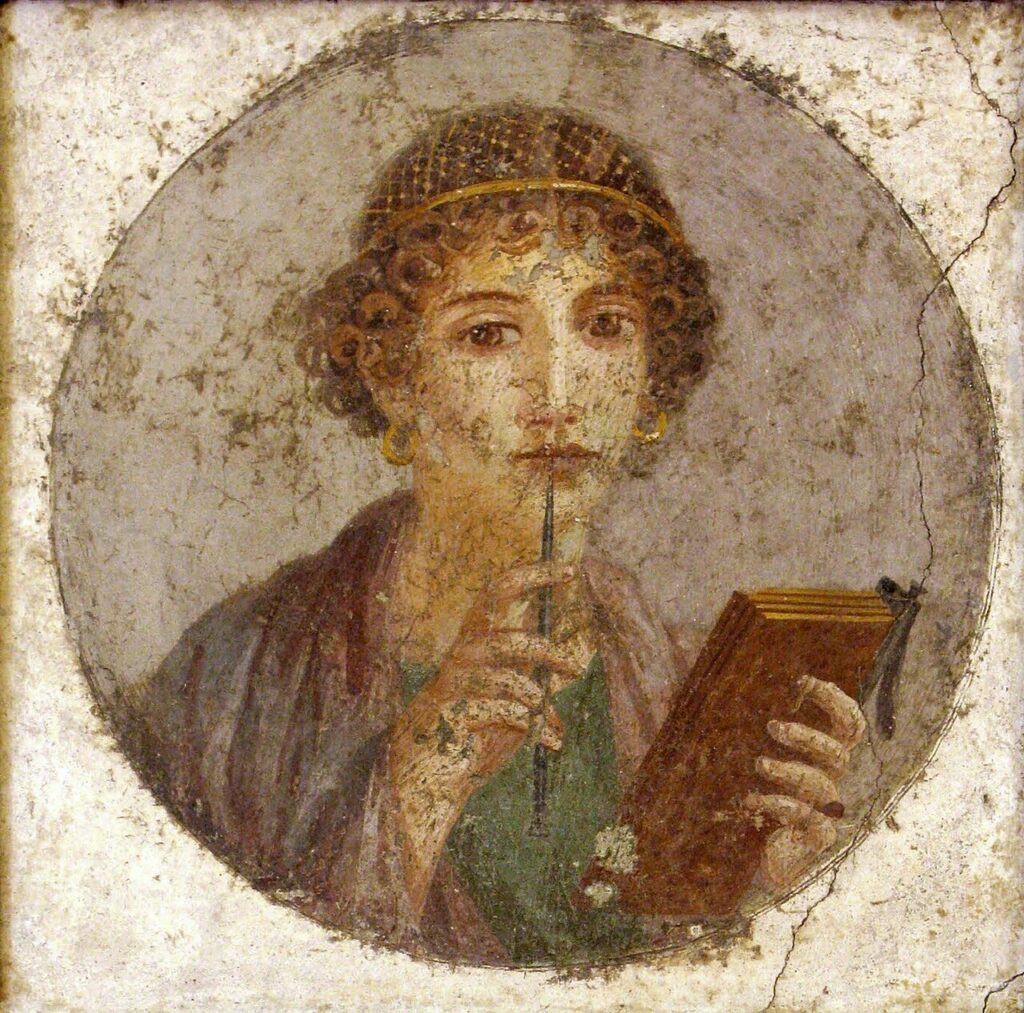
Woman with wax tablets and stylus, 55 -79 AD, public domain
Our dynamic encounters with agentic AI are clearly resulting in a bifurcation of our research tasks into those that we can or “should” offload to AI, and those that we should not. Writing, most agree, is a hard no, unless it’s for reviewing structured writing like grant applications. So, too, is locating source material. Transcribing these materials, however, is a task some claim is particularly well-suited to existing AI technologies. In fact, a couple of historians, including one of the webinar panelists, Mark Humphries, have even developed an AI tool to transcribe handwritten historical documents more quickly and more accurately than earlier systems.
Traditionally, this is the kind of paid work that has been reserved for graduate students, or other under- or precariously-employed humans, who rely on this kind of experience and supplementary income to get by and find future work. Even if senior scholars continue to make a concerted effort to hire research assistants to do “human-required” labour, the use of AI will still eliminate paid work in what is already a wildly competitive, precarious job market for new PhDs. This example speaks to how AI systems serve capitalism very effectively. The more we adopt AI technology, the more we fuel the industrialist, capitalist obsessions with productivity, efficiency, and profit.
The bigger, though not unrelated, questions I have relate to our creative processes and potential for political activism as researchers, writers, thinkers, and scholars of the past. As I’ve alluded to, adapting our workdays and workstyles to AI tech means abiding by the logic of capitalism, undermining efforts we might otherwise expend to produce activist or radical history. Besides resisting the constraints of capitalist stricture, tasks like transcribing, reviewing, summarizing, locating sources, compiling citations, and even sorting notes and indexing, help us solve problems and access creative thought. When we work on these purportedly unproductive or simply boring tasks, our minds often wander. This is hardly a bad thing. Stories abound of creative thinkers and artists who spent hours daydreaming as they took long walks and performed tasks unrelated to their “work.”
During my own workdays, I’ve solved many small yet meaningful research quandaries while doing busywork: I’ve stumbled across a great idea jotted down on a forgotten sticky note while revisiting handwritten notes; rediscovered a fantastic article that got lost in my Zotero bibliography; and found the ideal quote to open a book chapter while tracking down page numbers missing from a footnote.
Recent research on mind wandering and daydreaming also touts the wonder of the cognitive processes unlocked by performing busywork. UBC professor and psychologist Kalina Christoff Hadjiilieva suggests that it is precisely this kind of unstructured (or less structured) thought that stokes imagination and inspiration. It may also be worth mentioning here that Christoff Hadjiilieva sees modern tech as a significant barrier to this kind of creative thinking.
This reminds me of those rare but exciting eureka moments when, through open association and directionless thought, I discover complex connections between the narratives, sources, and theories I’ve been mulling over. Ezra Klein recently reflected on how often these moments arise for him during plane rides, a place that I, too, have done great writing. Call me a romantic (I am), but these insights, I think, reveal the magic, discovery, and possibility that come with practicing history. During the CHA webinar, panelist Ian Milligan called this “friction,” something he admitted was necessary for some historians. But this is not simply a difference in method, and by treating it as such, we risk offloading creativity itself to AI. Friction, research suggests, is actually essential to the kind of broad, creative thinking that produces innovative scholarship.
As Ed Dunsworth put it in his wonderful piece in AH last June, “We are not widget producers. Or at least, we should not be. We are producers of knowledge, of analysis, of ways of understanding the world.” To this, I would add, we are storytellers, and builders of hope and radical possibility for our present and future worlds.
Further Reading
Christoff Hadjiilieva, Kalina. “Mindfulness as a Way of Reducing Automatic Constraints on Thought.” Biological Psychiatry: Cognitive Neuroscience and Neuroimaging 10, no. 4 (2024): 393-401. https://doi.org/10.1016/j.bpsc.2024.11.001.
Echeverri Álvarez, Mariana. “Beyond Tech: What Does Responsible AI Mean in Higher Education?” UM Today, Apr 21, 2026. https://umtoday.ca/stories/beyond-tech-what-does-responsible-ai-mean-higher-education.
Gross, Terry. “Michael Pollan Says AI May ‘Think’ –But It Will Never Be Conscious.” Feb 19, 2026. Fresh Air. Produced by Anna Bauman and Susan Nyakundi. https://www.npr.org/2026/02/19/nx-s1-5713514/michael-pollan-ai-consciousness-a-world-appears.
Wong, May. “Stanford Study Finds Walking Improves Creativity.” Stanford Report, Apr 24, 2014. https://news.stanford.edu/stories/2014/04/walking-vs-sitting-042414.
Nastasha Sartore is a historian of gender, labour, and everyday life in modern Britain. She is currently working on her first book project, which reimagines the intimate lives of women living on the margins of society in late-Victorian and Edwardian London. Nastasha earned her PhD from the University of Toronto in 2024 and is the Elizabeth and Cecil Kent Postdoctoral Fellow in the Department of History at the University of Saskatchewan for 2025-7.

You have hit upon a very important question about AI use: as it replaces ‘menial’ tasks, is it adversely impacting our cognition?
I appreciate the allure of an AI program that will ‘read’ through handwritten documents and provide a transcription. I’ve read through every HBC post journal in the Lake Superior District from the late eighteenth century to the early twentieth century. I transcribed what I read. It was tedious, time-consuming, and foundational to my research.
It was only by reading and transcribing dozens and dozens of journals that I picked up on the seasonal, monthly, weekly, and sometimes daily rhythms at the posts. All of that, I think, is lost when someone puts a scanned copy of a post journal into a program and asks it to transcribe. I appreciate that someone can reply, “You’re still reading the document, even if it’s transcribed”; however, I think you lose something when you don’t struggle with the handwriting. I think it activates other parts of your brain and requires greater concentration, similar to the difference between a student who records a lecture, types their lecture notes on a laptop, or writes notes by hand.
Once it is transcribed, it is a short step to telling an AI program to look for patterns in the documents. I’m afraid we are going to start outsourcing our thinking.
Hear, hear!
I agree with everything in this blog post. In addition to the psychological and environmental costs of this technology, I also think that historians should be much more mindful about their use of AI tools like LLMs. Given current polling trends, especially among Generation Z, LLMs are losing public appeal. Have historians considered the impacts of using LLMs for research, writing, and PowerPoint presentations on the profession’s credibility?
In addition to the financial crisis afflicting the sector, we are already living in a time of deep distrust towards universities and university instruction. The last thing we need is the further erosion of the profession’s credibility in the eyes of the public and our students. Credibility is a hard thing to repair. Perhaps the profession should take greater care to consider it.