
Edward Dunsworth
While a small but vocal minority of historians have embraced the use of generative artificial intelligence in their research and teaching,[1] many of us find ourselves trying to hold the pedagogical line against what we perceive as serious threats to students’ ability to learn, reason, and express themselves intelligently.[2]
In this post, I share my attempts to “teach against AI” in an undergraduate course taught at McGill University in fall 2025. HIST 299, The Historian’s Craft, is an introductory theory-and-method class recently made a requirement for history majors. My objectives were for students to consider some of the major questions in the philosophy of history, learn about important changes over time in historiography, learn about some of the main ways that people “do” history, and then to try their hand at doing it themselves, via research and writing.
As I’ve made clear in past pieces, I don’t believe that generative AI has anything useful to offer students towards the attainment of any of these goals. To the contrary, I think it poses a significant danger to students’ ability to think independently and develop as thinkers, writers, and human beings. Emerging research supports my concerns.
I thus adopted a number of strategies in this course to encourage students to do things the “old school” way, with the aim of fostering the learning and skill development at the core of our mission as educators in humanities and social sciences. In what follows I outline what I did, what I didn’t do, and what students thought about it all.
What I Did
- Talk about AI from the jump. The first assigned readings of the course were Active History pieces by me and Mark Humphries in which we take different sides on the use of generative AI in teaching history. This debate informed our first in-class discussion, in which students expressed a range of views on the pros and cons of AI in education. My goal was not to convince them of my position (what could be more cringe?), but instead to encourage reflection on what it is that historians – and humanists – do, and how generative AI might support or challenge that. I felt that this earnest, constructive discussion, addressing the elephant in the room, set a positive tone for the remainder of the semester.
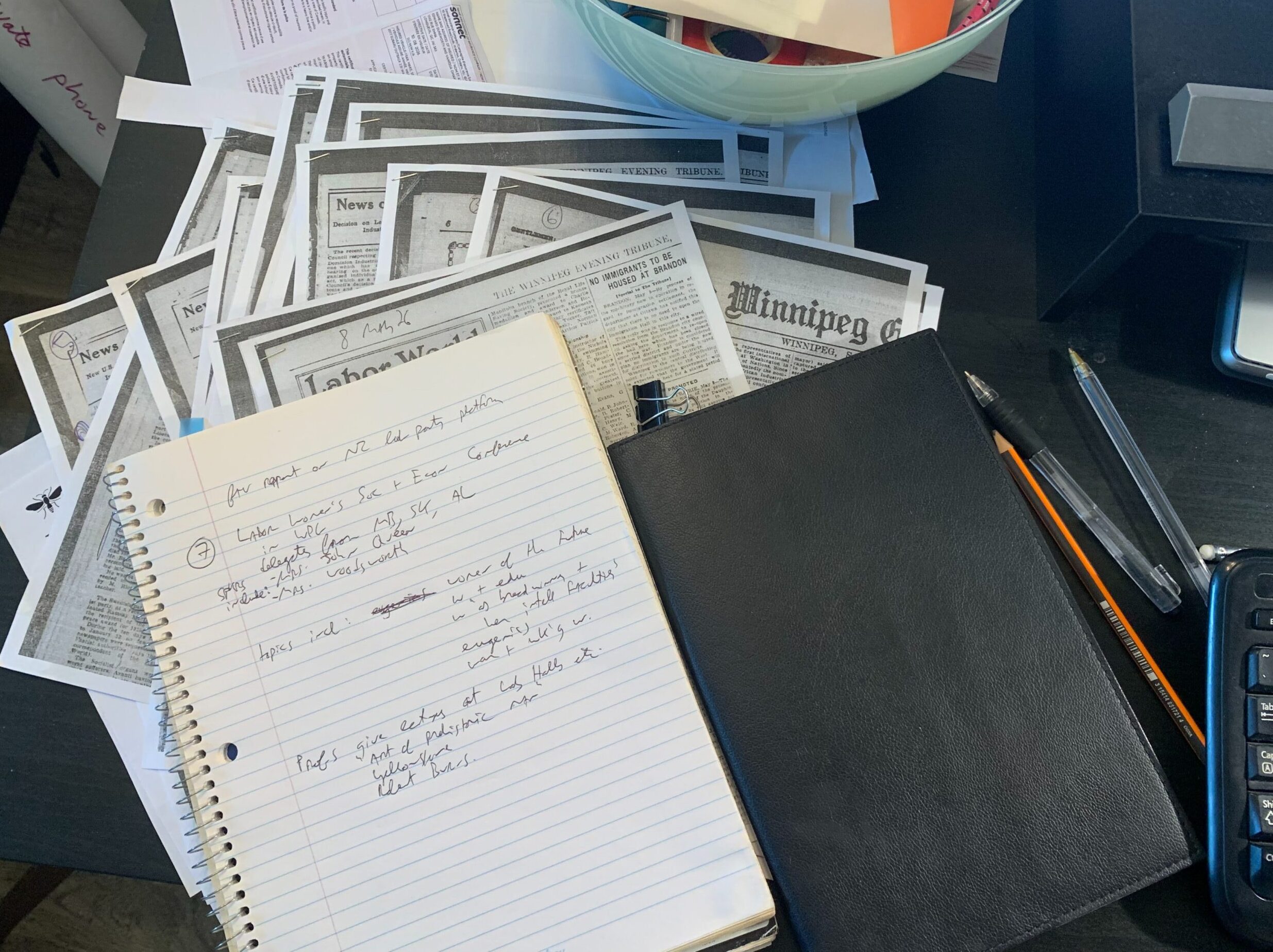
- Printed course packs. Even before the release of ChatGPT and the AI tools that followed, I harboured doubts about assigning students digital readings. Personally, I read much more effectively on the page versus on the screen. Research shows that I am not alone. I had long fantasized about assigning only hard-copy readings, but the ascendance of generative AI gave me the final push I needed. I assembled the assigned readings and sent them off to a student-run print shop, which sold the 271-page course packs for just under $20 each. It should be noted that this takes some more organization on the part of the professor, considering the lead time needed for printing. No more finalizing readings on the night before the first class; no more “readings TBD” on the syllabus. Surely this is a healthier practice anyway, even it requires slightly more August effort.
- Laptop ban. As with the course packs, this change was something I had pondered for years. It really had nothing to do with AI, but instead with the sense that laptops in class do not, in fact, help learning, but instead hinder it. Distraction is one thing. But even for undistracted laptop users, I question the benefits of the tool, particularly for notetaking during lectures. Laptops allow for a near-transcription level of notetaking. But is near-transcription a good way to take notes? My position is that it isn’t. A crucial skill that notetaking develops is to filter a lot of information down to its most important points. To use a culinary metaphor, a student should learn to create a reduction, boiling off the excess so that a denser essence remains. The process starts with lectures and readings. The student should take notes, but crucially the notes should be vastly shorter than the original source material. Then when it comes time to write an essay or prepare for an exam, the student reviews their notes and reduces further into an outline or study guide or something else. It has always seemed to me that notes taken on a laptop delay and perhaps even dissuade this practice of reduction. I don’t believe this to be a trivial matter in the slightest. Whether we call it reduction, filtering, funneling, or creating a hierarchy of information, this practice of organizing and ordering information is one of the core skills that we teach in higher education – and perhaps even more in history than in many other disciplines. So, I banned laptops.[3]
- In-class writing. Understanding the easy temptation of using generative AI for assignments such as reflection papers, I shifted this sort of assignment to in-class. Adopting a practice from my high school English teacher Geoff Peate (shout-out Mr. Peate), I had students do “power writing.” Ten times throughout the term, students would spend the first ten minutes of the class responding to a prompt, using paper and pen. It didn’t matter how much they wrote or how “brilliant” it was. They just needed to write. At the end of the ten minutes, students would deposit their page in their individually labelled file folder, which I lugged to and from class every time in a file box. It was not as awkward as it sounds.
- In-class reading and discussion. Students were assigned plenty of take-home reading to do on their own time, but I also sometimes used class time to have them read something short and discuss it. This was not so much a reaction against AI (though of course we know that students are often using AI to summarize their readings), as it was a valorization of reading time. If reading is so important (as I believe it to be), then why not devote some class time to it?
Interlude: what about accessibility?
I would hope this goes without saying, but just in case it doesn’t: of course, students with accessibility reasons for reading on the screen, or using a laptop in class, or students with any other accessibility requirements were accommodated, just as they would be in any other of my classes. See endnote #3 regarding accessibility and the laptop ban.
What I Didn’t Do
- Do away entirely with at-home assignments. I want to create structures in my classes that encourage students to develop as thinkers and writers. But I can’t control everything, nor do I want to. I am a teacher, not a cop. So I persist in assigning students conventional essays, while nurturing the skills needed to produce them independent of generative AI tools. Along the way I try to convey to students the benefits of old-fashioned research and writing for their own learning and development. As Mack Penner quipped in our co-authored piece about AI in classroom, adjustments to course delivery are well and good, but “We might also have a crack at persuasion.”
- Use AI detectors. Again, not a cop. And again, let’s try persuasion.
What Students Thought
In order to gauge students’ reception of HIST 299’s experimental components, I added tailored questions to the course evaluations that asked students about the in-class writing (“power writing”), laptop ban, and printed course pack.
In general, students responded positively to all three measures. The images below summarize their responses.
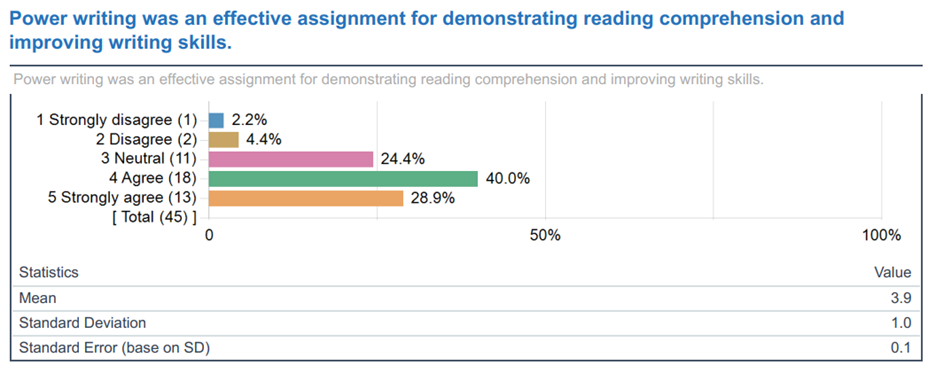
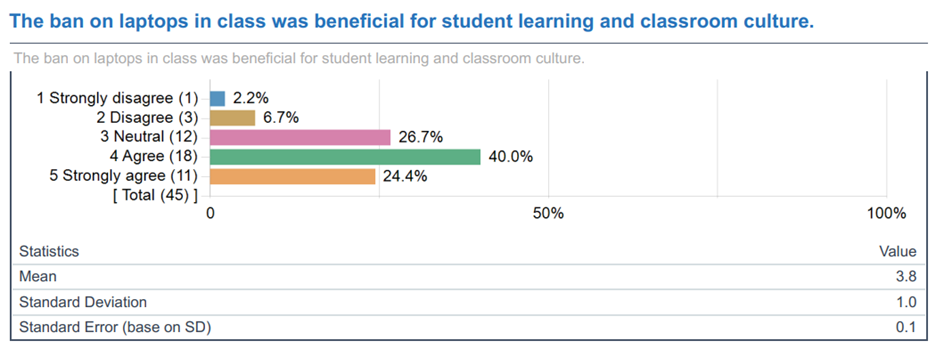
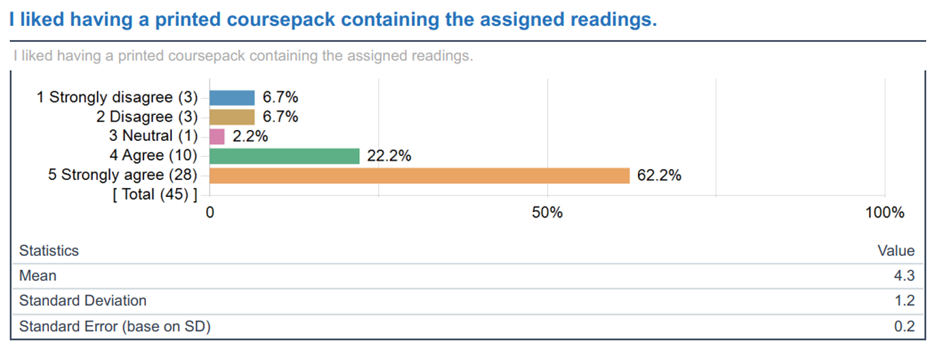
The quantitative data is useful, but student comments are even more revealing. Let’s consider responses to the three questions in turn.
In their comments, many students thought power writing to be an effective way to ensure the completion of readings but were less convinced that it helped them improve their writing. As one student shared: “It definitely ensures that people do the reading, and encourages them to really comprehend it. However, I don’t think it does much for writing skills because there is no opportunity to edit or plan what you write due to the limited time and lack of preparation. If it is intended to ensure comprehension, it is effective, but it does little for writing skills.” I take students’ points here, but am inclined to think that power writing at the very least loosened them up as writers, evidenced the steady lengthening of students’ submissions as the term progressed.
As for the laptop ban, only one student took the time to write a negative comment about it. The majority found it beneficial. Said one student: “Considering another class in which I had access to a laptop, I personally feel as though it made me far more effective and engaged as a student.”
The smash hit of the course’s experiments was the printed course pack. 84% of respondents liked having a printed course pack, with 62% expressing strong support. Again the comments are revealing. Of 22 comments made about the course packs, 19 were positive and 3 negative. Particularly striking is how effusive the positive comments were. A selection:
- This was very helpful! Much easier to read a physical copy, and it meant I could easily reference writings during [tutorials] and I wasn’t distracted by my screen.
- I hate doing readings on my computer so this really helped my eyes
- “We love reading on paper” – Everyone, at any point in time.
- My brain retains more information when it comes from the page
- LOVED!
- My eyes thank you for this one, I love not reading on a screen.
- It provided me with a greater ability to mark down my thoughts and an easier way to bookmark segments I consider interesting.
- I love love love the reading packet provided even though we had to pay for it. All profs should do this!
- I really appreciated having a course pack dedicated to our course’s reading material. It was refreshing to have my readings in print and helped me stay organized throughout the semester.
Final Thoughts
HIST 299 was my favourite course I’ve ever taught. The low-tech experiments were only part of that. The much bigger factor was the students, the vast majority of whom were keen and bright and constructive, making class stimulating and fun.
I do think that the low-tech experiments helped unleash this creative group of young people. Without laptops, students were more likely to talk to each other. With in-class writing, reading, and discussion, students engaged in collective endeavours rather than simply attending a lecture as passive receptors of information.[4]
Different professors will adopt different approaches to AI – and tech more broadly – in their classrooms. Indeed, one professor might take different tacks for different courses (I certainly do). My aim here is not to insist upon one correct way of doing things but simply to share the results of one historian’s ongoing pedagogical experimentation in an era of impressive socio-technological change and challenge.
Edward Dunsworth teaches history at McGill University and is a member of Active History’s editorial collective.
[1] At the February 2026 Canadian Historical Association panel, “Generative AI and the Practice of History,” for example, one panelist (Mark Humphries) repeated his oft-stated assertion that generative AI tools have either developed intelligence or that the question is moot since their outputs can’t be differentiated from humans’. Another panelist, Ian Milligan, criticized historians who weren’t using AI as somehow falling down on their job duties by remaining stubbornly inefficient. I find the first position preposterous and the second offensive but will leave my commentary to that. (The third panelist, L.K. Bertram, presented a more measured take on the use – and sometimes non-use – of AI technology in historians’ work.)
[2] Is my position in many ways a conservative one? Yes, it is. Does this make me, a committed socialist, a bit uncomfortable? Actually, no, not really. Leftists’ revolutionary aims get all the press, but leftism almost always contains strands of conservatism. We may want to conserve, for example, human dignity, freedom of thought, leisure time, forests, oceans, animals, insects, and so on. So, yes, I am a conservative when it comes to resisting the unchecked incursion of generative AI into our thinking and writing, especially in educational settings. Sue me.
[3] My sociologist colleague Barry Eidlin gave me an excellent strategy for implementing a laptop ban without discriminating against students with accessibility needs. The language in my syllabus makes it clear that students with accessibility requirements can of course use laptops if needed. Furthermore, any student at all who wishes to use a laptop need only to set up a meeting with the professor to explain why. This prevents students with accessibility needs from being “outed,” since laptop users in class could also be students who simply requested permission. In practice, few students avail themselves of this option.
[4] To be clear, I am not anti-lecture. In this particular class I did very little lecturing, but in other courses I adopt a more traditional approach. Different courses call for different tactics.

Thank you for a very interesting article. I think you took a very reasoned approach to your course, readings, and student work. I’ve been teaching university and secondary students for the last thirty years, and AI (when used for cheating) is the biggest challenge I’ve encountered.
In September, I’ll be teaching two undergraduate courses. I have also instituted a laptop ban, except for students registered with student services who require one. All assessments will be handwritten in class (unless, again, someone has an established reason for a laptop), and based on classroom material and student research. Students won’t receive the prompt until class starts, which will also (hopefully) minimize AI use to create their work.
I’ve read some research (albeit in news articles) that handwriting engages other parts of your brain and helps reinforce what you are learning (writing with a stylus on a tablet is the same). In my experience, students who took notes with a laptop transcribed without thinking.
Laptops are certainly useful tools; however, free access at all times isn’t helpful for students. They were always distraction machines, and now, with AI, they are increasingly becoming cheating machines. Some of my senior high school students asked me to ban them in seminars, as other students would ask AI to respond to questions or comments made in the seminar and then paraphrase the response as if it were their own. As soon as AI emerged, I started catching about 20% to 30% of my class using it to write their essays or create their presentations. It took hours to establish that these students cheated. I had to switch to in-class essays.
Many of those students have now graduated and are either at or headed off to university. You might see some of them in your classes come September.
I realize that copyright issues are different in Canada than the U.S., but how are you navigating copyright issues in your printed course packs? Kinkos lost a major law suit against publishers on just that issue because they didn’t do copyright clearance (which would raise the price of the course pack).
Thanks as always for your thoughtful comments, David. Interesting note re handwriting. For myself I certainly find I retain things better when I write by hand.
Chris, good question. I’m not a copyright lawyer, but I believe that assigning excerpts of books or articles for which the university pays subscription fees is considered “fair dealing.”
Thank you for writing this piece, which is a breath of fresh air. I have to-date not been persuaded by the bullish case from some members of the historical profession that LLMs are “inevitable” or that we need to use them to “adapt” to the future. The evidence marshalled in favour of the bullish case has been minimal, if not zero. In actuality, there is a lot of evidence against the benefits of LLMs for the profession and society as a whole, as per the reporting and analysis of journalists like Ed Zitron, Cory Doctorow, and Karen Hao. After seeing some long-tenured historians use LLMs to generate tasteless images for their slideshows at the Canadian Historical Association’s annual meeting in PEI and attending that CHA panel on AI in the spring, where one panelist claimed without evidence that we are witnessing an “intelligence revolution” (whatever that means), I think it is time we saw more measured and productive responses, as outlined in this blog post.
David, have you checked to see if the handwriting research held up after the news story buzz? My understanding wasn’t replicated. A laptop ban without Ed’s care forces students with language based disabilities to out themselves to the class. I know I would have just dropped the class as an 18 year old. I agree that AI is a massive challenge for teaching and learning. It is also a big help for a lot of neurodivergent people who’ve struggled in school until technology made it possible for us to read/write. I really hope professors grapple with both sides of that equation.
I know I’ve shared this many times but when I took this course with Prof. Travis Bruce in the fall semester of 2021, it changed my life. It opened my eyes to not only the value and challenges of doing history — especially ‘good’ history — but also the joy of it. Based on these comments, I’m willing to bet some of your students came away with a similar sentiment. In the age of AI, I think HIST 299 is more important than ever, and I’m glad to see that McGill has made it a mandatory part of their undergraduate History program.
HTST 300 is the University of Calgary undergraduate methods class. We have group discussions and in recent years, I’ve asked students submit their handwritten notes along with the group sheet so that students are not just signing the sheet. I noticed that the discussions improved and that they took good notes. I’m also lucky that the archivists at the University of Calgary/Glenbow Reading Room are excited to work with undergraduates. Student papers are based on archival work. We spend a week in the archives with them and they must do an additional 5 hours of research – again very lucky that the archivists are willing to keep track for me. Students are initially worried about the research, but really enjoy it. And their papers are pretty good!