
Rosemarie Forsberg
In 1979, lesbians in Fredericton, New Brunswick, found community not in a dedicated gay bar or a visible neighbourhood, but on the dance floor of the Cosmopolitan Club. On Thursday nights, women quietly gathered with friends, effectively “queering” a predominantly heterosexual venue. In a city without lesbian bars, bookstores, or formal organizations, even a dance floor could become a place of belonging. From 1979 to 1995, lesbians in Fredericton actively built and sustained physical and imagined queer spaces that fostered community, activism, and belonging. Whether through dances, newsletters, phone lines, private homes, or women-only organizing, these spaces reveal how meaningful lesbian community could flourish beyond Canada’s metropolitan centres. In recovering these histories, Fredericton’s lesbian spaces emerge not as exceptions to Canadian queer history, but as evidence that community has always existed.
Queer history in Canada is often centred on the country’s largest urban centres: Toronto, Vancouver, and Montreal. Histories of queer activism have long focused on these cities, where visible institutions such as bars, bookstores, political organizations, and later gay villages left a stronger archival footprint. Much of the scholarship has similarly centred the experiences of urban gay men, tracing legal milestones such as decriminalization, police repression, and the rise of liberation movements. However, this focus overlooks the rich and varied experiences of lesbians in places like Fredericton, where queer history did not always take the form of visible institutions. Lesbian histories outside major cities challenge the assumption that queer communities depended on permanent spaces such as gay villages or commercial venues. Instead, many rural and small-city lesbians built networks through temporary gatherings, personal relationships, and community-based organizing.
As the provincial capital and home to two universities, Fredericton occupies a unique position within New Brunswick’s largely rural landscape. For many lesbians living in smaller towns, it became the nearest place to find others like themselves. Women travelled hours by car to attend dances, softball tournaments, and other events in the city, while local publications and phone networks helped sustain connections across long distances.
One of the clearest ways that lesbians created space in Fredericton was through community organizations. The founding of Fredericton Lesbians and Gays (FLAG) in 1979 gave lesbians access to meetings, dances, discussion groups, and a volunteer phone line. Even without a permanent headquarters, FLAG transformed temporary spaces such as university classrooms, church gymnasiums, and rented halls into meaningful queer spaces. However, the 1980s brought a notable decline in lesbian participation in mixed queer organizations like FLAG, shaped by broader tensions including lesbian separatist politics and ongoing experiences of misogyny and marginalization within male-dominated queer spaces. Across Canada, many lesbians responded to these tensions by creating women-only spaces that prioritized lesbian voices outside of male-dominated gay spaces. In Fredericton, this shift contributed to the founding of WOMYN in 1991, a lesbian-focused group that hosted and organized a variety of social activities, including dances, potlucks, barbecues, and softball games. By organizing regular social events in dedicated spaces, WOMYN created consistent opportunities for lesbians to build relationships and foster a sense of belonging.
Nightlife was another important way that lesbians in Fredericton carved out space, even without a dedicated lesbian bar. In the 1970s, lesbians gathered at the Cosmopolitan Club, a straight-owned venue on King Street that became a key nightlife spot for both gay men and lesbians, especially on Thursday nights. Because it was still risky for lesbians to dance openly with other women, gay men and lesbians often danced together in mixed pairs to appear as a heterosexual couple. By the 1980s and 1990s, this nightlife expanded through FLAG’s mixed dances and later WOMYN’s women-only dances, which offered safer and more intentional spaces for the lesbian community, visibility, and belonging.
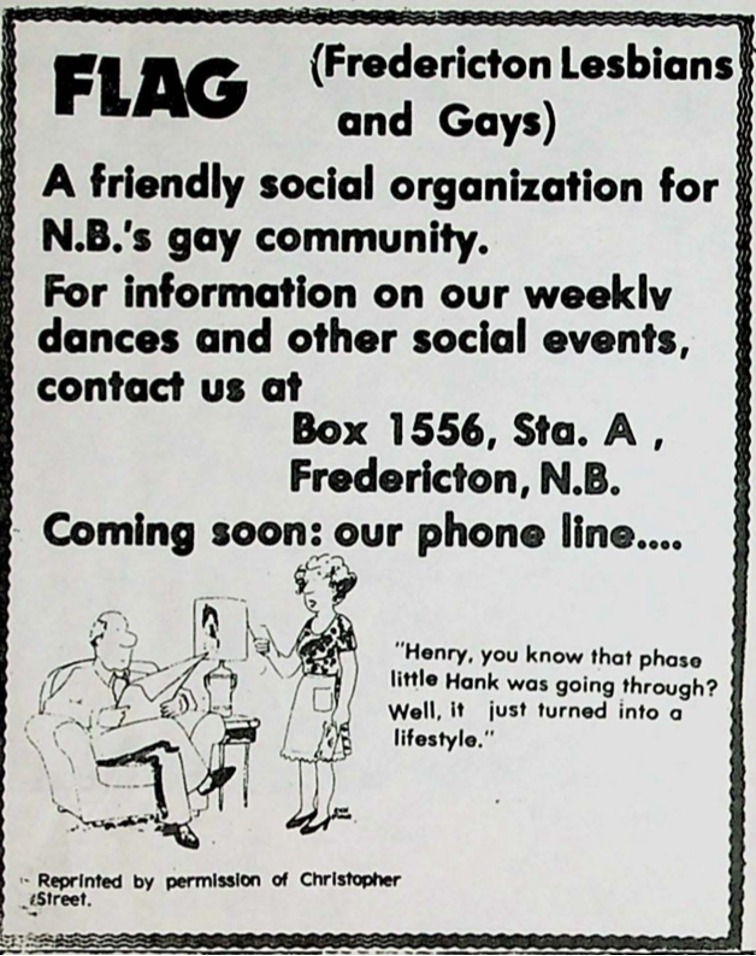
An advertisement for Fredericton Lesbians and Gays (FLAG) from the first edition of Flag Mag, 1980. (Flag Mag No. 1, September 1980: 2)
New Brunswick’s expansive natural landscape offered lesbians opportunities to gather and socialize through activities like hiking, camping, and team sports leagues such as softball, creating alternative spaces for connection outside of traditional venues. Unlike queer bars or meeting spaces, which were often temporary, exclusionary, or inaccessible, the outdoors offered a consistent and flexible environment where lesbians could gather while resisting discrimination and navigating the misogyny often present in mixed-gender queer spaces.
The 1990s saw a shift toward more lesbian-centred outdoor activities. Softball became a defining feature of lesbian life in Fredericton, with women’s teams emerging as early as the 1970s and growing in number in the 1990s. More broadly, softball became historically associated with lesbian communities across North America because it was inexpensive and provided opportunities for women, many of whom were unmarried, to participate in organized team sports. Unlike bars or bookstores, softball took place in public parks, making it more accessible and less dependent on commercial businesses or private venues. In Fredericton, WOMYN organized specifically lesbian-centred softball events, including the Annual Labour Day Lesbian Softball Tournament, which combined games with social activities such as dances and house parties. Through softball, lesbians in Fredericton created space for meaningful social interaction, both on and off the field.
Beyond the rented community centre halls and the softball fields, another kind of space thrived. It was not built with walls and doors, but comprised of phone calls, newsletters, and a collective identity. These imagined spaces, while intangible, offered structure and support, allowing Fredericton’s lesbian community to grow in ways that defied geographic spaces. In Fredericton, imagined space became vital. In a city where spaces for queer collectivity were often private, temporary, subject to discrimination, or dominated by gay men, imagined space became a necessary means for lesbians to find one another, build connections, and foster a sense of belonging, even without meeting face to face.
Queer organizations played a central role in producing these imagined spaces. Beginning with informal word-of-mouth networks in the 1970s, lesbians often relied on chance encounters and personal connections to meet others, a system that was both intimate and limited in reach. By the 1980s, organizations such as FLAG expanded this informal network through more structured forms of communication, especially through their newsletter Flag Mag, which circulated promotional events for FLAG, queer news, opinion pieces, and personal reflections. FLAG also created the Gayline, a volunteer-run phone service, often manned by lesbian members, that provided anonymous support, information about events, and was often a first point of contact into Fredericton’s queer community.[1] At the same time, campus-based organizing through the Gay and Lesbian Alliance of UNB (GALA) extended these networks through social events, columns in The Brunswickan, and campus radio programming, creating overlapping channels of communication that connected lesbians in Fredericton through shared information, media, and identity as much as through physical space.[2]
The 2000s marked a transitional period in Fredericton’s lesbian and broader queer history, as visible lesbian-specific spaces declined while digital communication and more inclusive organizations became more prominent. Although lesbian-specific venues and organizations are harder to trace in the archival record, lesbian presence did not disappear but instead shifted into new forms of visibility through activism, media, institutional spaces, and emerging online networks.
From informal word-of-mouth networks and softball fields to newsletters, radio programs, and church hall dances, lesbians in Fredericton consistently created spaces of connection, belonging, and resistance across changing social and political landscapes. While these spaces were often temporary, overlapping, or difficult to trace, they demonstrate that lesbian communities in the 1970s-1990s were not absent from Atlantic Canada but were actively constructed through both physical and imagined forms of space. This history challenges assumptions that meaningful queer life only existed in major urban centres, instead showing that lesbians in Fredericton were active in shaping their own communities. They built networks of friendship, love, and support, and created events, spaces, and shared meanings that gave depth and visibility to queer life in Fredericton.
Rosemarie Forsberg graduated with a master’s in History from Wilfrid Laurier University. She recently worked as an archivist at the Provincial Archives of New Brunswick and is now exploring the field of librarianship through her work at the London Public Library
Resources/Further Reading:
The Queer Heritage Initiative of New Brunswick (QHINB) https://www.queerhistoriesmatter.org/qhinb
Exploring Queer History and Activism in New Brunswick: CNBRDP https://canadacommons.ca/artifacts/30160044/exploring-queer-history-and-activism-in-new-brunswick/31059889/?__cf_chl_tk=0xGOgfaO4OSKugEJAX3NSMiZSlBUI_cTrXZqverpl3Q-1776288880-1.0.1.1-J6qV6IzhEFGDrg9yOdKWIbexi6DRWuF45Zd0Bs4QQW4
Falvey, Conor. “Foregrounds: Mapping Gay, Lesbian & Bisexual History in Fredericton, 1969-1992.” Master’s thesis. University of New Brunswick, 2015.
Warner, Tom. Never Going Back: A History of Queer Activism in Canada. Toronto: University of Toronto Press, 2002.
[1] Sorry! Wrong Number!” Flag Mag, April-May 1986: 6.
[2] “Update on GALA,” Flag Mag, November-December 1992: 9..
This work is licensed under a Creative Commons Attribution-NoDerivatives 4.0 International License. Blog posts published before October 28, 2018 are licensed with a Creative Commons Attribution-NonCommercial-ShareAlike 2.5 Canada License.