
Cynthia Wright and Franca Iacovetta
In November 1926, Emma Goldman, then 57 and beginning a first period of exile in Toronto, enthused over a “radiant” young Italian woman seated at a welcoming dinner for Goldman organized by the city’s Jewish anarchist comrades.[1] Just over six months later, Goldman dubbed Marie Tiboldo “a terrible prude” who did “not feel anything deep enough, whether…for a man or ideas, to do anything worth while.” Tiboldo appears only fleetingly in Goldman’s estimated 200,000 letters, but her assessment of the young woman’s shortcomings aligns with Goldman’s pronounced tendency to go hot and cold with friends, comrades, and lovers. It’s not surprising, then, that Goldman also emphasized her continuing interest in “Marie,” writing that “I do not mean to give her up” and “I will certainly see much of her.”[2]
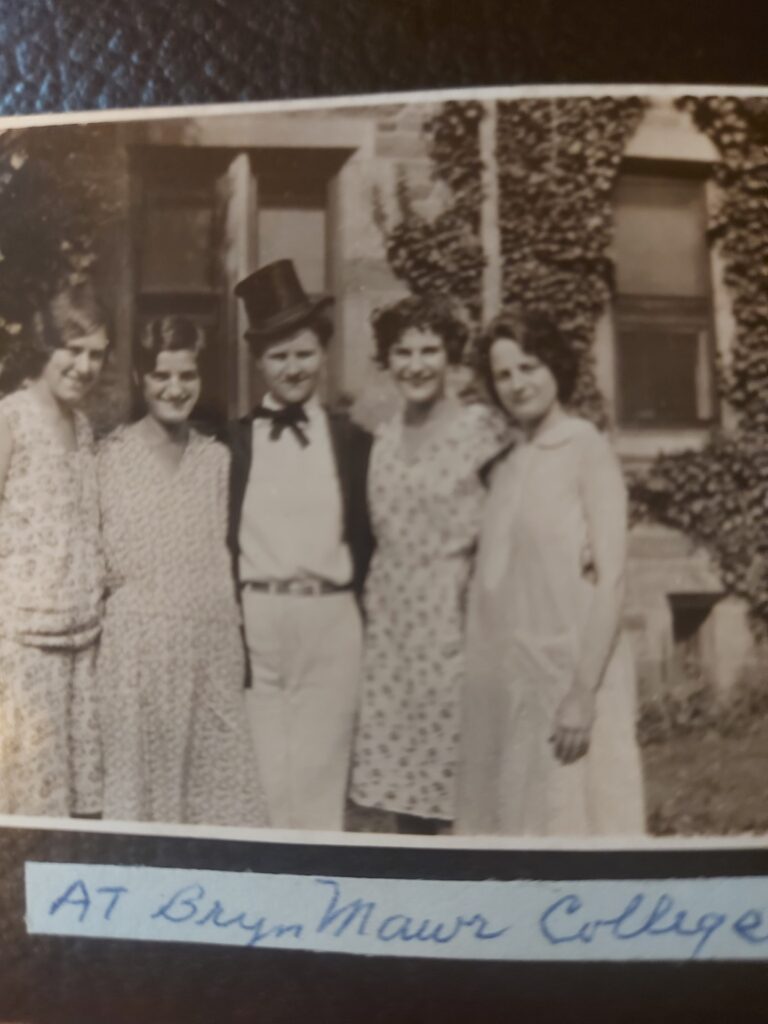
Marie Tiboldo (far right) at Bryn Mawr Summer School for Women Workers, 1929 (Julia Barnett Collection)
A Toronto-based protégé of Goldman’s (1869-1940) who outlived her “idol” by almost 70 years, Tiboldo (1904-2008) has remained virtually unknown even to Goldman specialists. Unlike some working-class women anarchists who, like Rose Pesotta, consciously fashioned their own archives, Tiboldo left behind no papers.[3] Goldman’s fame has often obscured the lives of other anarchist women but occasionally – as with Tiboldo – it has revealed clues about lesser-known figures in the period’s anarchist circuits.
Initial leads beyond Goldman’s letters were few but tantalizing, especially a short interview with a 99-year-old Tiboldo published in 2004 by Julia Barnett, a much younger socialist feminist who had befriended Tiboldo. A US composer we met at a symposium marking the 150th anniversary of Goldman’s birth led us to his brief 1993 videotaped interview with Tiboldo.[4] Research required attentiveness to inconsistences in the sources and the complex work of memory in the life of a long-lived Italian Canadian working-class anarchist. Our interest in Tiboldo stems from our project on how Goldman’s Toronto exile has been made and re-made inter-generationally in the city’s popular memory, with a focus on the political and cultural stakes of these reactivations.[5] Tiboldo played a role in creating that memory, but her own story offers intriguing glimpses into the trajectory of Toronto anarchism.
Tiboldo was the US-born and Canadian-raised daughter of northern Italian anarchists who left the United States in 1914 for Toronto. Their radical networks in the city included an anarchist circolo in which Marie’s father, Lorenzo, was a driving force and the anarchist Branch 339 of the mainly Jewish (and socialist) Workmen’s Circle. The latter facilitated Goldman’s initial encounter with Tiboldo. As late as 1993, Tiboldo remained friends with Branch 339 co-founders, Morris and Becky Langbord.[6]
A teenaged Tiboldo was hired in an embroidery shop in Toronto’s garment industry. She became a skilled embroidery worker and later designed embroideries for the “luxury trade,”[7] but exploitative conditions prompted worker unrest, leading to union activism and strikes. Led by socialists and Communists embedded in a vibrant Jewish working-class culture, garment workers, including women, became militants.[8] Among the few young Italian women in the sweatshops, Tiboldo became a labour activist in this milieu, but the sources contain inconsistencies.
One narrative has Tiboldo single-handedly organizing her shop right after being hired in 1920. Consulting the Labour Gazette indicates instead that Tiboldo emerged as a rank-and-file organizer during a North American-wide organizing campaign launched in 1925 by the International Ladies Garment Workers Union (ILGWU).[9] A US-based international union affiliated with the American Federation of Labor, the ILGWU grew significantly in these years due in part to the militancy of young immigrant workers in New York City, many of them Jewish and Italian women. A union heavily shaped by anarchists and socialists, and a key site of working-class feminism, the ILGWU embraced a social unionism that heavily promoted workers’ education and culture and a “labor interracialism” that “elevated racial cooperation among the working classes as integral to a more egalitarian future.”[10]
Tiboldo’s possible involvement in a successful 1926 strike by the Embroidery Workers Union, an affiliate of the ILGWU as Local 7 (Toronto), might explain her election not long afterwards as a delegate of that union to the Toronto Trades and Labour Council. And in 1929, she attended the Bryn Mawr Summer School for Women Workers, an immersive two-month program for industrial women workers that was also attended by Goldman comrade and anarchist labour organizer, Rose Pesotta.[11]
While Tiboldo had many male suitors, she neither married nor lived in a free love union. Influenced by Goldman’s radical views on sexuality and birth control, Tiboldo promoted young single women’s sexual autonomy, insisting they learn about sexual pleasure before marriage, not only the mechanics of pregnancy and giving birth.[12] Tiboldo praised the courage of the birth-control activists of her youth, though she likely knew that Goldman (among others) introduced Margaret Sanger to the birth-control cause, and then criticized her for abandoning radical politics for eugenics.[13] Proud of her association with Goldman’s famous April 1927 birth control lecture in Toronto, one that left a lasting impact on other left-wing women of the period,[14] Tiboldo critiqued the professionals, and their wives, who refused to chair the event. She recalled being horrified by Goldman’s suggestion that she chair it (thereby prompting Goldman’s ire) but agreed to be put “through some exercises” because it meant being with her “idol.”[15] Birth control activist Alice Loeb chaired the lecture.
Our forthcoming chapter on Tiboldo, which also covers her activism in the 1940s within the Communist-led United Electrical Radio and Machine Workers of America as well as her relationship with other Italian anarchists, offers further insights into the trajectory of working-class anarchism. Examining Tiboldo’s life on its own terms challenges any easy divide between sexuality-and-free-love rebels, of which Goldman is considered the exemplar, and anarchist labour organizers. Goldman’s own early history in the sweatshops is often ignored along with the material rhythms and conditions of her life as a revolutionary.[16] Goldman cultivated cross-class publics, but never lost ties with working-class anarchists for whom birth control and sexuality were fundamentally class issues and not external to class struggle. The Anarchist Queen could complain about her, but Tiboldo’s memories offer us valuable insights both into Goldman’s Toronto exile and the political choices made by Toronto’s anarchists before and after Goldman’s death in 1940.[17]
Franca Iacovetta is a Toronto-based historian and a member of the riseupfeministarchive.ca collective.
Cynthia Wright teaches in the School of Gender, Sexuality and Women’s Studies, York University, Toronto/Tkaronto.
Today (August 21, 2026) marks the 133rd anniversary of Emma Goldman’s famous Union Square, New York City “take bread” speech.
[1] Cited in Theresa Moritz and Albert Moritz, The World’s Most Dangerous Woman: A New Biography of Emma Goldman [hereafter WMDW] (Vancouver: Subway Books, 2001), 54.
[2] Emma Goldman Papers Public History Project, Emma Goldman to Ben Capes, 13 June 1927.
[3] Maria Tamboukou, “Labour Activists’ Archival Assemblages and Resistability in Memory Work: Emma Goldman, Jean Désirée, and Rose Pesotta,” Labour History 129 (November 2025): 29.
[4] Julia Barnett, “The Life and Times of Marie Tiboldo” [Barnett, “MT”]; New Socialist 46 (2004): 20-21; Interview with Tibaldo (sic) by Leonard Lehrman [LL interview with MT], Toronto, 1993, posted 2019, https://www.youtube.com/watch?v=t0BWLXGc3F4. Also, Minerva Davis, The Wretched of the Earth – And Me (Toronto: Lugus Publications, 1992), 83-6; Coleman Romalis, Emma Goldman – The anarchist guest (Documentary) 2000.
[5] Currently entitled Remembering Emma Goldman in Toronto: Making Intergenerational Radical Memory.
[6] ancestry.com Marie Tiboldo; Barnett, “MT”; LL interview with MT.
[7] Davis, Wretched, 88-9; LL interview with MT.
[8] Ruth Frager, Sweatshop Strife: Class, Gender, and Ethnicity in the Jewish Labour Movement of Toronto, 1900-1939 (Toronto: University of Toronto Press, 1992), chs. 5-7.
[9] Barnett, “MT”; Davis, Wretched, 88-9; Labour Gazette, April 1926, 397.
[10] Quotation from Victoria W. Wolcott, “Networks of Resistance: Floria Pinkney and Labor Interracialism in Interwar America,” Journal of African American History (Fall 2020): 569; Annelise Orleck, Common Sense and a Little Fire: Women and Working-Class Politics in the United States, 1900–1965 (Chapel Hill: University of North Carolina Press, 1995); Jennifer Guglielmo, Living the Revolution: Italian Women’s Resistance and Radicalism in New York City, 1880–1945 (Chapel Hill: University North Carolina Press, 2010); Daniel Katz, All Together Different: Yiddish Socialists, Garment Workers and the Labor Roots of Multiculturalism (NYC: NYU Press, 2011).
[11] “Workers Are on Strike After Union Is Formed,” 5 February 1926 and “Workers Back on the Job,” 9 February 1926, Toronto Daily Star; Labour Gazette, April 1926, 387, 397; Tiboldo at Bryn Mawr, Globe and Mail, 3 August 1929; 1985 documentary, The Women of Summer : Bauman, Suzanne.
[12] LL interview with MT; Barnett, “MT.”
[13] Candace Falk, Love, Anarchy, and Emma Goldman (New York: Holt, Rinehart, and Winston, 1984), 222-54.
[14] Dorothy Livesay, Journey with My Selves: A Memoir, 1909-1963 (Douglas and McIntyre, 1991), 66.
[15] Barnett, “MT”; LL interview with MT; Moritz and Moritz, WMDW, 86-8.
[16] Tamboukou, “Labour Activists,” 15.
[17] Cynthia Wright and Franca Iacovetta, “Radiant Creature and Anarchist Queen: When Marie Tiboldo Met Emma Goldman,” in Catherine Carstairs, Kassandra Luciuk, and Nadia Jones-Gailani eds. Feminist Provocations: Gender, Migration, and Activist Histories (University of Toronto Press, forthcoming).

What interests me most is how quickly Emma Goldman seems to have revised her opinion of Marie Tiboldo.
In November she is “radiant”; a few months later she is a “terrible prude” who apparently lacks sufficient passion for either men or ideas. And yet Goldman still refuses to give up on her.
There is something wonderfully impractical about that. A revolutionary determined to smash social conventions appears to have maintained a fairly demanding private quality-control system for other people.
Tiboldo is almost more interesting for precisely that reason: a labour activist, a working woman, an advocate of sexual self-determination, yet apparently unwilling to become exactly the kind of liberated woman Goldman had in mind.
Perhaps that is one of the more reliable side effects of great personalities:
They fight for freedom.
Then they are disappointed when other people use it differently.