
Kevin M. Anzzolin
Since publishing my first book in 2024, I’ve turned my attention to gathering material for a second. Provisionally titled A View from the North: Lost Anglo-American Literature on Mexico from the Twentieth Century, I am exploring pulp novels, young adult adventure stories, tales of espionage, tourist guides, and yes, even postcards — in hopes of showing the extent to which the “Good Neighbor” cultural diplomacy of the twentieth century was, in fact, a genuinely intercultural endeavor between the United States and Latin America. Who were the small players — dime store novelists, postcard photographers, and nightclub owners — who got swept up in the large-scale international initiatives between North and South?
The Doris Z. Stone Latin American Library on the campus of Tulane University is an ideal place to examine this particular historical moment. The collection is replete with Mexico travel and tourism ephemera — magazines, hotel brochures, and highway maps — all of which, I believe, serve to better understand how our southern neighboring countries were constructed as attractive vacation destinations during the mid-twentieth century. Mexico especially loomed large in the imagination of US tourists; it was the period when, as historian Mauricio Tenorio shows, Mexico was understood as a “Brown Atlantis” — where revolutionary thought fermented and the Pan-American Highway promised access to exotic adventures. Everyone wanted to meet Frida Kahlo, everyone wanted to visit Teotihuacán, all while dreaming up global politics anew.
Two brochures found in the Mexican ephemera collection tell how Mexico feted itself for an international community.
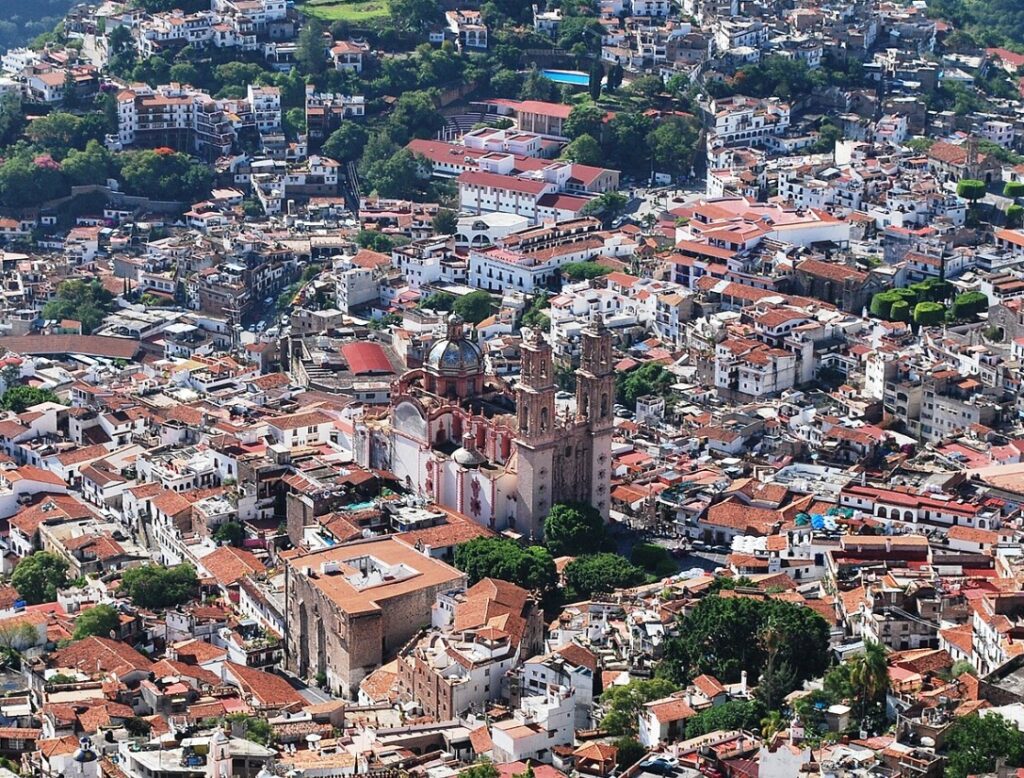
Panoramic of the city center of Taxco de Alarcón, Guerrero, Mexico. Viewed from the Christ Monument looking southeast, via Wikimedia Commons.
First, is a trifold brochure from arguably Mexico’s most famous nightclub during the second half of the twentieth century — Cantarranas, located in the silver-mining town of Taxco, some two and a half hours outside of Mexico City. As the brochure details, the “Hacienda Cantarranas was built in 1538 by order of Hernán Cortés. The actual construction was done by his son Martin de Cortés.” The estate was used for silver processing. The locale, built with large stones on a hillside, became a nightclub in 1957 under the direction of entrepreneur Antonio “Tony” Reyes Ramírez. He would later become Taxco’s minister of tourism. Cantarranas was known worldwide for its revelry through the 60s and 70s before being acquired by the government of the Mexican state Guerrero in 1983, when it was converted into a culinary school and arts center. In 1992, it was turned over to the Universidad Nacional Autónoma de México as a school for foreign nationals. The hacienda was named “Cantarranas” — that is, literally “singing frogs” due to the loud chorus of frogs living in the area nearby. The brochure obviously plays upon this idea — even if not representative of the real spectacles of the club, the image is fetching.
The brochure promises tourists that a night spent at Cantarranas includes “flamenco dancing by Estela Calderón,” “Carl Brice directly from Nassau, Bahamas,” “Primitive African Drums by the owner and Manager of Cantarranas Tony Reyes,” and “The Latin American Rhythms of the great pianist Juan García Esquivel.” The nightclub also housed distinct spaces — the “Twilight Room,” the “Patio,” the “Flamenco Room” and the “Mulata Room.” A newspaper article from 1974 also lists the club’s attractions, including “Flying Indian Men,” a discotheque called “The Psychedelic Cave,” bullfight lessons, a piñata party, and calypso songs by Carl Brice. By 1978, another newspaper reports that “Cantarranas is a little rough around the edges.” In 1980, Cantarranas had seemingly lost its sheen, as a newspaper article sarcastically notes “Cantarranas is the kind of place that you wouldn’t miss if you missed it. But worth it if you’re utterly bored.”
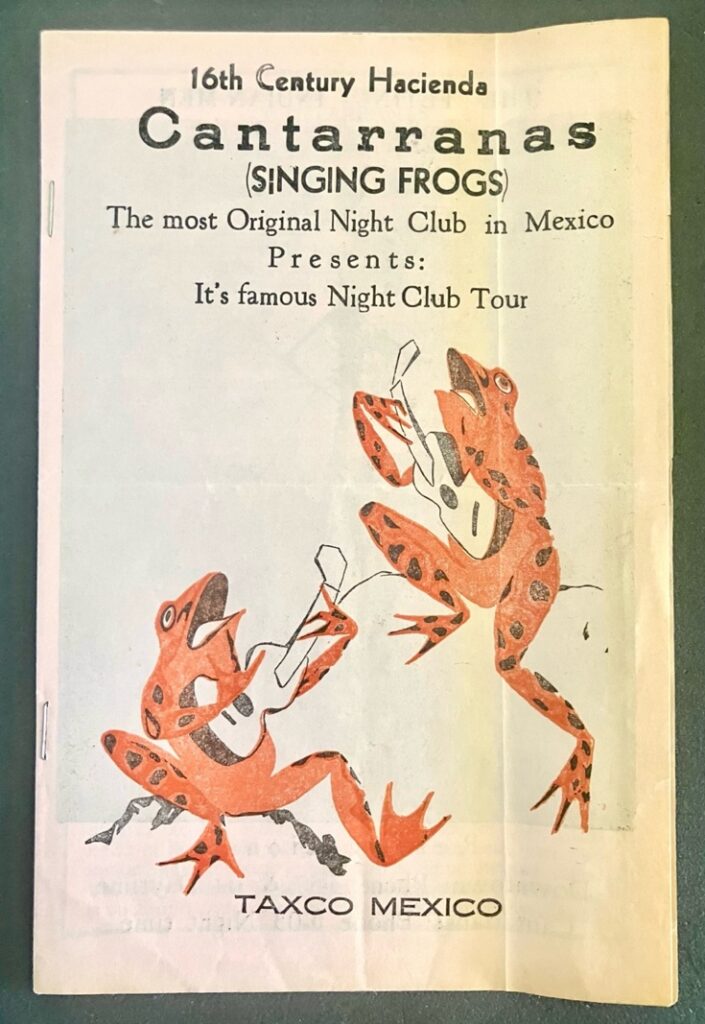
Cantarranas Nightclub Brochure. Courtesy of the Doris Z. Stone Collection at Tulane University.
Gone was the moment of Mexico’s mid-twentieth century Miracle. During the 1960s, newspapers still reported how, inside Cantarranas, “the audience moves en masse from room to room as each show finishes.” The brochure from Tulane explains that “among all the night clubs in Mexico Cantarranas was chosen for the filming of an episode of the N.B.C. colour T.V. Series ‘I Spy.’” That part of the brochure isn’t an exaggeration. The club was featured on the February 23, 1966 episode “Return to Glory.” Bill Cosby, playing the part of Alexander Scott — one half of a spy duo — is tipped off by US Intelligence to visit the club specifically, where he rendezvouses with the wife of a deposed president of an unnamed Latin American country. Famed Mexican actress Dolores del Río plays the part of the wife, as Bill Cosby and Robert Culp try to negotiate the democratic leader’s return to his home nation.
At least one similar brochure can be found online.
Surprisingly, the Tulane collection includes one more brochure with a singing frog on it — this one from Pemex or Petróleos Mexicanos, the company formed in 1938 by the Mexican government to sell the nation’s significant oil supply. The brochure includes maps of Mexican highways and invites travelers to explore the best routes. There is no mention of Cantarranas, or Taxco, or even nightclubs. Somehow, a singing frog had become emblematic of sightseeing around Mexico — the exotic sights, the electric nights, the cultural spectacles.
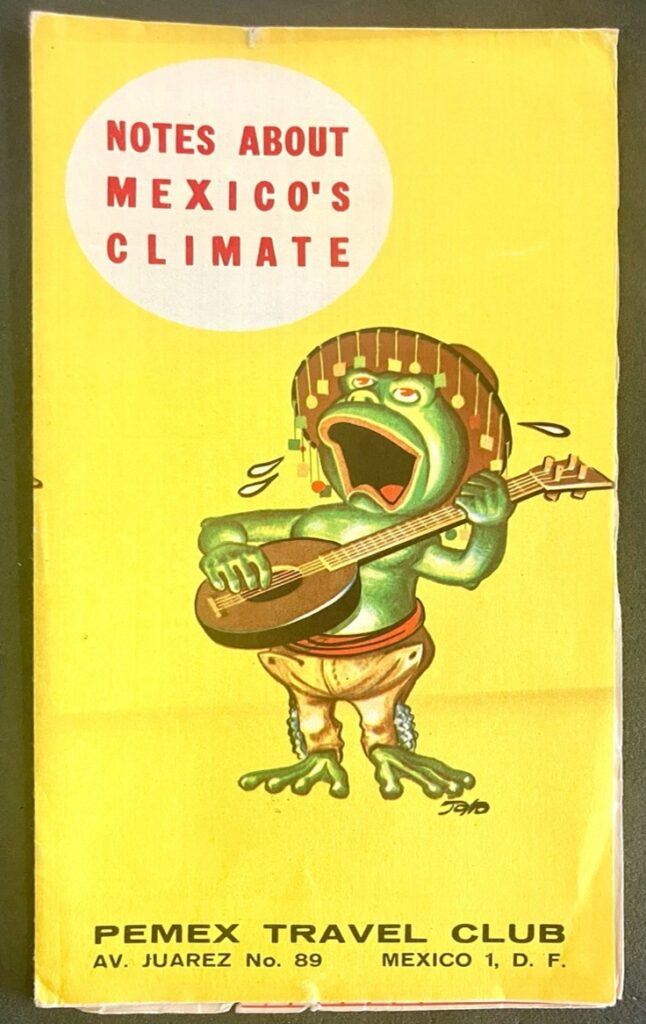
PEMEX Travel Club. Courtesy of the Doris Z. Stone Collection at Tulane University.
Intriguingly, in the decade that saw the beginning of Cantarranas’ end, a Mexican restaurateur — Carlos Anderson — opened in Mazatlán, Mexico the first restaurant of many that he would christen Señor Frog’s. The original locale, opened in 1971, tried to revive some of Cantarranas’ mid-twentieth century swagger, with waiters slinging tequila shots and cajoling spontaneous conga lines in a neon cave.
Thus, Tony Reyes’ “Singing Frogs” bar presaged today’s franchised “Señor Frog’s.” The brochure from Tulane documents how tourists were meant to imagine the delights of mid-twentieth century Mexico — strange, inviting, and culturally savvy — like a crooning amphibian. The Cantarranas and Pemex brochures ultimately serve to illustrate the extent to which commercial ephemera did the work that state pageantry once did. They are a testament to how compelling the “soft power” of the state was during the midcentury, when “Good Neighbor” diplomacy was translated into something a tourist could hold in their hand.
Further Reading
Linda Egan and Mary K. Long, eds., Mexico Reading the United States (Nashville: Vanderbilt University Press, 2009).
Dina Berger and Andrew Grant Wood, eds., Holiday in Mexico: Critical Reflections on Tourism and Tourist Encounters(Durham, NC: Duke University Press, 2010).
Douglas Monroy, The Borders Within: Encounters Between Mexico and the U.S. (Tucson: University of Arizona Press, 2008).
Darlene J. Sadlier, Americans All : Good Neighbor Cultural Diplomacy in World War II. (Austin, TX: University of Texas Press, 2012).
Stephen D. Morris, Gringolandia: Mexican Identity and Perceptions of the United States (Lanham, MD: Rowman & Littlefield, 2005).
W. Dirk Raat and Michael M. Brescia, Mexico and the United States: Ambivalent Vistas, 4th ed. (Athens: University of Georgia Press, 2010).
Dr. Kevin M. Anzzolin (Chicago, 1979), Lecturer of Spanish, arrived at Christopher Newport University in 2021, where he teaches a wide range of classes. His book, Guardians of Discourse: Literature and Journalism in Porfirian Mexico, was published with the University of Nebraska Press in May 2024 and garnered an Honorable Mention from LASA-Mexico for Best Book in the Humanities in 2025. His research focuses primarily on Mexican narrative from the 19th- to 21st centuries, and his work has been published in journals such as Letras Hispanas, Hispania, and Studies in Latin American Popular Culture. He is active in public scholarship as well, having written about pedagogy, pop culture, and local politics in different fora.E-mail: kevin.anzzolin@cnu.edu
This work is licensed under a Creative Commons Attribution-NoDerivatives 4.0 International License. Blog posts published before October 28, 2018 are licensed with a Creative Commons Attribution-NonCommercial-ShareAlike 2.5 Canada License.