
By Annabelle Penney
I did not expect to cry on the way home from the Calgary airport. It had been over a year since my last homecoming, and recently I’d wondered if ‘home’ still fit Alberta. I’d forged newfound allegiances to Quebec, a province embroiled in its own separatist debates. While working on my thesis for some of the flight, I’d also watched Christopher Nolan’s The Odyssey. Perhaps that informed my melodrama.
Beyond a certain political charge in the air, I didn’t know what to expect. Could Alberta still be hospitable to a committed Canadian? Since May, I’ve monitored Alberta’s political developments intently. Those 35 percent of Albertans who had polled in favour of separatism kept me up at night. Not out of reproach, but curiosity. The parallels between my own research on the provincial-federal squabbles between Pierre Trudeau and Peter Lougheed in the 1980s and the Alberta of today were evident.
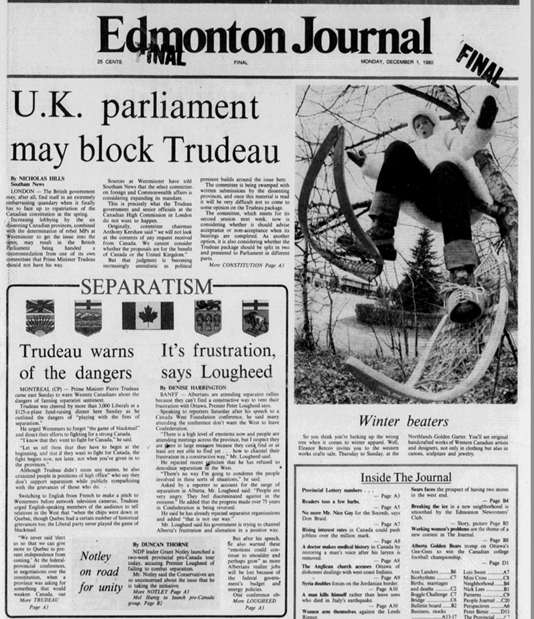
The point is, I was disheartened by the state of the province, tired of being disappointed by the selfishness of our government, and couldn’t help but see a despicable cycle perpetuating itself. On the flight, I’d stumbled upon something curious in the Edmonton Journal. A meagre article about Grant Notley and a two-week unity tour he undertook in December of 1980. Amid a sea of Op-Eds and articles skewering the federal government over the National Energy Program, here was a story of hope: “Notley on road for unity.”
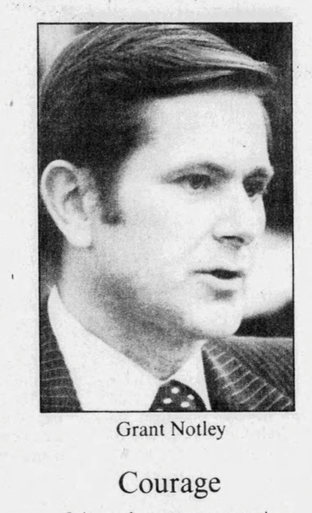
Grant Notley led the Alberta New Democratic Party (NDP) from 1968 until his death in 1984. Alberta born-and-bred (and with a history degree too), he devoted his life to the party, leaving U of A’s law school to spearhead the NDP mission in the province. After several unsuccessful campaigns, he was elected the MLA for Spirit River–Fairview on August 31, 1971. He remained the sole NDP member in the Alberta legislature for eleven years, until November 1982, when Ray Martin was elected, and Notley became leader of the Official Opposition. For much of his career, Grant Notley was a one-man party and the sole opposition against the bulwark of Alberta’s Progressive-Conservatives. A social democrat David against the Tory Goliath.
Grant Notley’s political impact is often traced to his daughter, Rachel Notley, who was elected Alberta’s first-ever NDP Premier on May 5, 2015. The line between the two Notleys is clear, but this framing, which undermines Rachel Notley as a politician herself, also obscures the substance of Grant Notley’s political beliefs. Grant Notley was more than a plucky political underdog who fathered a brilliant daughter. He was also Alberta’s most ardent Canadian federalist.
I used to onboard Wi-Fi to begin digging up what I could on this Unity Tour. At each stop across Alberta, Notley gave an interview to the local press, appeared on an call-in radio show to engage with local callers, and ended each stop with a set speech to a club, local chamber of commerce, or union group. Notley’s focus was not on “conducting an intellectual exercise…on separatist threats,” but in swaying voters, genuinely listening to their concerns, providing a counterargument, and then going back to Edmonton to “tackl[e] the problems aggravating the separatist itch.”[1] He reminded Albertans and Canadians of their duty to each other. Reflecting his old-school Prairie rearing, Notley preached that Albertans should love their neighbours as themselves.
1980 was an explosive year for provincial-federal relations — and not only in Quebec, where the first sovereignty referendum was held. With the backdrop of the OPEC crises, discontent over Trudeau’s 1973 price controls on oil, and negotiations over the repatriation of the Canadian Constitution, came the infamous National Energy Program. The lore on this policy runs deep in Alberta. For the purposes of this post, it suffices to say that after OPEC’s oil embargoes exposed vulnerabilities in North America’s energy supply, the federal government sought to create a Canadianized, self-sufficient energy industry. While the NEP created price stability for Eastern consumers, it came at a cost to Western industry.
In Alberta, the NEP seemed to reinforce the inequalities of the federalist system, while the threat of decreased oil royalties revived memories of the Great Depression’s scarcity. Pierre Trudeau’s cavalier attitude towards Albertan complaints didn’t help the situation, and Peter Lougheed, then Premier of Alberta, was in no rush to reach an agreement on oil policy. Anti-Ottawa sentiment, marketed as defending ‘provincial rights,’ proved profitable for Alberta’s Progressive Conservatives. On October 30, 1980, to protest the NEP, Lougheed ordered Alberta industry to cut its oil and gas production by fifteen percent and shelved negotiations for a number of big oil sands development projects. Lougheed wanted a bargaining chip to use in constitutional negotiations. Grant Notley was the sole MLA to oppose this measure in the Alberta Legislature.
At times, Notley’s Unity Tour was tense. In Fort MacMurray, the heart of Alberta’s oil sands, Notley defended the NEP against critiques from citizens hit the hardest by these tax measures. Notley himself was no fan of the NEP. He found the policy deeply flawed, though a nod in the right direction. At this point, Notley had argued for nearly a decade that Canada needed to own more of its energy sector. But Notley’s condemnation of Lougheed’s oil cutback wasn’t about policy; it was about precedent. He couldn’t stand to see Canadians made “hostages in a form of economic warfare with the government.”[2] He also couldn’t palate Lougheed’s wishy-washy stance on Alberta separatism. When Notley introduced a motion in the Legislature asking the Assembly to rebuke the viability of separatism in Alberta, and Lougheed refused to vote on it, he understood the province was headed for trouble. Notley believed that the Progressive Conservative’s Alberta-first politics would “balkanize the country, erode the powers of the national government, and leave a divided Canada to the tender mercies of giant multi-national corporations.”[3] It proved a prescient assessment.
Grant Notley could have cashed in on the golden goose of Western alienation, but he chose the harder path: optimism. He stood firm in his faith in the federalist system and condemned the politics of resentment. This was, in Notley’s words, “one of the most difficult times I’ve had.”[4] He received a thrashing at the hands of his fellow MLAs, who accused him of being a provincial traitor. One of Notley’s defenders took to the pages of the Edmonton Journal to lament, “It’s a sad comment on our times when an individual is subject to the kind of attack that Grant Notley was in legislature.”[5]
The attacks didn’t end when Legislature adjourned. Notley received a barrage of hate mail, phone calls, even resignations from party members. He had to defend his principles alone, recalling, “it would’ve been nice to have some colleagues to stand with.” The one ray of light was a letter from mentor Tommy Douglas: “This is a note to tell you how proud I was when I heard that you were the only member of the Alberta legislature to vote in opposition to Lougheed’s cutback in oil production…what makes it tough is the fact that we both understand why people are resentful of Central Canada… No man can ever be defeated ultimately by fighting for the things in which he devoutly believes.”[6] There is no doubt that Notley believed his federalist credo. He had been discussing the importance of Canadian unity since Lougheed and Trudeau’s first energy dispute in 1973, when Notley warned what would happen if neither side compromised.[7]
Despite the labour of this tour, which kept him away from his family and required taxing twelve-hour days, and the fact that Notley was a timid man who found public speaking draining, he persevered. At every stop, he reminded Albertans, “We should not, however angry we may be at a particular part of a particular policy, lose faith in the country.”[8] In doing so, Notley pushed back against the image of Alberta that circulated around Canada. Contrary to charges that Albertans were enriching provincial coffers to “feed their limitless greed,”Notley made it clear that he, and many Albertans, were committed to their country.[9]
Notley was one of the few politicians who understood the root of NEP-related frustrations. Albertans felt unseen by a federal government that was supposed to protect their interests. He gauged that the best response to neglect isn’t indignation, it’s careful attention. He rightfully criticized Albertans who engaged in the politics of victimhood, once critiquing the oil titans who had joined separatist movements as “country club separatists… alienated as they sit by their swimming pools, sipping on double martinis and talking about how bad it is.”[10] A proud Albertan, Notley empathized with those who felt peripheral to Eastern policy makers.[11] There was no love lost between Notley and federal NDP leader Ed Broadbent. Notley found Broadbent inflexible and opposed to hearing a Western perspective. As the single Albertan member of the party, he had little influence over the federal NDP, but Notley did not abandon ship. He accepted this fact and did whatever good he could with the measures at his disposal.
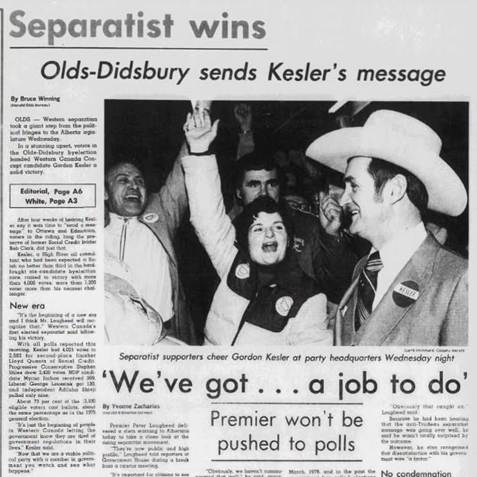
In 1982, Gordon Kesler, a former oil scout, won a byelection and became an MLA for the Western Canada Concept Party. Kesler remains the first and only separatist elected to Legislature in the West. While Kessler’s tenure didn’t last long, Notley was crushed. Adding insult to injury, Kesler’s riding was in his hometown. Notley must have felt that all his work had been done in vain.
Unfortunately, there was little else I could find on Grant Notley’s Unity tour, but tons of coverage on Kesler’s election. This reflects a tendency we continue to see in Canadian media. Separatism makes news. It’s punchy, scary, and threatens the status quo. Unity rarely receives the same attention. What would happen if it did?
There is also no mention of this Unity Tour in Notley’s political biography. Instead, it favours his more colourful campaign triumphs. Notley’s tour remains a two-week blip that exists only in regional papers and the memory of those Albertans he interacted with. Notley’s biographer and former executive assistant, Howard Leeson, wrote, “[Notley] built no buildings, no dams, no constitutions. He did not sit astride the history of Alberta as did E.C. Manning or Peter Lougheed. And yet, intuitively one has a sense that he was important.”[12] Grant Notley is important, and so was his tour. Not just as proof that Alberta has weathered a secessionist scare before, but also as an example of how a politician who cares about his province behaves during a constitutional crisis. As Edmonton Journal columnist Don Braid wrote, “It was a daunting and wearing job, but Notley was a skilful parliamentarian, maybe the best in the house—and always a gentleman who never resorted to insults.”[13] There can still be decency in provincial-federal disagreements. Grant Notley is proof.
So why did I cry on the way home from the airport? Perhaps it was the tragedy of Notley’s death, having been killed in a plane crash at forty-five, too young to fully realize his political impact or see his beloved daughter follow suit. That he died at the height of Albertan discontent in the ‘80s makes it all the more devastating. It could be that Notley’s baked-in Prairie pragmatism evoked memories of my grandmother. Or, it was seeing his impact in a sea of ‘Forever Canadian’ signs colouring Calgary’s suburban landscape on my drive home. Mostly, I think it’s because Grant Notley reminded me why I love Alberta.
I love the blue of our Prairie sky, the crisp mountain air, our tough yet warm disposition. Normally, I love a good dose of prairie pessimism too, but a referendum is a bridge too far. Why abandon something flawed when we could work to make it better? Since when did Albertans just give up when times were hard? Grant Notley shows us a different, courageous way to be an Albertan – and a Canadian too.
Annabelle Penney is a master’s student at McGill University and contributing editor at Active History. An avid lover of Albertan history, her thesis examines the folklore of the National Energy Program.
This post was produced within the project Historicizing Our Times: Histories of Migration and Climate in the Digital Space, which is supported in part by funding from the Social Sciences and Humanities Research Council.
[1] “800-Million from Alberta for the Cause of Canadian Unity,” Edmonton Journal, January 26, 1979.
[2] Debates and Proceedings, 2nd Session of the 19th Session of the Legislature of Alberta, April 10, 1980, pg. 272.
[3] Edmonton Journal, April 15, 1972, pg. A4.
[4] Howard Leeson, Grant Notley: The Social Conscience of Alberta, 2nd Eds. (University of Alberta Press, 2016), 294.
[5] “Brotherly Love?” in Reader’s Digest, Edmonton Journal, November 14, 1980, pg. A5.
[6] Leeson, 294-5.
[7] Edmonton Journal, November 21, 1977, Pg. A9
[8] “Alberta NDP Leader Combats Separatist Sentiment,” CBC Archives, December 5, 1980.
[9] Paddy Sherman, “Resource Recourse,” The Province, June 29, 1980; “Brotherly Love?” in Reader’s Digest, Edmonton Journal, November 14, 1980, pg. A5.
[10] “Alberta NDP Leader Accuses Conservative Government,” UPI Archives, February 1, 1981.
[11] Edmonton Journal, June 24, 1983.
[12] See Howard Leeson, Grant Notley: The Social Conscience of Alberta, 2nd Eds. (University of Alberta Press, 2016).
[13] Don Braid, “Slight of Pen Against a Decent Man Brings Regret,” Edmonton Journal, October 21, 1985.
This work is licensed under a Creative Commons Attribution-NoDerivatives 4.0 International License. Blog posts published before October 28, 2018 are licensed with a Creative Commons Attribution-NonCommercial-ShareAlike 2.5 Canada License.