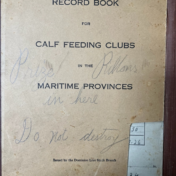
By Sarah Kittilsen In the summer of 2025, I was rifling through a box of uncatalogued materials at the Farm Equipment Museum in Bible Hill, Nova Scotia, when I happened upon an old record book. Tattered and yellowed with age, it had been used by fourteen-year-old Frank Daniels in the early 1930s to document what he expended and earned while… Read more »
By Jenni Makahnouk This post is part of the Indian Act 150 series The Indian Act is commonly treated as a governance structure: an object to be interpreted, amended, or dismantled through policy reform. This framing assumes neutrality where there is appetite. This article argues that the Indian Act functions less as a static legal instrument and more as a… Read more »
Inspired by recent 2025 labour disputes and renewed public conversation about Canada Post, the intention here is to examine the cultural impact and historical legacy of a controversial yet essential Canadian Crown Corporation. A national institution and the nation’s leading postal operator, Canada Post in its earliest iteration proceeded Canadian Confederation itself. Series editors Annabelle Penney and Raffaella Cerenzia Canada… Read more »
By Bob Joseph This post is part of the Indian Act 150 series. This year, 2026, marks 150 years of the Consolidated Indian Act of 1876. This serves as a timely opportunity to discuss the dismantling of this destructive and restrictive piece of legislation. The Indian Act has constrained and controlled the lives of Status Indians for generations, and reconciliation… Read more »
By Katie Carson, Sarah Kittilsen, and Sean Carleton Canada 150—the sesquicentennial celebration of the country’s confederation—was marked with pomp and circumstance, as the Federal Government encouraged Canadians across the country to commemorate what it called “one of Canada’s proudest moments.” April 12, 2026 will mark another sesquicentennial: 150 years since the Canadian government passed the Indian Act, the cornerstone of the legislative apparatus that continues to govern… Read more »
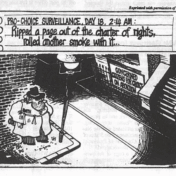
By Lilia Scudamore Few Canadian governments — federal or provincial — have been so embroiled in scandal as William “Bill” Vander Zalm’s Social Credit Party (known colloquially as the ‘Socreds’). The government was routinely caught performing an array of improprieties, ranging from back-door deals to openly disobeying the Supreme Court of Canada to fighting with journalists on air.[1] The contemporary… Read more »
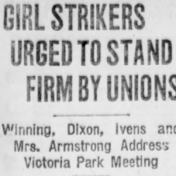
Ella Prisco This essay is part of a 2-part series. See the other entry here. “They have borne the lonely hours with fortitude,” stated the Winnipeg Citizen in its coverage of scabbing women during the Winnipeg General Strike of 1919.[1] Indeed they had, taking up positions as telephone switchboard operators and waitresses in response to the nearly thirty thousand workers… Read more »
Ella Prisco This essay is part of a 2-part series. The second post will be published next week. Depending on who you asked, Winnipeg on May 15, 1919 was either a city in chaos or on the precipice of a brave new world. It was the first day of the Winnipeg General Strike, the culmination of weeks of tension between… Read more »
The rich history of drag has strong roots in Atlantic Canada; one notable example being Ross Hamilton, the famed female impersonator from the concert party troupe the Dumbells. During and following the First World War, Hamilton not only brought pride to Canada with his ability to craft the perfect illusion of womanhood, but also to Nova Scotia, as a resident of the province. Although queer desire was criminalized by the Canadian military, drag entertainment was seen as a necessity to support the flagging morale of troops.
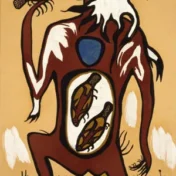
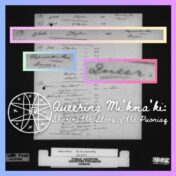
In the Mi’kmaw language, puoin (boo-oh-in) refers to a shaman or witch. In Mi’kmaki — the area we now call Atlantic Canada and parts of Maine and Québec—these puoinaq (plural of puoin) are sacred figures who possess the ability to shapeshift and to convoke the spirit world. Inspired by Mi’kmaw History Month, this installment of Queering Atlantic Canada troubles our understanding of region with Indigenous methodologies; it also offers a method to queering Indigenous history and culture through the Mi’kmaw language and storytelling alongside our own against-the-grain readings of the colonial record.