
Felicia Gabriele
The expression, “May you live in interesting times,” seems on its face, pleasant enough. Resembling a well-wish, its sunny exterior deftly cloaks the dark, cavernous depths within. To live in interesting times, is quite simply, to be cursed.
To teach American History in interesting times, is, well… akin to having a staring contest with the evilest of evil eyes. I should know. I teach American History at McGill University. The day after Donald Trump won the presidential election in November 2024, heartbroken and numb, there was still a lecture to give, emails to answer, coffee to drink. Teaching American History in America’s 51st state is hard work after all!
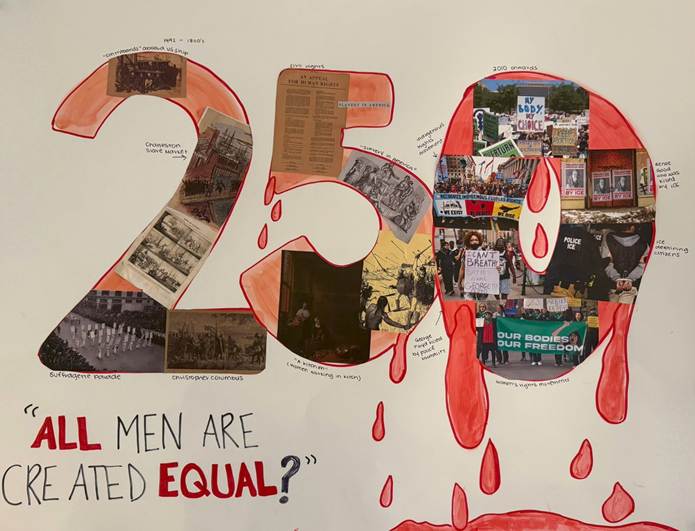
“All Men Are Created Equal?” April 2026 (Shared with student permission)
Due to its location and comparatively lower tuition, McGill attracts a substantial number of American undergraduates, many of whom enroll in my history classes.
I’ve lost count of the times American students have told me they learned more of their own history in my classes than back home. Sadly, living in interesting times means living concurrently with the sanitization of historical truths; wholescale erasure of history and other subjects deemed too “woke”; and the unmistakable death-rattle of academic freedom. While Canada is certainly not perfect, at least professors are not compelled by law to teach blatant untruths such as slavery “benefitted” Black Americans.
With that in mind, I introduced a new assignment in my Early America survey: the America @ 250 Project. I asked students to reflect on the following questions:
- What do the key ideas, values, and promises represented in the Declaration of Independence mean to you? What do you think they meant to Americans in 1776? To Americans in 2026?
- How are you thinking and feeling about this occasion? How would you begin to express or articulate what America @ 250 means to you?
- How would you begin to evaluate and assess the state of America @ 250?
- What do you hope for America’s future? Think about what you hope America can achieve and how collectively we (the people) can help make it a reality.
To answer these questions, I gave students two options:
Option #1: Write an Op-Ed to make an argument about America @ 250 by connecting a present-day issue to a historical topic, theme, or event related to our class.
Option #2: Make a Creative Project in the form of an analog or computer-generated PowerPoint presentation, poster, collage, scrapbook, photo album, video montage, etc. that shows how you are envisioning America 250 years in. With your creation, submit a short reflection piece explaining your artistic vision.
While impossible to share each project, I include here some truly extraordinary America @ 250 projects.
When Art Imitates Life
Separated by centuries, and various miracles including indoor plumbing, the invention of penicillin, commercial air travel, The Real Housewives, and Katy Perry’s ascension to outer space, 1700s America and 2020s America could not be further apart. But as historians, we know better. Then, like now, America is as polarized and divided as ever before. This comes as no surprise to Ken Burns, prolific documentarian of the American experience. In a conversation on NPR’s Fresh Air, while promoting his 2025 documentary, The American Revolution, he notes, “We’ve always been divided. I don’t know if you can take comfort from it, given the current state of affairs. But I do believe that the historian’s perspective is one that permits you to understand, as Ecclesiastes says, there’s nothing new under the sun.” This is something my students absolutely picked up on, with the astounding clarity and storytelling chops that Burns himself could only marvel at.
One student in particular, deliberately used the medium of painting to draw parallels between the historical then and ever-unfolding now.
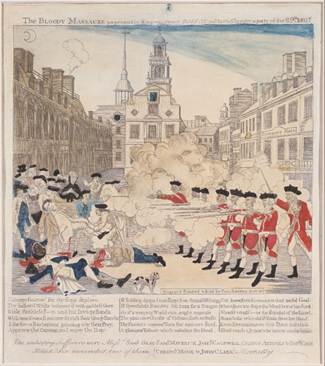
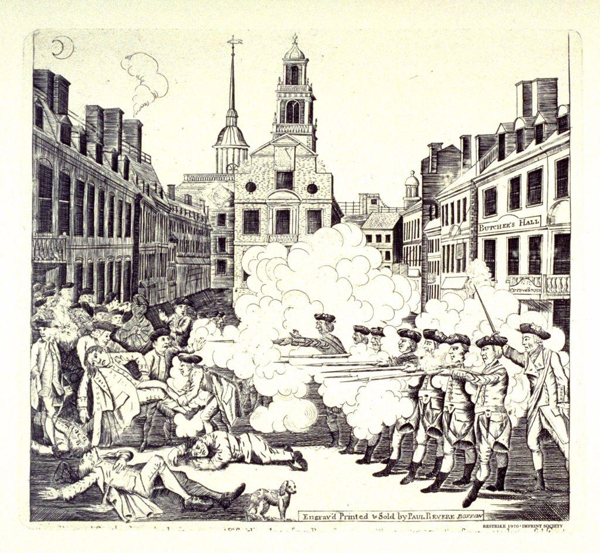
Left: Paul Revere Jr., after Henry Pelham, The Boston Massacre, 1770, Metropolitan Museum of Art
Right: Paul Revere II, The Boston Massacre, 1770, engraving, Fine Arts Museums of San Francisco
For her creative project, aptly titled America 250: History Repeats, it was important for this student- artist’s work to be in conversation with arguably the most viral engraving of the 18th century, Paul Revere’s The Bloody Massacre. One that, in her words, operates as a “nationalistic symbol,” ubiquitous in both the American cultural imagination and “in modern American textbooks as a primary reference of the oppression the colonists faced and a major reason for why the revolution was necessary to safeguard freedom.”
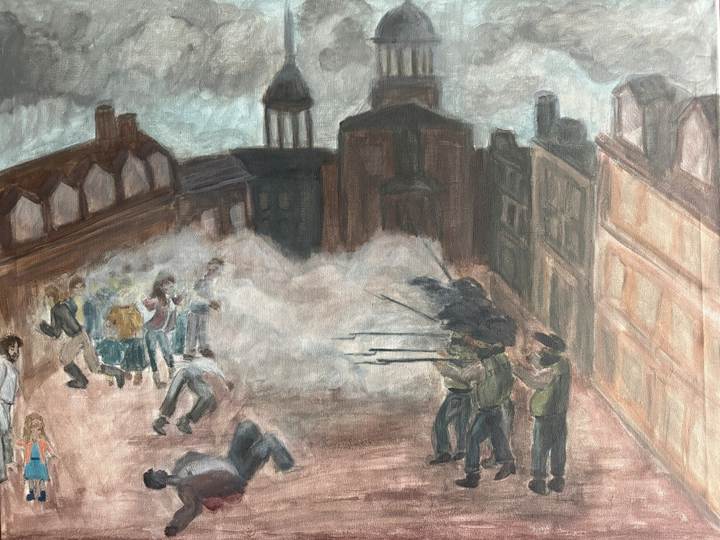
America 250: History Repeats, April 2026 (Shared with student permission)
Revere’s original engraving captures the grim reality of life during a military occupation. “Stationing armed forces in a location has never been a neutral decision,” writes the student-artist in her accompanying written reflection. She correctly notes that occupying forces “are not subject to the same laws everyone else must follow. Wherever an army goes fear and violence arises and the freedom of everyone is at risk.” This is exactly what happened in Boston that terrible day in March of 1770 and is exactly what we are seeing today in majority Democrat cities across the US.
“Instead of colonists and British soldiers, my scene depicts a modern crowd facing armed U.S. Immigration and Customs Enforcement (ICE) officers,” the student-artist writes. Unlike the British soldiers, the ICE agents are cloaked in unconstitutional anonymity.
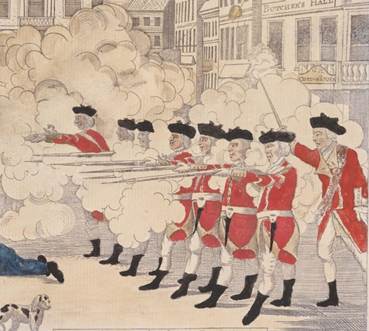
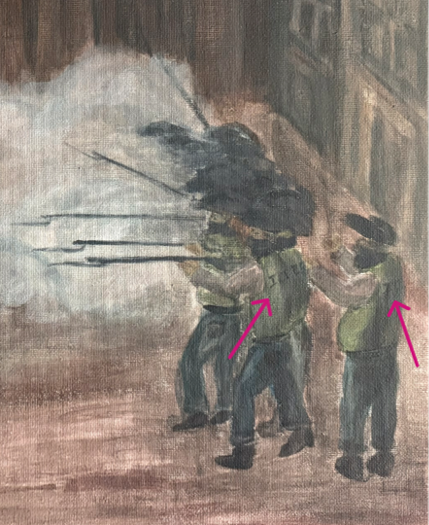
Note the stylistic similarities between the two scenes. In the latter, look closely to where the pink arrows point to the “ICE” lettering emblazoned on the backs of the agents’ green vests.
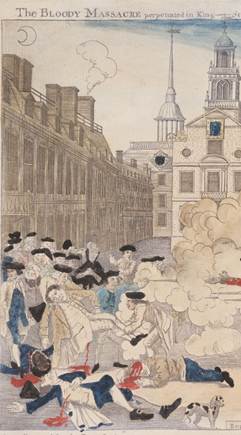
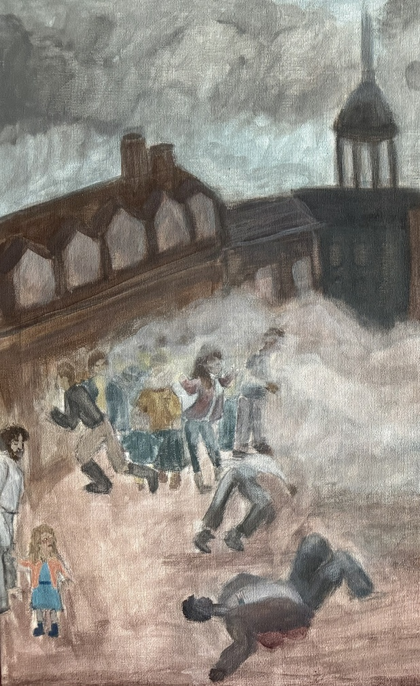
Revere’s engraving features primarily white figures, except Crispus Attucks (left). In contrast, by placing the Black man in the forefront of the scene, the student-artist gestures to the long history of lethal police violence towards Black and POC Americans.
Using language of “self-defense” the British army tried to spin the events of the Boston Massacre. “This is remarkably similar to how the Republican party has framed the murders ICE have committed as having been provoked, and therefore justified,” notes our student-artist. Responding to the murder of Renee Good, Vice President JD Vance blamed Good for her own death, calling her a “domestic terrorist” . Senior Trump officials defended the ICE officer for “acting in self-defense.” Not long after, ICE murdered Alex Pretti, and the same officials spewed the same hateful narrative, declaring Pretti a “domestic terrorist” and branding him an “assassin” whose sole aim was to “murder federal agents.”
Students overwhelmingly responded to the ICE occupations and immigration raids happening in real time. We all watched in horror as ICE officers gleefully and shamelessly ramped up their deportation tactics, showcasing the shocking depths of cruelty and inhumanity they seemed more than happy to plumb. Students pointed to the explicit racial profiling, abductions, mass arrests, the targeting of parents and young children, and the seemingly never-ending warehousing of bodies deemed too “alien”, “illegal”, “dangerous”.
All Men Are Created Equal?
One student happened to be in Minneapolis while completing her assignment. Her op-ed, “America at 250 Years: Equality Was Always Conditional, and Still Is” captures the moment, with all the searing intensity you’d expect. At the heart of her op-ed is the issue of racial profiling and belonging: “In effect, people of colour must constantly prove their right to exist freely in public, while others who share resemblance to the founding fathers, are never questioned at all.” Her op-ed was one of many assignments where students questioned, challenged, and systematically picked apart the threads of what should supposedly be self-evident, that all men are created equal. And they did so in such creative ways!
Take, for instance, the collage above which poses the question, “All Men Are Created Equal”? “The one thing that has really stuck in my brain from both what we learned in this class and the news is the bloodshed, violence, and inequality our country is built upon,” this student-artist writes in her accompanying written reflection.
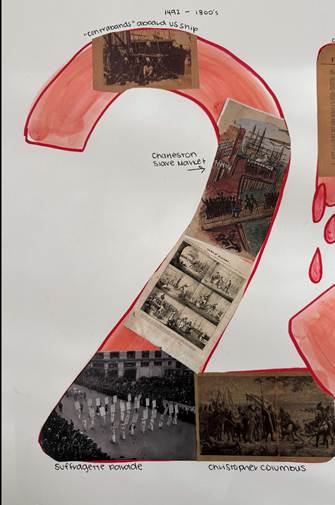
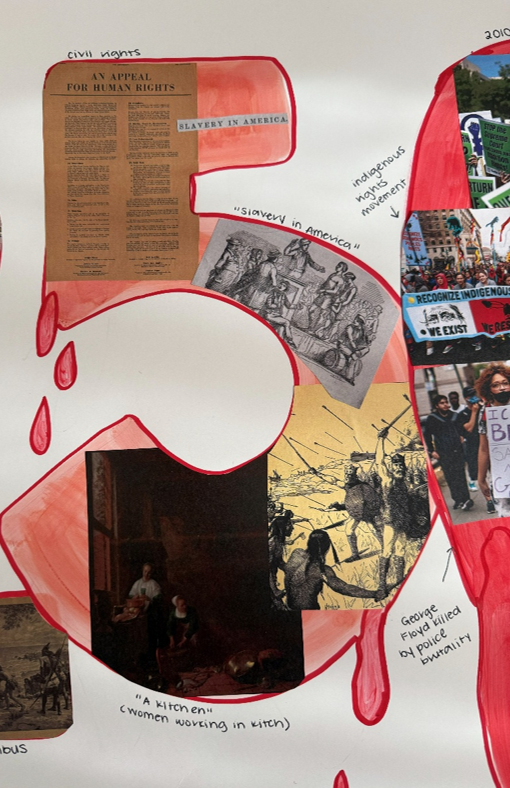
She purposefully populates the ‘2’ and ‘5’ with images of slavery, colonialism, and the violent destruction of Indigenous people to show that the “all men” category has always been, and perhaps always will be, exclusionary to its very core.
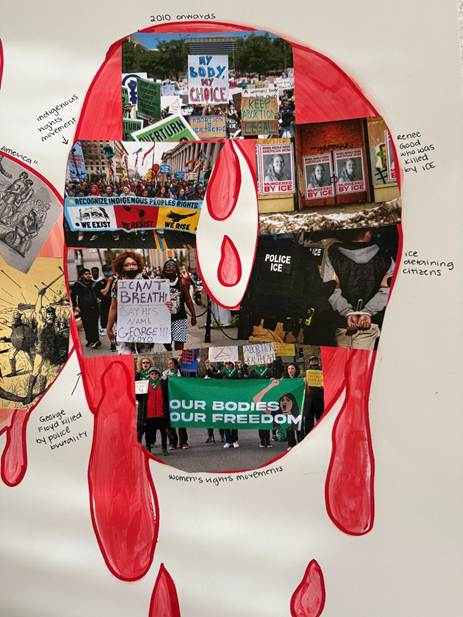
The final ‘0’ is meant to show that we in 2026 are not inherently superior to those in 1776. In the words of the student who wrote her op-ed in Minneapolis, “If the United States is to move forward, it must do more than celebrate its founding words; it must redefine them. Equality cannot remain conditional if it is to have meaning in the next 250 years.”
Another project that contended with the conditional “all men are created equal” came in the form of a short film showcasing the resilience and richness of Black history and culture. Here’s how the student-auteur describes his vision, “this project frames Black history not as a linear or marginal narrative, but as one of the most revealing vantage points from which to understand both the failures of the American “experiment” and its most profound capacities for resistance, creativity, and civic transformation, capacities that echo the nation’s founding rhetoric even where its institutions have persistently betrayed it.”
Using a rich array of “carefully curated, expressionistic collage of images and footage” and set to Tupac’s “Do For Love,” this film aims “to illuminate major developments in the evolution of Black America and its place within the larger American narrative.”
I was blown away by the artistry of this film. The student-auteur’s rationale for the song selection was especially moving: “[it] felt tremendously fitting because its longing and vulnerability echo the film’s concentration on the pursuit of recognition, belonging, and dignity within a nation that has so often withheld all three.” Like any important anniversary or milestone, we perform the celebratory glass-clinking merriment the occasion calls for, but deep down, we know better. We continue to live in the shadows of what once was, what could have been, lives cut short, dreams deferred, unspeakable grief, infinite longing. America’s semiquincentennial is no different.
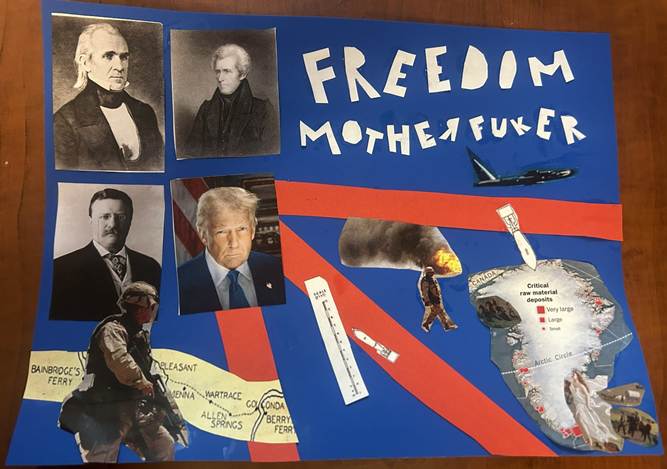
Freedom Motherfucker, April 2026 (Shared with student permission)
While many students grappled with lofty words and ideals, others explored the nakedly self-interested, grasping, genocidal impulse of American expansionism. For example, the student-artist’s work above satirizes the (literal) weaponization of American “freedom.” He notes in his reflection piece, “Every instance of projecting American power over history has been done with false intentions, not to bring freedom and liberty like the Declaration of Independence says, but to claim resources, whether it be land, gold, oil, or rare earth metals.”
By connecting the destructive belief in “Manifest Destiny” to the American obsession with westward expansion and the Frontier mythos, this student-artist points to the violence and greed at the foundation of the so-called “Land of the Free.” The poster features portraits of presidents with imperialist agendas, James K. Polk, Andrew Jackson, Theodore Roosevelt, and Donald Trump. In the bottom right corner, we see Greenland, strategically placed beside the central figure in John Gast’s 1872 painting “American Progress”. Incredibly clear-eyed, the student-artist states the obvious, “America will not bring “freedom” to Greenland; instead, they will extract rare earth metals from rich deposits.” In this depiction of America @ 250, the nation’s founding ideals act as mere window-dressing for the main event: resource extraction.
You’re Cordially Invited
Speaking of the main event…

2026 Invitation (All invitations shared with student permission)
One student even conceptualized her America @ 250 project as a series of invitations. “The phrase that inspired this project is “Who’s Invited to the Party?” This idea led me to design a series of invitations: one for Independence Day and others for each semi-centennial anniversary, ending in 2026,” she wrote in her reflection piece.
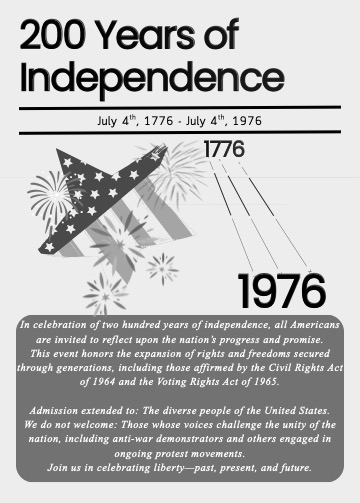
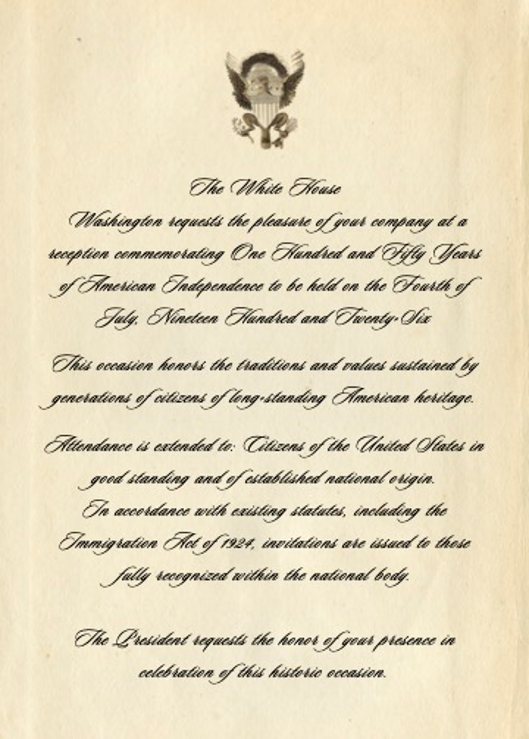
1976 Invitation 1926 Invitation
This student-graphic designer modelled her invitation designs on a variety of primary sources from each era, capturing the historical mood, tone, and aesthetic of each. Crucially, she notes, “Each invitation identifies who was “welcome” and “unwelcome,” thus highlighting how American liberty has always been unevenly distributed, granting freedom to some while excluding or oppressing others.”
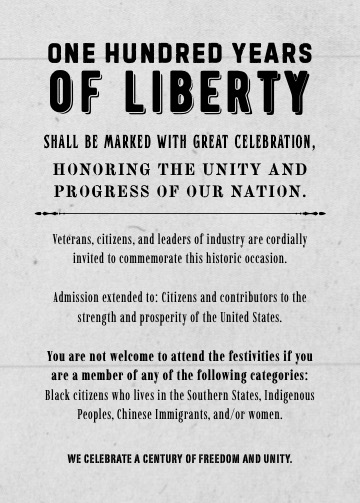
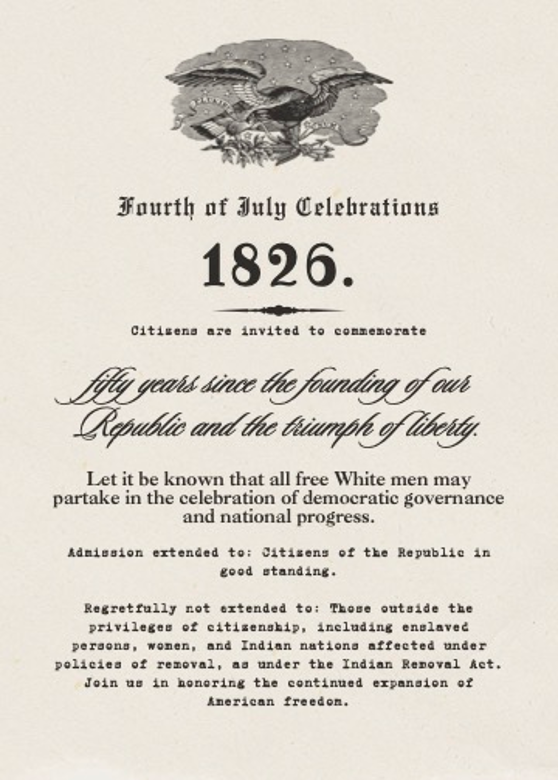
1876 Invitation 1826 Invitation
Themes of conditional belonging and who “counts” as American take centre-stage . Or as our student-graphic designer points out, “Through examining each semi-centennial anniversary, this project shows that American liberty has never been fixed or guaranteed, despite it making up the core motif of national rhetoric.”
Echoing the previous words of her student colleagues, she writes, “While the nation has consistently celebrated ideals of freedom since 1776, access to those ideals has been uneven and exclusionary.”
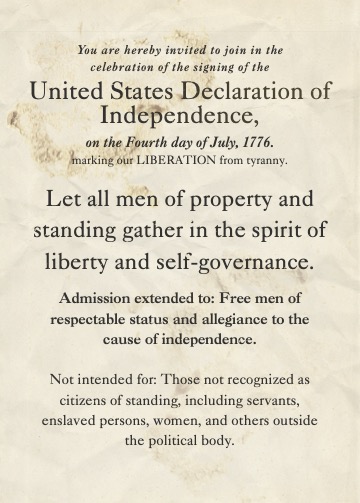
The OG, 1776 invitation
“By reframing these anniversaries through the question of “who is invited to the party,” I attempt to describe the history in which American freedom has often been the exception as opposed to the rule,” the student-graphic designer writes.
As with prior examples, I remain in awe of the creativity, imagination, and great effort that went into this project! One final line from our student-designer: “I hope that bringing attention to this will continue to highlight that the struggle for, and discussion around, freedom and liberty are just as relevant today as they were 250 years ago.”
*
In our interesting times of compliance in advance and bending the knee to authoritarian agendas, my pedagogical practice is rooted in transgression. The classroom, bell hooks writes in Teaching to Transgress, is “the most radical space of possibility in the academy.” I could not agree more.
What felt especially radical was how many students opted to make something. Perhaps in the age of AI, our role as educators is to equip our students with the courage necessary to create weird, messy, and flawed works in an increasingly frictionless, surface-obsessed world. We may indeed live in interesting times, but we must not lose sight of how truly interesting, brave, and brilliant our students can be.
Felicia Gabriele is a historian, writer, and educator based in Montreal. Her public scholarship has appeared in Maisonneuve, Electric Literature, The Rambling, and elsewhere. You can find her on Bluesky @feliciagabriele.bsky.social
This work is licensed under a Creative Commons Attribution-NoDerivatives 4.0 International License. Blog posts published before October 28, 2018 are licensed with a Creative Commons Attribution-NonCommercial-ShareAlike 2.5 Canada License.