By Daniel Macfarlane
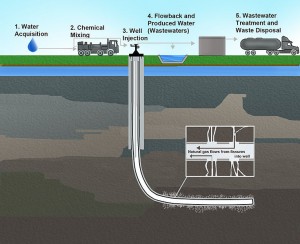
The fracking process. Wikimedia Commons
The recent showdown between Native protestors and police over “fracking” in New Brunswick brought together several contentious issues that have simmering, and periodically boiling over, in Canadian society as of late (an interactive map of New Brunswick fracking can be found here). Obviously one of them, and probably the most prominent, is the Canadian state’s past and present treatment of First Nations.
But another is the use of fracking, short for hydraulic fracturing (the oil and gas industry tends to spell it without the “k” – so “fracing” or “frac’ing”). Though I don’t want to downplay the many vital Native rights issues at stake, I do want to concentrate here on the fracking aspect. In Canada, this method of energy recovery has intensified and increased in the past decade, especially the last few years. For example, Apache Corp claimed in 2011 that it had performed in northern British Columbia the largest hydraulic fracturing operation ever – and then topped it a few months later.
Fracking typically involves the pumping of massive volumes of water at high pressure in order to fracture rock, often shale, where natural gas is trapped several kilometers underground in rock formations. Chemicals are included in the mix, as is a “proppant” such as sand, which is used to keep the fracture open and allow the gas to flow to a well where it can be recovered. Fracking became a particularly effective means of accessing unconventional and previously inaccessible sources when combined with horizontal drilling – if it helps, think of The Simpsons episode where Mr. Burns used slant-drilling to steal the oil under Springfield Elementary. Continue reading