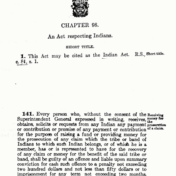
Amy Swiffen, Keith Cherry, Hannah Wyile and Kris Millett This post is part of the Indian Act 150 series There is a harmful provision of the Indian Act that, until recently, has never been the object of sustained scholarly scrutiny: Section 141. In force from 1927 to 1951, this provision made it an offence for Indigenous peoples to raise funds or retain… Read more »
By Erin Isaac and Cady Berardi In the weeks after a sudden February announcement that twelve provincial museums were slated to close in Nova Scotia, murmurs began to circulate that some of these sites might be rescued. The controversial decision to remove these rural sites from the Nova Scotia Museum followed significant budget cuts to several provincial departments including the… Read more »
Daniyal Elahi and Harris Elahi In December 2025, ActiveHistory.ca published our first piece on Private Hasan Amat, a soldier of the 1st Battalion, Canadian Expeditionary Force, killed at the Battle of Hill 70 on August 20, 1917. To our knowledge, he is the first identified Muslim soldier killed in action serving with the CEF. He is also one of twenty-two… Read more »
Andrew Burke This is the seventh post in a series about the Great Acceleration as a framework and reconnaissance for Canadian environmental history. The posts in this series are cross-posted with NiCHE It is fundamentally about change; constant, rapid change. J. R. McNeill and Peter Engelke described the Great Acceleration, in part, as “what is certainly the most anomalous and unrepresentative period in… Read more »
Christo Aivalis This is the third and final post in the Canada Post and Canadian Culture series. Canada Post and its employees have had an undeniable impact on the culture of this country, both via the artistry and symbolism on stamps, and also as an essential facilitator of communication across a vast and diverse nation. From my perspective as a… Read more »
Shannon Stunden Bower This is the sixth post in a series about the Great Acceleration as a framework and reconnaissance for Canadian environmental history. The posts in this series are cross-posted with NiCHE. In The Great Acceleration, J.R. McNeill and Peter Engelke proposed four paired concepts as avenues into the global transformations they see as defining the period from the end of World… Read more »
Alicia Carefoote This is the fifth post in a series about the Great Acceleration as a framework and reconnaissance for Canadian environmental history. The posts in this series are cross-posted with NiCHE. When environmental historians describe the “Great Acceleration,” they usually point to dramatic post-Second World War transformations in human activity.1 Carbon emissions surged. Industrial production expanded. Highways, suburbs, pipelines, and hydroelectric megaprojects reshaped… Read more »
Daniel Sims This post is part of the Indian Act 150 series In May 2024, I attended a meeting of Parks Canada’s Indigenous Cultural Heritage Advisory Council in Sydney, British Columbia. One of our agenda items was the federal government’s commemoration of upcoming historical events, including the passage of the Indian Act in 1876. The hope was that we would tell the… Read more »
Josh Sandlos This is the fourth post in a series about the Great Acceleration as a framework and reconnaissance for Canadian environmental history. The posts in this series are cross-posted with NiCHE. Each year in my “Canadian History Since Confederation” survey class, I take my students on a deep dive into something that has high potential to be boring: Statistics Canada tables on historical… Read more »
John W. Bessai This is the third post in a series about the Great Acceleration as a framework and reconnaissance for Canadian environmental history. The posts in this series are cross-posted with NiCHE. Lake Diefenbaker concentrates the Great Acceleration within one prairie watershed. It shows how postwar Canada joined environmental transformation, settler state authority, hydraulic control, agricultural expansion, and the reordering of Indigenous… Read more »