Krista McCracken October 21st to October 27th, 2019 is International Open Access Week. This global, community-driven week is designed to promote discussions about open access and to inspire broader participation in open access publishing. It is celebrated by institutions, organizations, and individuals all around the work. Open Access to information – free, immediate, online to scholarly research, and the right… Read more »
By Colin Osmond On October 4th, hundreds of people gathered at Pictou Landing First Nation and marched to A’Se’k (Boat Harbour, N.S.) to demand that the governments of Nova Scotia and Canada live up to their promise to stop the flow of toxic waste into the tidal lagoon. A’Se’k is the site of an effluent treatment facility handling wastewater from… Read more »
Editor’s note: This post is the final one in our special series on the history of elections in Canada. Colin Grittner Canada’s 43rd federal election takes place this Monday, October 21st. By now someone somewhere has probably told you why, as a Canadian voter, you really ought to vote. That person may have told you that you make your voice heard… Read more »
Editor’s Note: This post is the third in our special series on elections. Matthew Hayday Energy taxes. Housing affordability. Deep regional divisions in Canada, exacerbated by the first-past-the-post electoral system. Oh wait, you mean we’re talking about 2019, and not about the pair of federal elections from forty years ago? This election season is offering us a great deal to… Read more »
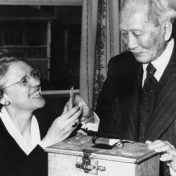
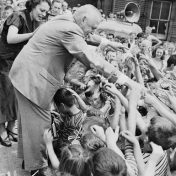
Editor’s Note: This post is the second in our special election series. Timothy J. Stanley The photograph of Won Alexander Cumyow voting in the 1949 federal election marks an important landmark in the struggle for democratic rights in Canada. Although born in Canada before the country existed, Cumyow had to wait 88 years to have the unfettered right to vote…. Read more »
Editor’s note: Over the course of the next week, Paul Litt, Timothy Stanley, Matthew Hayday and Colin Grittner will provide insights on the history of elections and electoral politics in Canada from the 19th century to the present, with a special focus on the 1949 and 1979 – 1980 elections. Although references to history have dotted the current election campaign, they… Read more »
Alan MacEachern As I drove deeper into a suburb in the small town of Matane on Quebec’s Gaspé Peninsula, things got busier instead of quieter. More and more parked cars lined the streets. There were no sidewalks, so the many people walking were all in the street, all of them headed toward the same low-slung, nondescript office building in the… Read more »
Cheryl Thompson Years ago, my former Banting-postdoctoral supervisor Stephen Johnson, Professor Emeritus at the Centre for Theatre, Drama and Performance Studies at the University of Toronto was to appear on a radio talk show to explore the question, “Why has there been a resurgence in the use of blackface in contemporary society?” The interview never took place because seemingly more… Read more »
Jessica Knapp and Krista McCracken For the past two years we have hosted a Canada Wide Wikipedia Edit-a-thon for Canadian history. This national event has encouraged folks from across Canada to join us in editing Canadian history content on Wikipedia. As of 21 August 2013, there were 113,554 articles on Wikipedia relating to Canada, a mere 1.92% of the articles… Read more »
Erin Gallagher-Cohoon In this morning’s post, I focused on how parliamentarians were invoking a sense of history and nationalism to argue both for and against legalizing same-sex marriage. In this post, I explore the history that is often left unsaid in this debate: the history of queer parenting. By 2005, when many parliamentarians were arguing that marriage rights should not… Read more »