Jim Clifford In the lead-up to my take-home exam last April, I was trying to think of questions ChatGPT could not answer. I hoped that by focusing on details from my lectures that are not available on Wikipedia and other similar online sources, the large language model would fail to provide a strong answer. I was dead wrong:
By Karen Froman, Leah Kuragano, Aileen Friesen, Cathy Mattes, Mary Jane Logan McCallum On Sept 25, 2023, the University of Winnipeg’s History Department Indigenization Committee presented a panel engaging with the Interim Report of the Office of the Independent Special Interlocutor for Missing Children and Unmarked Graves and Burial Sites associated with Indian Residential Schools, entitled Sacred Responsibility: Searching for… Read more »
By Erin Isaac The thoughts and sentiments shared in this essay are my own and do not represent the Nova Scotia Museum or Shelburne Historical Society. The Ross-Thomson House & Store Museum, in Shelburne, NS, has always been known as a site of enslavement in this community. Most people around here reference this by speaking about a pair of leg… Read more »
By Erin Isaac I first reached out to Dr. Amy Scott (University of New Brunswick) about visiting her in Cape Breton in February 2020, after attending a public lecture she gave at New Brunswick’s Provincial Archives. In her talk, Dr. Scott told us about the things her team was learning about 18th-century disease, injury, and lifeways from the grave goods… Read more »
You have probably heard about OpenAI’s ChatGPT, Microsoft’s Bing Chat or Google’s Bard. They are all based on Large Language Model (LLM) architectures that produce human-like text from user prompts. LLMs are not new, but they seem to have recently crossed a virtual threshold. Suddenly, artificial intelligence—or AI for short—is everywhere. While it is true that they sometimes “hallucinate,” producing factual errors and quirky responses, the accuracy and reliability of LLMs is improving exponentially. There is no escaping it: generative AI like ChatGPT is the future of information processing and analysis, and it will change the teaching and practice of history. Although some of its effects can be felt already, its long-term implications are not as clear.
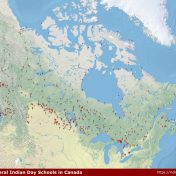
Jackson Pind and Sean Carleton Many Canadians are finally coming to terms with the truth that the Canadian government, in co-operation with Christian churches, ran a genocidal school system targeting Indigenous Peoples for more than a century. What most people do not realize, however, is that Canada’s system of “Indian education” was not limited to Indian Residential Schools. It also… Read more »
ActiveHistory.ca is pleased to announce that its application to the Canada History Fund, made in partnership with McGill University (grantee), HistoireEngagée.ca, and the Asian Canadian and Asian Migration Studies Program at the University of British Columbia, was successful. Our project, “Active History on Display,” has been granted $99,958 to create two digital exhibits: one on the lived experiences of Asian… Read more »
Sam Huckerby Piece by Piece uses images, maps, and public-friendly text to show that 19th century English clothing materials connected to everything from bird preservation movements to slavery. Born out of a desire to start filling in the gaps of how we talk about historical dress, Piece by Piece shows that clothes are more than just aesthetics: they have history… Read more »
In collaboration with Histoire Source | Source Story, a video series for history educators, Active History is recruiting writers to write complementary posts on themes related to one of seven Histoire Source | Source Story conversational videos. While the videos were designed for a K-12 teaching audience, they are rich in content for a broader audience. Thus, we envision these… Read more »
Krista McCracken The Shingwauk Residential School operated in Sault Ste. Marie, Ontario from 1874 to 1970. In 1971, Algoma University College – today known as Algoma University – moved onto the Shingwauk Site. Since 2010, I’ve been part of the staff at the Shingwauk Residential Schools Centre (SRSC) that seeks to promote sharing, healing, and learning in relation to the… Read more »