
By Karen Dearlove
It’s a story that has grown far bigger than Brantford. Articles in the Globe and Mail, the Toronto Star, the Hamilton Spectator, and the KW Record have drawn attention to what’s happening in downtown Brantford.
It’s a story about heritage buildings, those trying to save them, a city council, a university, and academics caught in the middle. It’s a story that raises questions about academics’ responsibilities in the community, academic freedom and activism, and the universities they work for.

At risk are 41 buildings located along three blocks of Colborne Street, the main street of Brantford’s downtown. More than half of these buildings were constructed prior to 1867, and some claim this to be the largest stretch of pre-Confederation buildings left in Ontario. It’s true these buildings have seen better days, as with much of Brantford which has suffered hard since the closing of major industries in the 1980s. But Brantford has experience a significant resurgence in the past decades, due in large part to the growing Laurier Brantford campus downtown.
 The content of history textbooks and curriculum is an important factor in the political socialization of succeeding generations of students. This study of representative classroom textbooks authorized for use in Ontario at three distinct eras of the 20th century shows how the main lines of interpretation have shifted over time. During the pre-World War II era, the persistent underlying tone was one of reverence for Canada’s connection to Britain. By mid-century, the main theme was Canada’s bilingual dualism within North America. As the end of the 20th century loomed, the textbook authors were focusing much more on previously marginalised groups within the Canadian multicultural mosaic. Each era produces its own historical narrative, but within the school context, an authorized interpretation impacts the beliefs of the generation to follow. The ultimate goal must be to nurture democratic citizens of the global future with a sure understanding of their own national identity.
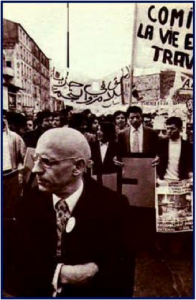 “What does a queer, sadomasochistic philosopher have to do with the study of Canada’s past?” This is the question I ask students at the beginning of my first-year survey course on Canadian history. Over the years, colleagues have suggested that first-year undergrads aren’t ready for Foucault. But experience tells me that not only are many of Foucault’s ideas readily translatable in the classroom, but that many first-year students, not always convinced that the study of Canadian history might have some connection to their present, eagerly grasp onto them. This past week was a case in point.

 What if my supervisor disagrees with what I write? What if someone in the community sends me a nasty email? What if the editor ignores my article?
 A controversy has erupted over the past week surrounding how Canadians should remember Louis Riel, a 19th century Métis who not only led the 1869 Red River and 1885 Northwest Rebellions, but also negotiated the terms for Manitoba’s entry into Confederation in 1870 before his execution in 1885 for high treason.