By Casey Burkholder During a late fall afternoon of syllabus writing, and distracted Googling, I came across the activist archival work of Dusty Green, who has developed the New Brunswick Queer Heritage Initiative (NBQHI). The NBQHI emerged after Dusty came across pictures donated to the New Brunswick Provincial Archives of rural New Brunswick boyfriends, Leonard and Cub, photographed between 1905… Read more »
By Adam Chapnick I work in what must be one of the most interdisciplinary academic departments in the country. For the last decade, the Royal Military College of Canada’s Department of Defence Studies has included eleven full-time faculty. One has a PhD in chemistry; one is a defence economist; one is a psychologist; one is a military sociologist; two of… Read more »
By Andrew Nurse Should one “debate” the Holocaust? The answer, according to failed PC London West candidate Andrew Lawton, is yes. In an interview that surfaced shortly before the recent Ontario provincial election, Lawton said that he fully understood why Jewish people would find this idea of debating the Holocaust revolting and he would, too, if he were Jewish. But,… Read more »
By the end of this week, students across Canada will be out of school. During their school year, students in Canada would have learnt from the provincially mandated curricula as well as professional attempts at engaging in work of truth and reconciliation. However, while we can talk about the curriculum in our schools, any formal education young people have gained have… Read more »
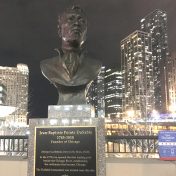
By Thomas Peace Let’s begin with a question: without help from the internet, can you name the person who founded the city of Chicago? I suspect that for many of our readers, the answer is ‘no’. “Founders” are not terribly in vogue these days, anyways. It was, however, the man who founded Chicago that helped me make a profound shift… Read more »
This month’s post on Quebec’s history curriculum was written by Catherine Déry, a PhD candidate at Collège Jean-de-Brébeuf. Click here for an English translation: Quebec History Curriculum: A Program with Inconsistencies —- Au Québec, en septembre 2016, un nouveau programme d’Histoire du Québec et du Canada entre en vigueur en troisième secondaire. Le programme, applicable sur deux ans, couvre chronologiquement… Read more »
By Thomas Peace It’s that time of the year again. Over the coming weekend, historians will join our colleagues in the social sciences and humanities in Regina for the annual Congress of the Social Sciences and Humanities, during which the Canadian Historical Association (CHA) will meet. This year, the CHA has been organized around the theme of “Gathering Diversities,” reflecting… Read more »
This is the final essay in a five part series featuring the Lost Stories Project. By Scott Pollock It seems as of late that whenever I turn on the news, or pick up a newspaper, I am confronted with another story about historical markers, public memory, and commemoration. Recent examples range from the debate over the possible re-naming of Sir… Read more »
This month, as part of the review of the History and Social Studies curriculum across Canada, Profs. Lindsay Gibson and Carla Peck from the University of Alberta have reviewed the Alberta’s Social Studies curriculum to situate the current revisions within a larger context. Current Curriculum Context Based in “progressive” child-centered, inquiry-based curriculum reform that began in the mid-1930s, Alberta is… Read more »
In 2014, the Digital Historian Project began as a partnership in Experiential Learning between 3 secondary schools in Dufferin County (the Upper Grand DSB) and the Duffern County Museum and Archives (DCMA). The goal was to offer a 4-Credit semester-long intensive program taught in situ at the Museum to senior students, in which curriculum would be delivered by a History… Read more »