By Andrew Nurse What do you do when a course goes wrong? This is not a title but a question. One that I am asking, perhaps, while treading on thin ice. There is a chance that a student of mine (perhaps even a student in the course that is on my mind) will read this and wonder if I am… Read more »
by Rose Fine-Meyer In yesterday’s post, Seneca undergrad Jvalin Vijayakumaran found that there has been a cursory integration of women in the current grade 7 & 8 Ontario history curriculum. His research supports what scholars have found since the 1970s, that women’s historical experiences are either missing or are limited in their inclusion in school history textbooks and resources. The… Read more »
In recognition of International Women’s Day on March 8, and the celebration of Women’s History Month in March in both the USA and UK (Women’s History Month in Canada takes place in October), this post shares the findings of an undergraduate student from Seneca College about whether women in the grade 7 and 8 Ontario history curriculum were “significant.” Spoiler… Read more »
February is one of my favourite months. Not only do red and pink hearts predominate, but there is a proliferation of events, displays, and articles celebrating the contributions of Black Canadians as part of Black History Month. Growing up in the southern United States and in the Caribbean, I was introduced to the richness of Black history as a young… Read more »
By Graeme Sutherland At 8:30 am on a fresh fall morning in 2014, I was sitting at the front of a comfortable tour bus as it was pulling out of Amboise, a beautiful town in France’s Loire Valley. It was my first 11-day tour with a new travel company. Having already greeted my tour members over breakfast, I launched immediately… Read more »
By Skylee-Storm Hogan and Krista McCracken, with Andrea Eidinger In recent years, particularly since the publication of the TRC Calls to Action, there has been an increasing push to integrate Indigenous content into elementary and secondary classrooms across the country. While we believe that this work is essential, recent news reports have given us cause for concern. From the ongoing… Read more »
Two years ago, following the election of Donald Trump to office, historians specializing in the history of migration and ethnicity in the United States compiled the #ImmigrationSyllabus to serve as a resource and teaching tool for instructors, students and the general public. It was an inspired collaboration, one that showcased how historians can play an important role in disseminating knowledge… Read more »
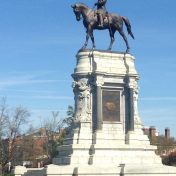
By Gabriel A. Reich In his two part series, posted on Active History earlier this month, Stéphane Lévesque puts forward a “new approach” to considering the role of historical monuments as an object of study in history education. That approach frames the pedagogy of historical monuments as a historiographical problem that can be best approached using the tools of historical… Read more »
By Rebekah Ludolph “If the past 30 years have taught us anything, it is that there is a powerful, loud bunch of privileged white settlers who do not want to learn about us or from us…they are unaware and do not have to bother doing their research.” – Kateri Akiwenzie-Damm (Anishinaabe) Akiwenzie-Damm calls for settlers to self-educate. To do their… Read more »
Everything is Connected: The Manitoulin Island Summer Historical Institute (MISHI) 2018 on Doodemag: Exploring Anishinaabe Worldviews Through Clans By Carolyn Podruchny Anishinaabe holistic pedagogy and academic interdisciplinarity make a good fit, as we learned during a seven-day summer institute (MISHI) focused on exploring Anishinaabe worldviews through the lens of clans and generations. Co-sponsored by the Ojibwe Cultural Foundation (OCF), an organization… Read more »