By Lillian Shirt, Corinne George and Sarah Carter
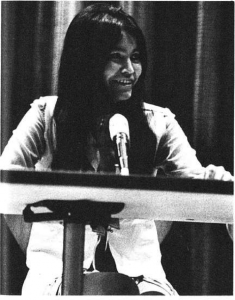
Lillian Piché Shirt speaking at the University of Alberta in Sept. 1969 for the Native Peoples Defense Fund. The Gateway 29 Sept., 1969: 1
It was the summer of ’69. Lillian Piché Shirt, a twenty-six year old Cree woman from the Saddle Lake Cree Nation, was living in a tipi with her four young children on Sir Winston Churchill Square outside Edmonton’s City Hall. She was protesting the lack of housing for Indigenous people in Edmonton. Lillian had been evicted from her apartment two months earlier when ownership changed hands, and had not found other accommodation since. Landlords refused to rent to her.
Interviewed in 2006 by Corinne George for her M.A. thesis on Aboriginal women activists of Alberta in the 1950s – 1980s, Lillian explained: “I decided I was going to do something about it, it was in May, and I thought, well, how am I going to do this? I am not many in number, not too many people will risk anything, and I looked at it from all different directions… So I went and picked up my tipi at my grandma’s, cause I had decided what I was going to do. I was going to put up a tipi right smack dab in the middle of Churchill Square- right in front of city Hall, where the mayor could see me from his desk.” She declared “I won’t move until I’m forced out or I get a proper house to live in.”[1] Lillian said the protest was not just about housing, but about discrimination in education and welfare and a call to respect human rights. She was concerned that Indigenous children were not being taught their own history in school, that children were losing their identity, and she called for schools on reserves rather than young people having to go to the cities.[2] The tipi went up on May 30.
Edmonton’s police station, court house, and the public library also all looked out onto the square where Lillian was camped. City Hall would not give her a permit to live on the square.[3] But Mayor Ivor Dent was sympathetic, as was Joe Poss of the Edmonton Police who provided security. Lillian had friends and supporters who helped her raise the tipi, brought supplies and took the older children to and from school. By early July she was joined by others in three pup tents and one more tipi.[4] A Citizens Committee on Housing and Discrimination was formed. She intended to stay on the square until accommodation was found, and if the city forced her off she was going to move to the grounds of the legislative building.[5]
The protest received local, provincial and national attention, and Lillian’s protest was covered in newspapers, television and radio. On May 31 for example, an article was published in the Toronto Globe and Mail under the headline “Mother Confronts Edmonton Authority: Erects Teepee Outside City Hall.” That same day a photo of Lillian holding one of her children and one of her tipi appeared in the Toronto Daily Star with the headline “Crees Camp in Edmonton Square.”
Just at this time John Lennon and Yoko Ono were in Canada. Continue reading →

 Children’s historical books can serve many purposes. They can teach children about history, as well as develop emotion and empathy about figures from the past. In “Recreating the Past,” Evelyn Freeman and Linda Levstik argue that children’s historical fiction fosters ongoing process of historical interpretation in which the child is an active participant (pg. 331). From my own experience as a child reading
  Back in 2011, I wrote an article in the Ottawa Citizen arguing that hyperbole didn’t work in Canadian political life. In the midst of the Stop Harper movement, I felt that words like ‘dictator’ were counterproductive. If you want to challenge somebody’s politics, then do so in a rationale, reasonable way that focuses on the issues at hand. In the five years since, our social media dominated
 #/media/File:Reception_of_the_American_Loyalists.jpg)



 In September the All Party Parliamentary Group on Drug Policy Reform in the UK stated there was “