Kevin M. Anzzolin
Since publishing my first book in 2024, I’ve turned my attention to gathering material for a second. Provisionally titled A View from the North: Lost Anglo-American Literature on Mexico from the Twentieth Century, I am exploring pulp novels, young adult adventure stories, tales of espionage, tourist guides, and yes, even postcards — in hopes of showing the extent to which the “Good Neighbor” cultural diplomacy of the twentieth century was, in fact, a genuinely intercultural endeavor between the United States and Latin America. Who were the small players — dime store novelists, postcard photographers, and nightclub owners — who got swept up in the large-scale international initiatives between North and South?
The Doris Z. Stone Latin American Library on the campus of Tulane University is an ideal place to examine this particular historical moment. The collection is replete with Mexico travel and tourism ephemera — magazines, hotel brochures, and highway maps — all of which, I believe, serve to better understand how our southern neighboring countries were constructed as attractive vacation destinations during the mid-twentieth century. Mexico especially loomed large in the imagination of US tourists; it was the period when, as historian Mauricio Tenorio shows, Mexico was understood as a “Brown Atlantis” — where revolutionary thought fermented and the Pan-American Highway promised access to exotic adventures. Everyone wanted to meet Frida Kahlo, everyone wanted to visit Teotihuacán, all while dreaming up global politics anew.
Two brochures found in the Mexican ephemera collection tell how Mexico feted itself for an international community.
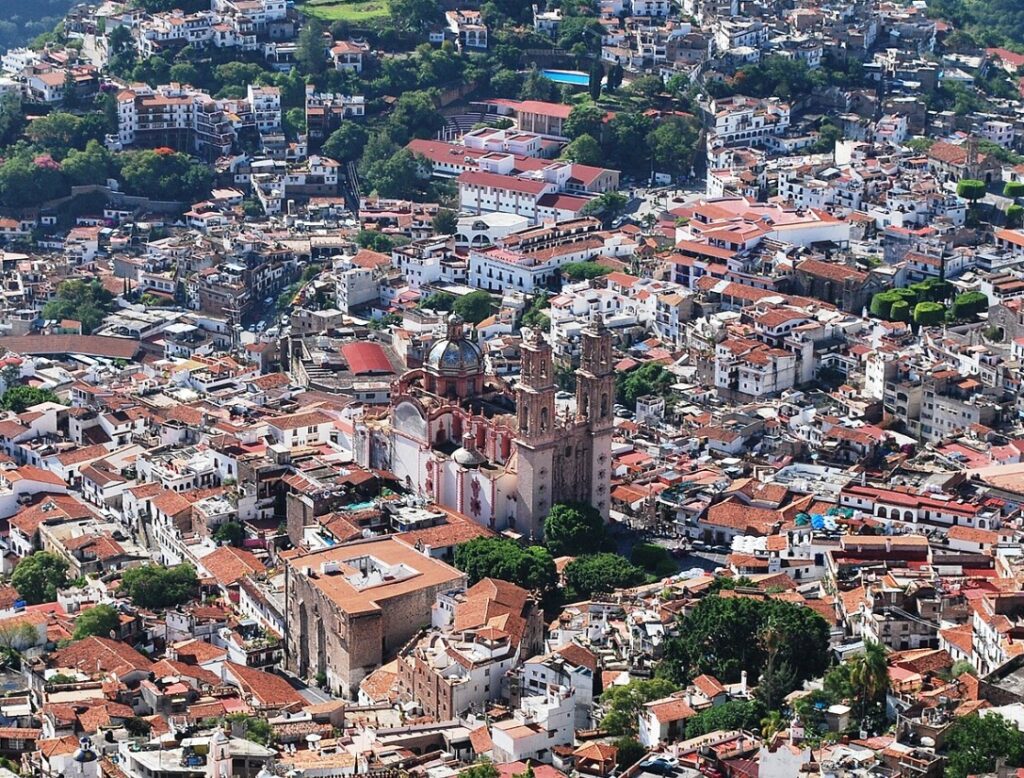
Panoramic of the city center of Taxco de Alarcón, Guerrero, Mexico. Viewed from the Christ Monument looking southeast, via Wikimedia Commons.
First, is a trifold brochure from arguably Mexico’s most famous nightclub during the second half of the twentieth century — Cantarranas, located in the silver-mining town of Taxco, some two and a half hours outside of Mexico City. As the brochure details, the “Hacienda Cantarranas was built in 1538 by order of Hernán Cortés. The actual construction was done by his son Martin de Cortés.” The estate was used for silver processing. The locale, built with large stones on a hillside, became a nightclub in 1957 under the direction of entrepreneur Antonio “Tony” Reyes Ramírez. He would later become Taxco’s minister of tourism. Cantarranas was known worldwide for its revelry through the 60s and 70s before being acquired by the government of the Mexican state Guerrero in 1983, when it was converted into a culinary school and arts center. In 1992, it was turned over to the Universidad Nacional Autónoma de México as a school for foreign nationals. The hacienda was named “Cantarranas” — that is, literally “singing frogs” due to the loud chorus of frogs living in the area nearby. The brochure obviously plays upon this idea — even if not representative of the real spectacles of the club, the image is fetching.
Continue reading