
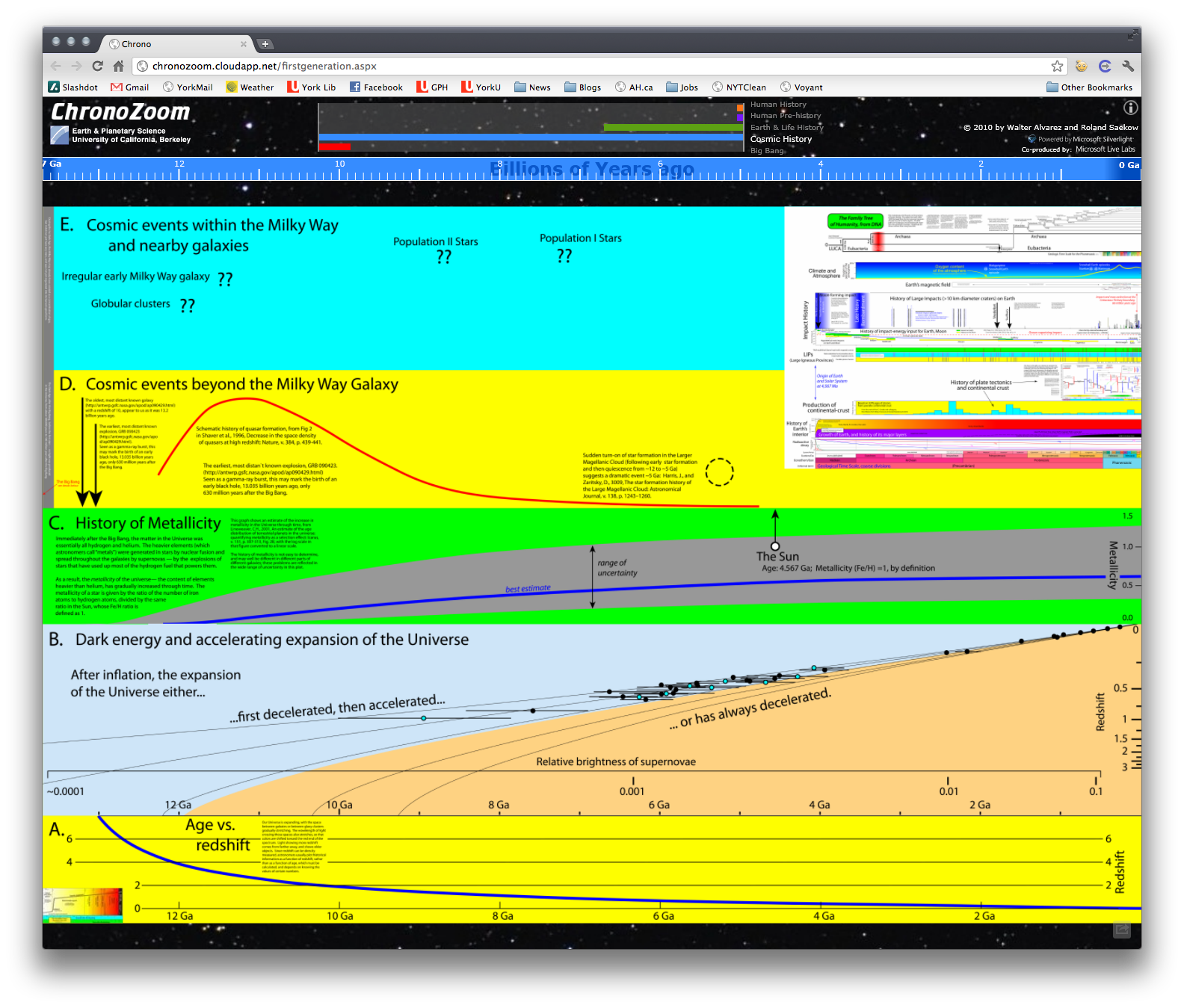
Surveying all of cosmic history using ChronoZoom: you can't even see human history up there in the upper right corner.
Historians aren’t always the best at crossing the hall to the sociologists across the way, let alone the astronomers, physicians, or geologists across campus. Scientists who study the Big Bang, however, are engaged in history – just a (very) different kind. Similarly, those who study the very long-term geographical forces that have shaped Earth, those who study evolutionary processes across flora and fauna, even those who study broader, galactic or universal phenomena, are often seen as very distinct from historians.
Big History, a new and emerging field, seeks to bridge these very real but also occasionally artificial disciplinary boundaries. It can be hard, however, to really establish how we can go forward and what a Big History approach might look like in real, deliverable terms (Bill Gates and David Christian have a great project also looking at how to teach these concepts to classrooms). Look no further: ChronoZoom, from the University of California-Berkeley’s Department of Earth and Planetary Science, has a working model that gives us a sense of what this might look like. Continue reading
 In the third installment of this five-part