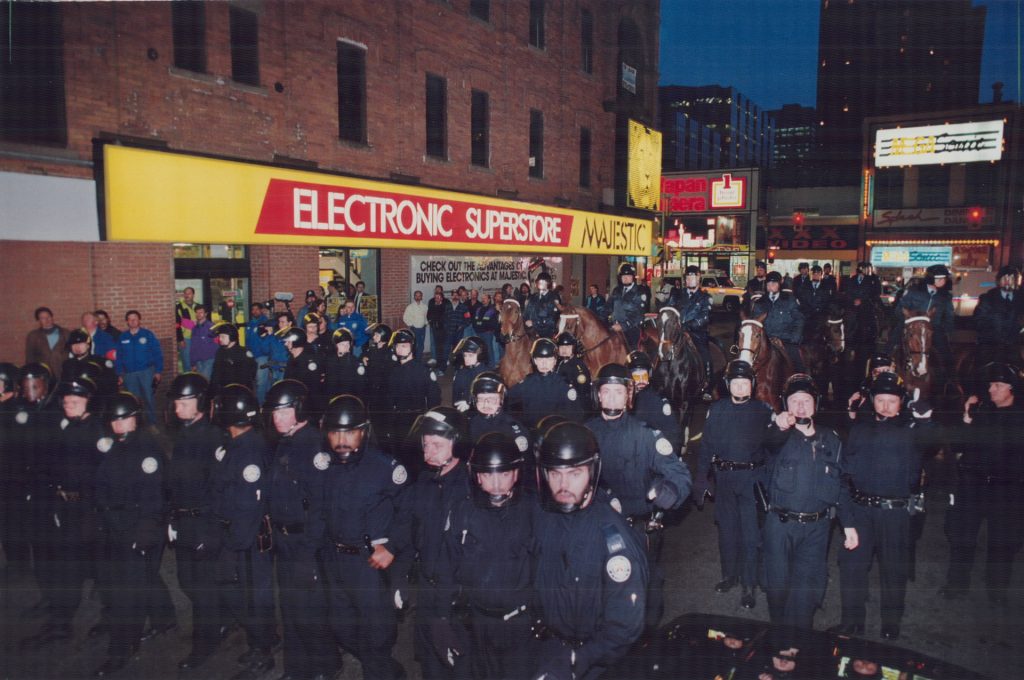
Toronto police in riot gear block intersection of Gould and Yonge Streets, 1992. Jim Wilkes, Toronto Star Archive tspa_0012135f.
David M. K. Sheinin
As a city changes, as tensions grow between the police and the communities they serve, how can we know if a candidate has what it takes to lead a major police force? Is it possible to predict success (or failure)? Those questions are at the core of a debate that has raged for decades on whether institutional racism exists, on possible improvements, and on implementing changes in policing.
In the mid-1970s, as Toronto faced such challenges, Reva Gerstein emerged as a strong voice for reform. She believed we could scientifically forecast hiring and promotion outcomes. Gerstein began to work closely with the Metropolitan Toronto Police Force toward that end. An eminent psychologist, Gerstein wrote a report in 1976 for the Law Reform Commission of Canada on the use of psychological tests in recruiting and promoting police officers.[1]
In 1982, the Metropolitan Toronto Police Commission asked Gerstein to conduct a psychological assessment of an extremely bright, fast-rising forty-nine-year-old superintendent; William J. McCormack was a candidate for deputy police chief. Gerstein’s assessment offers strikingly few insights into McCormack beyond what those who worked with him would already have known. She sidestepped racism on the force and poor police-community relations — precisely the problems Gerstein herself had highlighted for years as resolvable through the effective psychological evaluation of officers.
Since the 1960s, tensions had escalated between racialized communities and the police in Toronto and in other North American cities. Racism on the Toronto force was reflected in the pages of News & Views, the newsletter of the Metropolitan Toronto Police Association. In a 1979 issue, retired constable Ken Peglar complained that he wished he were “a Black man or a Pakistani or Jewish….” Unemployment, inflation, and neglected children, he went on, were among many problems that concerned him. “But nobody expects a Black man,” Peglar wrote, “to think of anything but his colour or a Jew to concern himself with anything but his Jewishness. And you know something, they seldom do.”
These and other cases of casual, malevolent police discrimination appalled Mayor John Sewell, Alderman Allan Sparrow and many others who voiced their outrage. But repeatedly, the Toronto police rebuffed, diminished, or whitewashed community efforts to make the police more accountable to the public and better equipped to combat police racism. Gerstein’s report contributed to the institutional culture of police insistence that at worst, racism was a very minor problem, and that a purportedly hostile media, unspecified political radicals, and minority community members were the true cause of police tensions with minority communities.
The Psychologist
By the mid-1970s, Reva Gerstein had earned dozens of accolades, including membership in the Order of Canada, for her cutting edge research on children’s mental health and on the shift to treating mental illness outside psychiatric hospitals. She moved in social circles with high-ranking police officers and other movers and shakers. In December 1980, for example, Gerstein’s friends organized a dinner in her honour at the Royal York Hotel. Guests included the federal Leader of the Opposition Joe Clark, Ontario Premier William Davis, and Toronto Chief of Police Jack Ackroyd.
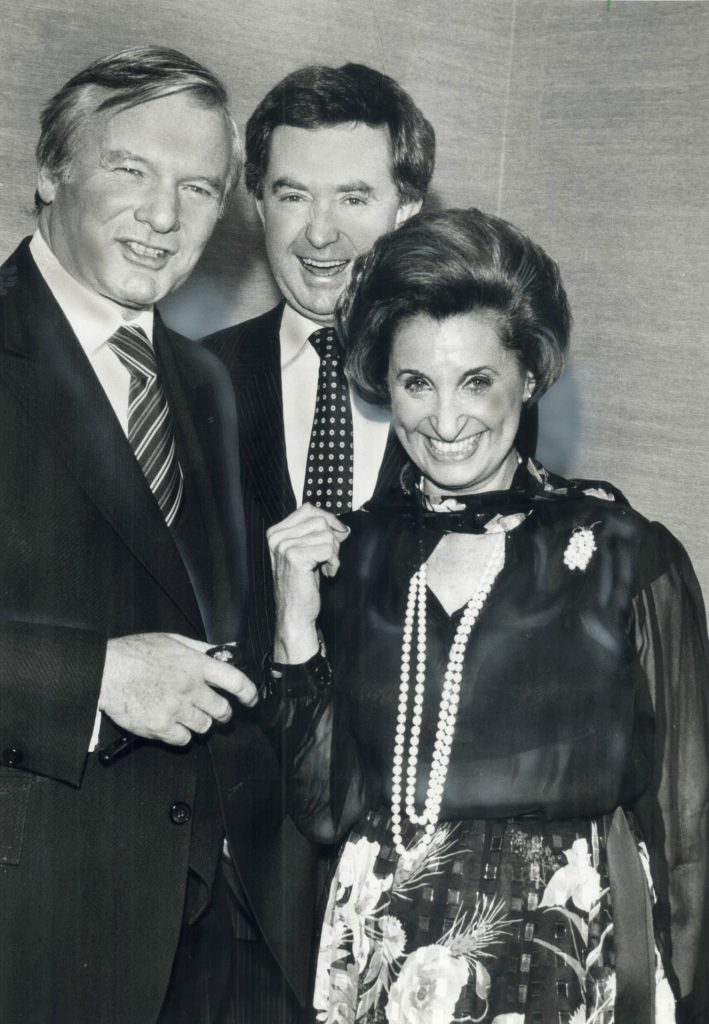
Gerstein pictured with federal Opposition Leader Joe Clark and Ontario Premier Bill Davis in 1980. Dick Darrell, Toronto Star Archive, tspa_0049723f.
She worked regularly as a paid consultant to the Toronto police and in 1979, she chaired the three-member provincial government Task Force on the Racial and Ethnic Implications of Police Hiring, Training, Promotion and Career Development. Gerstein wrote the task force report. Its most important findings backed the police on alleged racism; there was no evidence, Gerstein argued, that Ontario police forces discriminated against minorities in hiring. The media, she went on, projected an anti-police bias and played a major role in promoting tensions between minority groups and the police. Asked to give examples where the press had exacerbated police-community tensions, Gerstein demurred. That there were few minority group members on police forces in Ontario was the fault of minorities themselves; they refused to join. Gerstein told reporters that she was surprised to hear that racialized communities in Toronto were afraid of the police. “When I asked [minority community members] why, they said it was because of TV and newspaper reports.” Toronto media found Gerstein out of touch, insensitive to the concerns of minority communities, and too close to the police.[2]
The Assessment
In October 1978, the Toronto Police Commission adopted a psychological assessment program to screen out racially prejudiced and anti-social recruits. Continue reading →



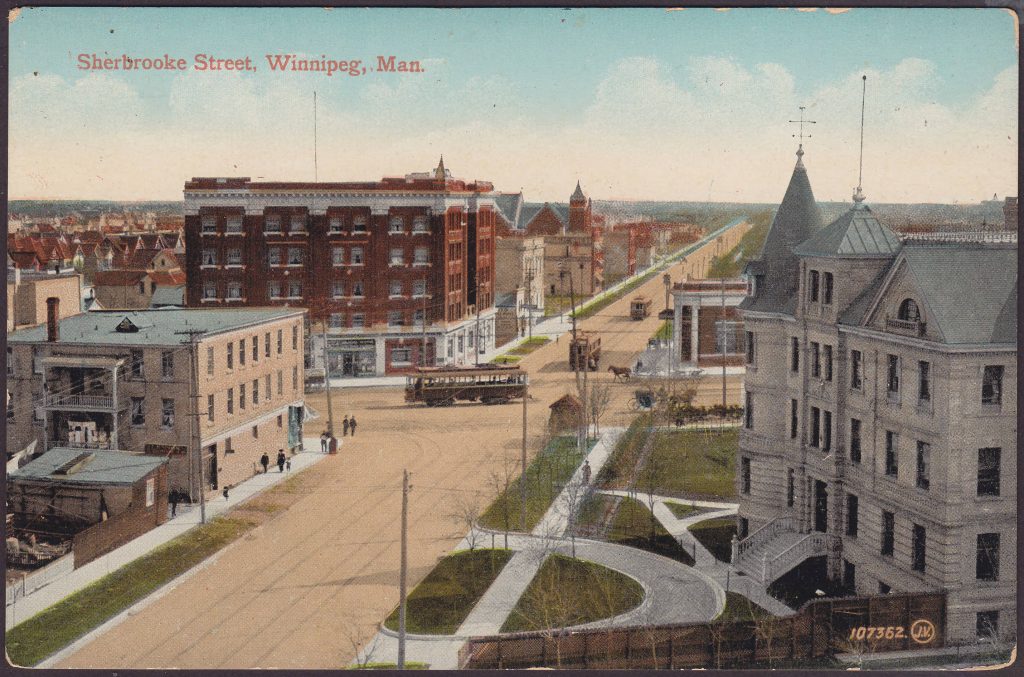

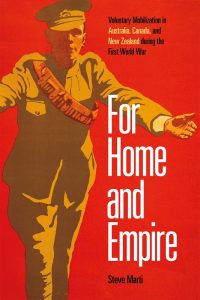 When we talk about the First World War, it is usually in national terms. In Canada, there is discussion of national mobilization efforts and the federal government’s implementation of programs and policies to support the war effort. These efforts, though, took place at a local level. Battalions within the Canadian Expeditionary Force, for instance, were typically distinguished by where they were from –

 The Smithsonian Institute bills itself as