Ten years ago, the Truth and Reconciliation Commission (TRC) issued its final report on the history of residential schools in Canada. Mandated to “inform all Canadians about what happened in residential schools”, the “TRC documented the truth of Survivors, their families, communities and anyone personally affected by the residential school experience.” It found that residential schools were part of a… Read more »
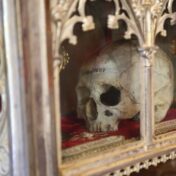
This case study of Jean de Brébeuf emphasizes the intricacies of colonial tensions and complicates colonial narratives and ideas of civilization hierarchies. Indigenous cannibalism was used as a means of ‘othering’ conducted by Catholic missionaries in the writings of the Jesuit Relations that recount the story of the cannibalization and martyrdom of Brébeuf and Lalement. The prescription of Brébeuf’s relics by a Catholic nun in 17th century Quebec complicates the simplicity of this process by contrasting it with the long standing European medical tradition of human consumption: corpse medicine.
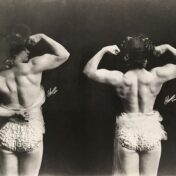
In 1985, filmmakers George Butler and Charles Gaines produced Pumping Iron II: The Women. It followed women bodybuilders at a bodybuilding show in Las Vegas during 1983, but mainly focused on two vastly different competitors to explore the expressions and understandings of femininity in the masculine-coded sport. Rachel McLish, the reigning Ms. Olympia champion, performed a socially accepted version of bodily femininity in the film; she was very lightly muscled with some body fat that contoured her body. On the other end of the film’s gender continuum was Bev Francis, a powerlifter-turned-bodybuilder who carried more muscle mass than female bodybuilding had ever seen.
Gender subversion was embodied in Bev Francis. Francis was far more muscular than the other competitors, and the film used her subversive body to drive the plot forward. Conversations between competitors, judges, and onlookers were often in reference to Francis’ body; it is unlikely that femininity would have been as intensely debated had Francis not been a competitor. She challenged women’s bodybuilding so much so that the judges and officials called an emergency meeting to discuss the competition’s ruleset after seeing Francis’ body.
By Sean Graham As part of our series with the 2025 Shannon Lecture Series, I talk with Sarah Hogenbirk, who will deliver the opening lecture on Monday entitled ‘Fighting for Their Place and Recognition: Canadian Servicewomen and Women Veterans in Post-Second World War Canada. The lecture will serve as a launch for Cold War Workers: Labour, Family, and Community in… Read more »
Hannah Roth Cooley Over roughly the last decade, settler Canadians and Americans have started to take note of Indigenous activist initiatives, thanks in large part to social media. Beginning with the explosion of #IdleNoMore in 2012, social media has become an important tool for circulating political messages and sharing cultural knowledge within and beyond Indigenous communities. Certainly, Indigenous Peoples advocating… Read more »
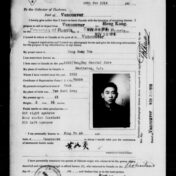
June Chow This post is a sequel to The right to remember the past: Opening Chinese immigration records in Canada’s national archives published on March 27, 2025. It is adapted from a presentation made on June 11, 2025 at the Association of Canadian Archivists conference held at Carleton University (Ottawa, Ontario) to an audience that included Librarian and Archivist of Canada, Leslie… Read more »
Daze Jefferies and Rhea Rollmann Editor’s note: the following work by Daze Jefferies and Rhea Rollmann is a piece of creative history. Transfeminine histories are often especially difficult to recount through traditional historical writing. By engaging with archival fragments, as well as oral histories completed by Rhea for her exceptional book A Queer History of Newfoundland, this article uses the… Read more »
By Sean Graham We’re back from our summer hiatus with a new season and we’re kicking it off by talking with Craig Baird, the host of Canada History Ehx about his new book Canada’s Main Street: The Epic Story of the Trans-Canada Highway. We talk about his motivation to write about the highway, why the highway doesn’t have the same… Read more »
By Christine Cooling When Canadians tuned into their first radio broadcasts in the 1920s, much of what they listened to wasn’t Canadian. American stations with stronger signals and flashier programming initially dominated the airwaves. The radio audience developed over time as the medium entered the domestic space, but Canadian listeners were part of a transnational media environment from the very… Read more »
Laura Ishiguro, Nicole Yakashiro and Ayaka Yoshimizu What can one racialized migrant woman’s life teach us about resistance and community-building in today’s context of rising conservatism, nationalism, and securitization? The open educational resource (OER) we’ve created centres on the life of Kiyo Tanaka-Goto, a Japanese woman who lived much of her adult life in Vancouver’s Downtown Eastside (DTES), especially during the interwar… Read more »