By Sean Graham This week, I talk with John Moses ahead of his November 3 Shannon Lecture entitled ‘This is not my story, but yours: The Russ Moses residential school memoir.’ We discuss his father’s experiences at the Mohawk Institute, his military service, and Reconciliation. You can hear John talk about the memoir on Monday November 3 as part of… Read more »
During the 1920s, Jell-O advertising in North America focused on both the product’s convenience (the fact that it could be consumed almost anywhere) and its connection with idealized domestic settings. Both themes were central to a 1922 “at home everywhere” advertising campaign in the United States and Canada. Booklets distributed in both countries featured images of people serving or consuming Jell-O in a series of disparate settings: camping in the woods, on a farm in the “wheat belt,” and in a snow-bound cabin. Indeed, both the American and Canadian versions of the booklet featured a bear and a cabin on the cover. But the Canadian and American booklets differed on one key point. The American booklet included a plantation in its compilation of idealized Jell-O consuming locations and featured an illustration of an African-American boy serving the dessert to a white woman at the “Big House.” The Canadian version did not. When it came to promoting their product in Canada, Jell-O’s advertisers recognized that while some cultural allusions were transferable, others were not. Jell-O could be both Canada’s and America’s “most famous” dessert but the reference points used to justify such claims required selectivity and political awareness.
Julia Grummitt In the late eighteenth and nineteenth centuries, Métis communities emerged across a region of North America known as the historic North-West. These communities were formed by Indigenous descendants of the fur trade—the children of European fur traders and Indigenous women—who over generations of endogamy (intermarriage) developed a distinct identity as Métis with a shared culture, political consciousness, and… Read more »
By Nir Hagigi In October 2023, as Israeli bombs began to fall on Gaza, something unprecedented unfolded. For the first time in history, the victims of mass atrocity —and only the victims— broadcast their own destruction in real time. Unlike previous conflicts where foreign journalists or outside observers mediated what the world saw, in Gaza the task of witnessing fell… Read more »
Thomas Schlich and Bruno J. Strasser Robert F. Kennedy Jr. is best known as a vaccination skeptic, but he is also skeptical about using masks for infection control. At the Libertarian National Convention in Washington, DC in May 2024, Kennedy Jr. recalled being asked during the pandemic whether he was scared of dying of COVID-19 since he wasn’t wearing a… Read more »
Perhaps the principal legacy of revisionism, then, is the light that it shed on the quotidian experiences “from below” that were occluded by earlier, state-centric ideas of repressive regimes. One role of historians in the present is to bridge the gap between inherited simplifications and more nuanced understandings; by advancing academic arguments in more accessible forms historians can foster more meaningful public engagements with history and its uses in the present. When we look at Russia today, we cannot turn away from its suppression of free speech nor its persecution of political critics, but we should also acknowledge the limits of this vision. We must consider, to invoke a Russian concept, that individual and independent “existence” (byt) are also aspects of Russian life.
As we head into the fall season, we want to invite new contributors to help build the Active History Project! Activehistory.ca invites proposals for standalone blog posts, thematic blog series, and other contributions, all of which explore new research, innovative historical approaches, and history that matters today. We welcome submissions from historians and scholars in related disciplines who engage with… Read more »
This summer, the Government of Canada helped to promote visits to museums through the Canada Strong pass. While initially focused on seven of the country’s nine national museums, other provinces and territories also opted to offer reduced and free admission. Ultimately, 87 museums across the country were part of the initiative, and early data indicates that it helped to boost attendanc. While the removal of admission fees increases accessibility, and – in turn – public enjoyment and appreciation of museums, the reality is that museums across the country are suffering from a lack of resources. To be effective stewards of the cultural heritage that they care for, museums need adequate financial support.
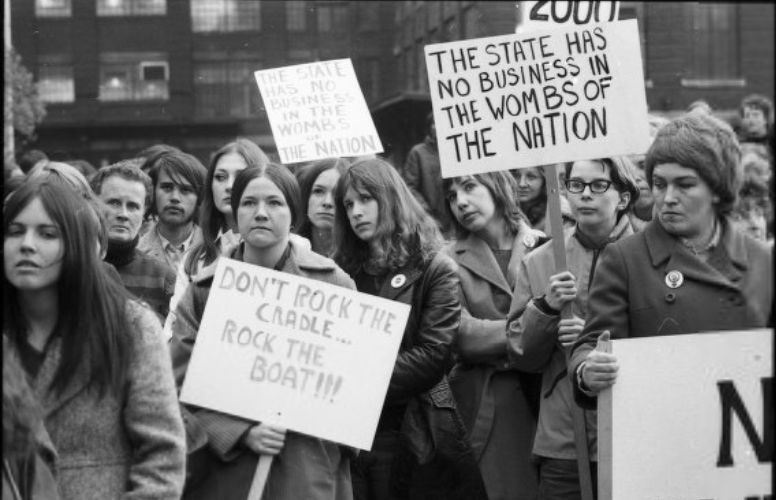
By Hailey Baldock With a black coffin strapped to the top of their van and a fiery determination to scrap Canada’s abortion laws, the women of the 1970 Abortion Caravan knew they had to make a scene. And they did. Over the course of two weeks, the Caravan moved across the country from Vancouver to Ottawa, rallying supporters and drawing… Read more »
By Sean Graham This week, I talk with Matthew S. Wiseman, historian of science and medicine in modern Canada. We discuss why militaries engage in scientific research, the civilian benefits of that research, and how scientists navigated their research during the Cold War. We also chat about research consent within a military environment, the challenges of researching the Cold War… Read more »